
Catalogue Search | MBRL


Are you sure you want to remove the book from the shelf?

{{itemTitle}}
77,047
result(s) for
"Theory of knowledge."
Sort by:

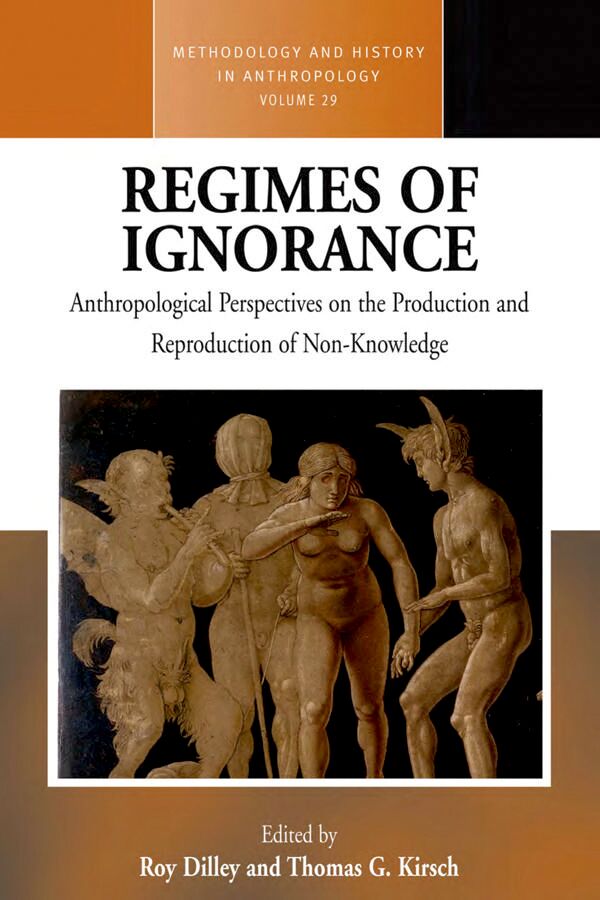
Regimes of Ignorance
Non-knowledge should not be simply regarded as the opposite of knowledge, but as complementary to it: each derives its character and meaning from the other and from their interaction. Knowledge does not colonize the space of ignorance in the progressive march of science; rather, knowledge and ignorance are mutually shaped in social and political domains of partial, shifting, and temporal relationships. This volume's ethnographic analyses provide a theoretical frame through which to consider the production and reproduction of ignorance, non-knowledge, and secrecy, as well as the wider implications these ideas have for anthropology and related disciplines in the social sciences and humanities.
eBook


Local Histories-Global Designs
Local Histories/Global Designs is an extended argument about the \"coloniality\" of power by one of the most innovative Latin American and Latino scholars. In a shrinking world where sharp dichotomies, such as East/West and developing/developed, blur and shift, Walter Mignolo points to the inadequacy of current practices in the social sciences and area studies. He explores the crucial notion of \"colonial difference\" in the study of the modern colonial world and traces the emergence of an epistemic shift, which he calls \"border thinking.\" Further, he expands the horizons of those debates already under way in postcolonial studies of Asia and Africa by dwelling in the genealogy of thoughts of South/Central America, the Caribbean, and Latino/as in the United States. His concept of \"border gnosis,\" or sensing and knowing by dwelling in imperial/colonial borderlands, counters the tendency of occidentalist perspectives to manage, and thus limit, understanding. In a new preface that discusses Local Histories/Global Designs as a dialogue with Hegel's Philosophy of History, Mignolo connects his argument with the unfolding of history in the first decade of the twenty-first century.
eBook


The Democratization of Knowledge in Renaissance Italy
The book identifies to what extent it is possible to speak of a democratization of knowledge in Renaissance Italy. It establishes the boundaries of the present investigation within the Aristotelian tradition, and outlines democratization as a process capable of assigning power to people. It deals with how the democratization of knowledge historically is invested equally in ideas from religion and philosophy, involving the same democratizers, moved by similar intentions, employing identical techniques of vulgarization and targeting equivalent communities of recipients.
eBook


Disknowledge
\"Disknowledge\": knowing something isn't true, but believing it anyway. InDisknowledge: Literature, Alchemy, and the End of Humanism in Renaissance England, Katherine Eggert explores the crumbling state of learning in the sixteenth and seventeenth centuries. Even as the shortcomings of Renaissance humanism became plain to see, many intellectuals of the age had little choice but to treat their familiar knowledge systems as though they still held. Humanism thus came to share the status of alchemy: a way of thinking simultaneously productive and suspect, reasonable and wrongheaded.
Eggert argues that English writers used alchemy to signal how to avoid or camouflage pressing but discomfiting topics in an age of rapid intellectual change.Disknowledgedescribes how John Donne, George Herbert, Henry Vaughan, John Dee, Christopher Marlowe, William Harvey, Helkiah Crooke, Edmund Spenser, and William Shakespeare used alchemical imagery, rhetoric, and habits of thought to shunt aside three difficult questions: how theories of matter shared their physics with Roman Catholic transubstantiation; how Christian Hermeticism depended on Jewish Kabbalah; and how new anatomical learning acknowledged women's role in human reproduction.Disknowledgefurther shows how Shakespeare, Ben Jonson, and Margaret Cavendish used the language of alchemy to castigate humanism for its blind spots and to invent a new, posthumanist mode of knowledge: writing fiction.
Covering a wide range of authors and topics,Disknowledgeis the first book to analyze how English Renaissance literature employed alchemy to probe the nature and limits of learning. The concept of disknowledge-willfully adhering to something we know is wrong-resonates across literary and cultural studies as an urgent issue of our own era.
eBook


La Gestion de l'intelligence émotionnelle Au Travail
La gestion de l'intelligence émotionnelle au travail : guide pratique pour les gestionnaires et les managers aborde la conscience des états émotifs, la sensibilité sociale, le niveau d'empathie et la gestion active des émotions. Chaque chapitre fait un survol des connaissances les plus récentes sur les plans scientifique et professionnel afin de permettre aux cadres, aux managers, aux psychologues et aux spécialistes en ressources humaines d'intervenir de façon efficace en matière d'intelligence émotionnelle. Les approches nord-américaines et européennes sont combinées afin d'offrir un panorama de la question.
eBook