
Catalogue Search | MBRL


Are you sure you want to remove the book from the shelf?

{{itemTitle}}
1,473
result(s) for
"Thought experiments."
Sort by:
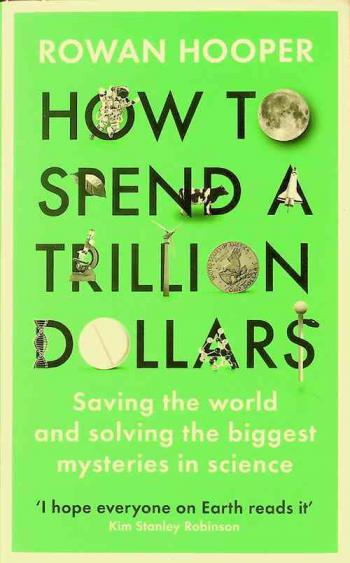
How to spend a trillion dollars : saving the world and solving the biggest mysteries in science
If you were given one trillion dollars, to be spent in a year, on science, what would you do? It's an unimaginably large sum, yet it's also the total of the money held by the Norwegian oil investment fund alone, or the current valuations of Apple Computer and of Amazon. So it's both huge and possible. But what could you achieve? You could eradicate malaria, for one, or end global poverty. You could start to colonise Mars. You could build a massive particle collider to explore the nature of dark matter like never before. You could mine asteroids, build quantum computers, develop artificial consciousness, or increase human lifespan. Or how about transitioning the whole world to renewable energy? Or preserving the rainforests? Or saving all endangered species? You could refreeze the melting Arctic, reverse climate change, cure all diseases, and even launch a new sustainable agricultural revolution.

Thermodynamics and the structure of quantum theory
Despite its enormous empirical success, the formalism of quantum theory still raises fundamental questions: why is nature described in terms of complex Hilbert spaces, and what modifications of it could we reasonably expect to find in some regimes of physics? Here we address these questions by studying how compatibility with thermodynamics constrains the structure of quantum theory. We employ two postulates that any probabilistic theory with reasonable thermodynamic behaviour should arguably satisfy. In the framework of generalised probabilistic theories, we show that these postulates already imply important aspects of quantum theory, like self-duality and analogues of projective measurements, subspaces and eigenvalues. However, they may still admit a class of theories beyond quantum mechanics. Using a thought experiment by von Neumann, we show that these theories admit a consistent thermodynamic notion of entropy, and prove that the second law holds for projective measurements and mixing procedures. Furthermore, we study additional entropy-like quantities based on measurement probabilities and convex decomposition probabilities, and uncover a relation between one of these quantities and Sorkin's notion of higher-order interference.
Journal Article


Empirical-Scientific and Fictional Thought Experiments: A Comparison
The paper attempts to clarify a fundamental similarity and some relevant differences between empirical-scientific and fictional thought experiments. For this purpose, the second section of the paper provides a brief outline of a quasi-Kantian account of thought experiments (TE) in the empirical sciences from the viewpoint of a radically functional, strictly not material, a priori. On the basis of this account, a fundamental similarity and two main differences between empirical-scientific and narrative thought experiments are brought to the fore: the counterfactual construction of idealised scenarios is a fundamental characteristic that is shared by scientific and fictional thought experiments (and, more generally, by science and art). The differences depend on the different intentionalities to which this construction is subordinated. Fictional TEs, instead of resolving the dimension of counterfactuality in real empirical facts or processes, use it to transpose certain cultural contents (thoughts, feelings, possible courses of action, etc.) into a dimension outside any particular space and time, which are able to produce a symbolic shelter that protects us from the particular adverse events of concrete life. This, on the one hand, generates in us the feeling of pleasure or enjoyment that tradition has so often linked to artistic enjoyment and, on the other, urges us, implicitly or explicitly, to re-enact those contents in the first person and to take an evaluative stance towards them.
Journal Article

Going underground : the science and history of falling through the Earth
\"This book follows the historical trail by which humanity has determined the shape and internal structure of the Earth. It is a story that bears on aspects of the history of science, the history of philosophy and the history of mathematics. At the heart of the narrative is the important philosophical practice of performing thought experiments -- that is, the art of considering an idealized experiment in the mind. This powerful technique has been used by all the great historical practitioners of science and mathematics, and this book looks specifically at the long history of considering what would happen if an object could be dropped into a tunnel that cuts all the way through the Earth's interior. Indeed, the story begins with a historical whodunit, tracing back through the historical literature the origins of what is now a classic, textbook problem in simple harmonic motion\"-- Provided by publisher.
Book

Varieties of academic capitalism and entrepreneurial universities
This article begins with a brief review of research on the development of ideas about the knowledge-based economy (analysed here as 'economic imaginaries') and their influence on how social forces within and beyond the academy have attempted to reorganize higher education and research in response to real and perceived challenges and crises in the capitalist order since the mid-1970s. This provides the historical context for three 'thought experiments' about other aspects of the development of academic capitalism. The first involves a reductio ad absurdum argument about different potential steps in the economization, marketization and financialization of education and research and is illustrated from recent changes in higher education. The second maps actual strategies of the entrepreneurial university and their role in shaping academic capitalism. The third speculates on possible forms of 'political' academic capitalism and their changing places in the interstices of the other trends posited in these thought experiments. The article ends with suggestions for a research agendum that goes beyond thought experiments to substantive empirical investigations.(HRK / Abstract übernommen).
Journal Article

Climate Change May Alter Rainfall‐Partitioning in Ways Unlikely To Be Detected in the Coming Decades
Droughts around the world have resulted in less annual streamflow relative to annual rainfall. The decrease in streamflow cannot be explained by changes in land‐use, precipitation or temperature alone. Rather, the decrease in annual streamflow has been linked to changes in annual rainfall‐partitioning. Climate change is predicted to induce similar, if not worse conditions than previous droughts. This could make the disproportionate shifts in annual streamflow more frequent or intense. Currently, most methods assume annual rainfall‐partitioning remains constant and thus are unlikely to accurately predict how climate change could impact streamflow. Our aim is to conduct a thought‐experiment to examine the various ways climate change could alter annual rainfall‐partitioning and to determine what types of changes in rainfall‐partitioning are likely to be statistically detectable in the coming decades. Using a synthetic streamflow model, we show how changing the rainfall‐runoff intercept, rainfall‐runoff slope, lag‐1 autocorrelation, standard deviation per rainfall depth and, skewness per rainfall depth alters rainfall‐partitioning. Of all the rainfall‐partitioning changes examined only the rainfall‐runoff intercept and slope are likely to be statistically detectable in the coming decades. Changes impacting lag‐1 autocorrelation of annual streamflow, standard deviation per rainfall depth and skewness per rainfall depth are unlikely to be statistically detectable in the coming decades. Although being unlikely to be statistically identified, these changes still alter both the rainfall‐runoff and streamflow‐time relationships. Rainfall‐partitioning changes that alter streamflow and are unlikely to be statistically detected in the coming decades will make prediction and allocation of water resources more challenging.
Journal Article

Who Created the World(s) and How? A Thought Experiment Among Science Fiction, Physics, and Theology in the Novella Professor A. Dońda by Stanisław Lem
This paper interprets Stanisław Lem’s novella Professor A. Dońda as a thought experiment. In the novella, Lem proposes Dońda’s law, a formulation that allows for a sophisticated theory of creation, at once theological and scientific. This is based on the equivalence of mass-energy-information and on the existence of Dońda’s barrier, which limits the accretion of knowledge. The novella is discussed in the context of Lem’s conception of the art of writing as the art of translating—in this case, translating theological issues into the language of physics and computer science. The result of this translation, which is effectively a thought experiment, is that even if man were to discover the real mechanism of the creation of the world, neither the existence of God nor the non-existence of God could be unambiguously deduced from understanding the mechanism. The protagonist of the novella articulates a theory of being whose initial premise and fundamental category is the concept of error. The paper provides a thorough analysis of the issues raised by the novella and a discussion of genre. The discussion broadens to include the context of contemporary theories in physics, mainly the mass-energy-information principle (MEIE) and the information catastrophe.
Journal Article
Visions of the Future
This book is inspired by the author’s work as part of a major international and interdisciplinary research group at the University of Konstanz, Germany: “What If—On the Meaning, Relevance, and Epistemology of Counterfactual Claims and Thought Experiments.” Having contributed to great discoveries, such as those by Galileo and Einstein, thought experiments are especially topical in the twenty-first century, since this is a concept that bridges the gap between the arts and the sciences, promoting interdisciplinary innovation. To study thought experiments in literature, it is imperative to examine relevant texts closely: this has rarely been done to date and this is precisely what this book does as a pilot study focusing on selected works of philosophy and literature. Specifically, thought experiments by Thomas Malthus are analyzed side by side with short stories and novels by Vladimir Odoevsky and Nikolai Chernyshevsky, Alexander Bogdanov and Aleksei Tolstoy, Alexander Chaianov and Nina Berberova.
eBook

Thought Experiments in Philosophy: A Neo-Kantian and Experimentalist Point of View
The paper addresses the question of the nature and limits of philosophical thought experiments. On the one hand, experimental philosophers are right to claim that we need much more laboratory work in order to have more reliable thought experiments, but on the other hand a naturalism that is too radical is incapable of clarifying the peculiarity of thought experiments in philosophy. Starting from a historico-critical reconstruction of Kant’s concept of the “experiments of pure reason”, this paper outlines an account of thought experiments in philosophy that tries to reconcile the thesis of a principled difference between scientific and philosophical TEs with the position of a methodological naturalism that does not admit any difference in kind between the methods of science and of philosophy.
Journal Article