
Catalogue Search | MBRL


Are you sure you want to remove the book from the shelf?

{{itemTitle}}
11,424
result(s) for
"Time Philosophy."
Sort by:

Brewing Legal Times
Much socio-legal scholarship assumes that even if experiences of law and time differ, people and laws exist within an overarching, shared timeframe. In Brewing Legal Times , Emily Grabham boldly departs from this assumption, drawing on perspectives from actor-network theory, feminist theory, and legal anthropology to advance our understanding of law and time.
Grabham argues that human, material, and legal relationships constantly generate new temporalities because of human and nonhuman interactions. By engaging with the creative potential of “things” such as cells, viruses, reports, legal documents, and more, our understanding of law and time is subject to change. In challenging the scholarship on the materiality of time and law, Brewing Legal Times encourages us to confront the multiple and mundane ways in which time is enacted through legal networks.
eBook
Saving time : discovering a life beyond the clock
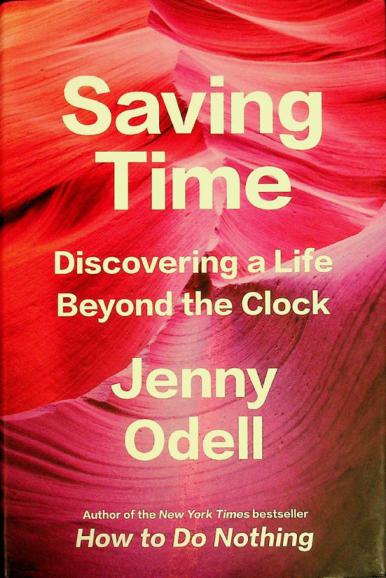
\"Our daily experience, dominated by the corporate clock that so many of us contort ourselves to fit inside, is destroying us. It wasn't built for people, it was built for profit. This is a book that tears open the seams of reality as we know it-the way we experience time itself-and rearranges it, reimagining a world not centered around work, the office clock, or the profit motive. Explaining how we got to the point where time became money, Odell offers us new models to live by--inspired by pre-industrial cultures, ecological, and geological time--that make a more humane, more hopeful way of living seem possible. In this dazzling, subversive, and deeply hopeful reframing of time, Jenny Odell takes us on a journey through other temporal habitats. As planet-bound animals, we live inside shortening and lengthening days, alongside gardens growing, birds migrating, and cliffs eroding. The stretchy quality of waiting and desire, the way the present may suddenly feel marbled with childhood memory, the slow but sure procession of a pregnancy, or the time it takes to heal from injuries--physical or emotional. Odell urges us to become stewards of these different rhythms of life, to imagine a life, identity, and source of meaning outside of the world of work and profit, and to understand that the trajectory of our lives--or the life of the planet--is not a foregone conclusion. In that sense, \"saving\" time-recovering its fundamentally irreducible and inventive nature-could also mean that time saves us\"-- Provided by publisher.
Book

Measuring Time, Making History
Time is the crucial ingredient in history, and yet historians rarely talk about time as such. These essays offer new insight into the development of modern conceptions of time, from the Christian dating system (BC/AD or BCE/CE) to the idea of “modernity” as a new epoch in human history.
eBook


The Time of Our Lives
The project of all philosophy may be to gain reconciliation with time, even if not every philosopher has dealt with time expressly. A confrontation with the passing of time and with human finitude runs through the history of philosophy as an ultimate concern. In this genealogy of the concept of temporality, David Hoy examines the emergence in a post-Kantian continental philosophy of a focus on the lived experience of the \"time of our lives\" rather than on the time of the universe. The purpose is to see how phenomenological and poststructuralist philosophers have tried to locate the source of temporality, how they have analyzed time's passing, and how they have depicted our relation to time once it has been--in a Proustian sense--regained. Hoy engages with competing theoretical tactics for reconciling us to our fleeting temporality, drawing on work by Kant, Heidegger, Hegel, Husserl, Merleau-Ponty, Nietzsche, Gadamer, Sartre, Bourdieu, Foucault, Bergson, Deleuze, Žižek, and Derrida. Hoy considers four existential strategies for coping with the apparent flow of temporality, including Proust's passive and Walter Benjamin's active reconciliation through memory, Žižek's critique of poststructuralist politics, Foucault's confrontation with the temporality of power, and Deleuze's account of Aion and Chronos. He concludes by exploring whether a dual temporalization could be what constitutes the singular \"time of our lives.\"
eBook


Time and Philosophy
\"Time and Philosophy\" presents a detailed survey of continental thought through an historical account of its key texts. The common theme taken up in each text is how philosophical thought should respond to time. Looking at the development of continental philosophy in both Europe and America, the philosophers discussed range from Hegel, Marx, Kierkegaard, Nietzsche, Husserl, Heidegger, Arendt, Adorno and Horkheimer, Sartre, de Beauvoir, Foucault, Derrida, to the most influential thinkers of today, Agamben, Badiou, Butler and Ranciere. Throughout, the concern is to elucidate the primary texts for readers coming to them for the first time. But, beyond this, \"Time and Philosophy\" aims to reveal the philosophical rigour which underpins and connects the history of continental thought.
\"Time and Philosophy fills a great vacuum in the literature on continental philosophy, providing students with an invaluable orientation into this complex tradition. The book - while necessarily implementing a selective criteria - sets forth a nuanced and exhaustive reading of the diversity of the tradition, and suggests the unifying thematic of temporality as the essential concern and horizon of continental philosophy. This book will be useful to continental and analytic philosophers alike.\" - James Luchte, University of Wales
eBook

The illusions of time : philosophical and psychological essays on timing and time perception
This edited collection presents the latest cutting-edge research in the philosophy and cognitive science of temporal illusions.
Book

About Time
Mark Currie brings together theoretical and philosophical ideas about time in his analysis of anticipation and other forms of projection into the future. In the work of such writers as Ali Smith, Ian McEwan, Martin Amis, and Graham Swift, he considers \"prolepsis\" or \"flashforward,\" in which a character experiences the present as the object of a future memory, and outlines a set of questions about tense and temporal reference that redefines the function of stories in contemporary culture. He also revisits traditional questions about the difference between literature and philosophy in relation to knowledge of time.
eBook