
Catalogue Search | MBRL


Are you sure you want to remove the book from the shelf?

{{itemTitle}}
2,830
result(s) for
"Time Political aspects."
Sort by:


Periodization and Sovereignty
Despite all recent challenges to stage-oriented histories, the idea of a division between a \"medieval\" and a \"modern\" period has survived, even flourished, in academia.Periodization and Sovereigntydemonstrates that this survival is no innocent affair. By examining periodization together with the two controversial categories of feudalism and secularization, Kathleen Davis exposes the relationship between the constitution of \"the Middle Ages\" and the history of sovereignty, slavery, and colonialism. This book's groundbreaking investigation of feudal historiography finds that the historical formation of \"feudalism\" mediated the theorization of sovereignty and a social contract, even as it provided a rationale for colonialism and facilitated the disavowal of slavery. Sovereignty is also at the heart of today's often violent struggles over secular and religious politics, and Davis traces the relationship between these struggles and the narrative of \"secularization,\" which grounds itself in a period divide between a \"modern\" historical consciousness and a theologically entrapped \"Middle Ages\" incapable of history. This alignment of sovereignty, the secular, and the conceptualization of historical time, which relies essentially upon a medieval/modern divide, both underlies and regulates today's volatile debates over world politics. The problem of defining the limits of our most fundamental political concepts cannot be extricated, Davis argues, from the periodizing operations that constituted them, and that continue today to obscure the process by which \"feudalism\" and \"secularization\" govern the politics of time.
eBook


The challenge of linear time : nationhood and the politics of history in East Asia
The papers collected in this volume, although dealing with several different themes, congeal around a debate about the ways and extent of the dominance of linear time and progressive history and the concomitant delineation of the nation in Chinese and Japanese historiography.
eBook

Timing Canada : the shifting politics of time in Canadian literary culture
\"From punch clocks to prison sentences, from immigration waiting periods to controversial time-zone boundaries, from Indigenous grave markers that count time in centuries rather than years, to the fact that free time is shrinking faster for women than for men--time shapes the fabric of Canadian society every day, but in ways that are not always reasonable or consistent. In Timing Canada, Paul Huebener draws from cultural history, time-use surveys, political statements, literature, and visual art to craft a detailed understanding of how time operates as a form of power in Canada. Time enables everything we do--as Margaret Atwood writes, \"without it we can't live.\" However, time also disempowers us, divides us, and escapes our control. Huebener transforms our understanding of temporal power and possibility by using examples from Canadian and Indigenous authors--including Jeannette Armstrong, Joseph Boyden, Dionne Brand, Timothy Findley, Lucy Maud Montgomery, and Gabrielle Roy, and many others--who witness, question, dismantle, and reconstruct the functioning of time in their works. As the first comprehensive study of the cultural politics of time in Canada, Timing Canada develops foundational principles of critical time studies and everyday temporal literacy, and demonstrates how time functions broadly as a tool of power, privilege, and imagination within a multicultural and multi-temporal nation.\"-- Provided by publisher.
Book

The cosmic time of empire
Combining original historical research with literary analysis, Adam Barrows takes a provocative look at the creation of world standard time in 1884 and rethinks the significance of this remarkable moment in modernism for both the processes of imperialism and for modern literature. As representatives from twenty-four nations argued over adopting the Prime Meridian, and thereby measuring time in relation to Greenwich, England, writers began experimenting with new ways of representing human temporality. Barrows finds this experimentation in works as varied as Victorian adventure novels, high modernist texts, and South Asian novels—including the work of James Joyce, Virginia Woolf, H. Rider Haggard, Bram Stoker, Rudyard Kipling, and Joseph Conrad. Demonstrating the investment of modernist writing in the problems of geopolitics and in the public discourse of time, Barrows argues that it is possible, and productive, to rethink the politics of modernism through the politics of time.
eBook


Conceptual History in the European Space
The result of extensive collaboration among leading scholars from across Europe, Conceptual History in the European Space represents a landmark intervention in the historiography of concepts. It brings together ambitious thematic studies that combine the pioneering methods of historian Reinhart Koselleck with contemporary insights and debates, each one illuminating a key feature of the European conceptual landscape. With clarifying overviews of such contested theoretical terrain as translatability, spatiality, and center-periphery dynamics, it also provides indispensable contextualization for an era of widespread disenchantment with and misunderstanding of the European project.
eBook

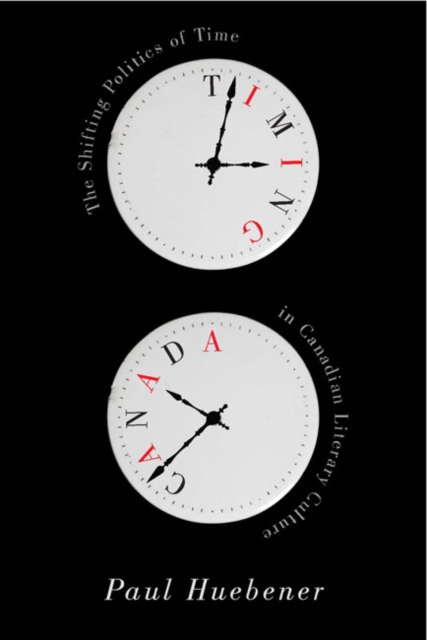
Timing Canada
From punch clocks to prison sentences, from immigration waiting periods to controversial time-zone boundaries, from Indigenous grave markers that count time in centuries rather than years, to the fact that free time is shrinking faster for women than for men - time shapes the fabric of Canadian society every day, but in ways that are not always visible or logical. In Timing Canada, Paul Huebener draws from cultural history, time-use surveys, political statements, literature, and visual art to craft a detailed understanding of how time operates as a form of power in Canada. Time enables everything we do - as Margaret Atwood writes, \"without it we can't live.\" However, time also disempowers us, divides us, and escapes our control. Huebener transforms our understanding of temporal power and possibility by using examples from Canadian and Indigenous authors - including Jeannette Armstrong, Joseph Boyden, Dionne Brand, Timothy Findley, Lucy Maud Montgomery, Gabrielle Roy, and many others - who witness, question, dismantle, and reconstruct the functioning of time in their works. As the first comprehensive study of the cultural politics of time in Canada, Timing Canada develops foundational principles of critical time studies and everyday temporal literacy, and demonstrates how time functions broadly as a tool of power, privilege, and imagination within a multicultural and multi-temporal nation.
eBook