
Catalogue Search | MBRL


Are you sure you want to remove the book from the shelf?

{{itemTitle}}
383
result(s) for
"Titanic"
Sort by:

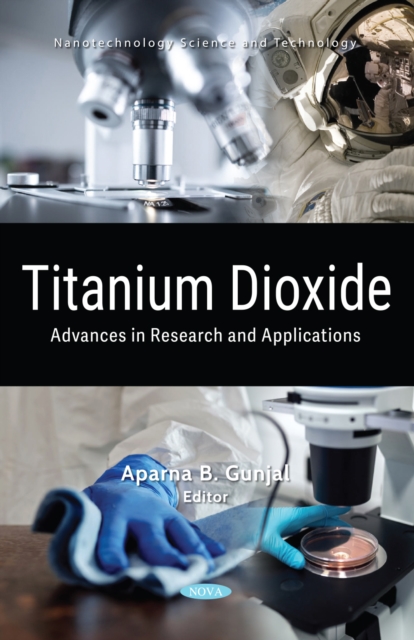
Titanium Dioxide: Advances in Research and Applications
This book, titled Titanium Dioxide: Advances in Research and Applications, deals with important aspects of applications of titanium dioxide and recent developments in the areas of research of titanium dioxide. There are 5 chapters in this book contributed by various authors. Chapter 1 deals with applications of titanium dioxide in space and its photocatalytic activity in a vacuum environment. Chapter 2 mentions various applications of titanium dioxide in the biomedical field, such as in bone implantation, immobilization of drug carriers, and in cancer therapy as well as in environmental remediation, such as degradation of hazardous pollutants and treatment of wastewater. Chapter 3 deals with doped titanium dioxide nanostructures for visible light driven photo catalysis. The applications of visible light on active titanium dioxide photocatalysts for degradation of various toxic pollutants are described. Chapter 4 deals in detail with various methods of biosynthesis of titanium dioxide nanoparticles and their antibacterial activity. Chapter 5 describes preparation of titanium dioxide nonmaterials, their forensic applications, and fingerprint imaging. The book Titanium Dioxide: Advances in Research and Applications will be of immense use to students, professors and researchers of various colleges, universities and research institutes. It will increase knowledge regarding the synthesis, applications and various aspects of titanium dioxide.
eBook

Titanic : the disaster that shocked the world!
Describes the disastrous 1912 sinking of the world's largest ocean liner after colliding with an iceberg during its maiden voyage.
Book
DK timelines. Season 1, episode 23, The voyage of the RMS Titanic
This is a timeline of the tragic events of the RMS Titanic's maiden voyage from Southampton, England to New York in April 1912. Its fateful collision with an iceberg led to the loss of more than 1,500 lives.
Streaming Video

The Titanic, lost-- and found
A simple account of the sinking of the Titanic and the discovery of its remains many years later.
Book
Understanding and controlling the hydrothermal growth process and the electronic properties of rutile TiO2 nanorods
As a nontoxic, chemically stable, and frequently occurring material with various valuable electronic and optoelectronic properties titanium dioxide (TiO2) has great potential for innumerable applications. The broad range of properties and applications can even be extended by using nanostructured TiO2. In addition, nanostructured TiO2 systems offer a high surface area, single crystal structures, and shape related scattering facilities. In spite of intensive research on this material in the past, many properties which are essential for various applications are not yet understood or even controllable. In this book, fundamental questions of the growth mechanism, the position-controlled fabrication, and the optical and electronic properties of rutile TiO2 nanorods are discussed.At the beginning, the properties of TiO2 are listed in detail. Subsequently, the preparation of suitable seed layers for the hydrothermal growth of rutile TiO2 nanorods on various substrates is described in detail. A chapter dealing with the hydrothermal growth process itself explains the origin and importance of the fine structure in these rods. Furthermore, new low-cost and efficient lithography techniques such as a scanning probe and a laser-induced melting technique are introduced for the structured growth of these nanorods. The resulting superstructures are compared with those of conventional electron-beam lithography. In addition to a variety of possible applications of such structures, some aspects of their light scattering properties are discussed in this book. Finally, the electronic properties of these nanorods are presented and the influence of crystal defects on the bias and time-dependent transition current is described.
eBook

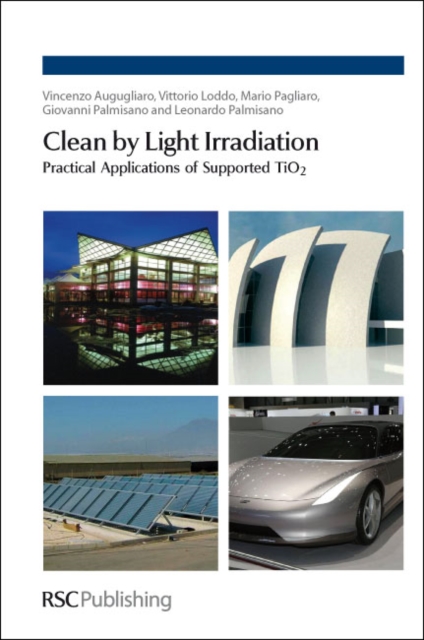
Clean by light irradiation
The book deals with the environmentally friendly cleaning materials functionalized with TiO2, a widely known semiconductor giving rise to redox reactions under artificial or solar irradiation. The role of Titanium dioxide in the worldwide community is introduced first. The fundamental working principles of heterogeneous photocatalysis follow and a critical section on the semiconductor bulk and surface properties open the way to the differences between TiO2 blend features with respect to analogous thin film layouts. Then follows the main section of the book which deals with the techniques applied to manufactured commercial devices, ranging from glasses to textiles and from concrete and other construction materials to paintings. Also road asphalt and other devices, such as photocatalytic air conditioning machines are outlined. Last generation materials, not yet commercialized, and the deposition techniques applied to prepare them are also widely discussed. The final part of the book covers the difficult and modern topic of standardization and comparison of performance of photocatalytic processes and in particular the guidelines proposed by various worldwide organizations for standardization are discussed. The book covers the general matters as well as the practical applications with the supporting methods discussed in detail. This book brings together a team of highly experienced and well-published experts in the field, providing a comprehensive view of the applications of supported titanium dioxide.
eBook

Titanic : truth and rumors
\"Labels common stories about the Titanic as fact or fiction and teaches readers how to tell the difference between truth and rumors\"--Provided by publisher.
Book

Facile synthesis of TiO1.77(OH)0.46·0.2 H2O and TiO2 and their applications for aqueous ammonium-ion battery
Rechargeable aqueous ammonium-ion batteries (AAIBs) have attracted more and more attention in energy storage devices because of great safety and cost-effectiveness, as well as excellent rate capability. Recently, it is the main exploration focus for the further improvement of AAIBs to develop suitable electrode materials. Herein, titanic acid and TiO
2
were simply synthesized by the facile co-precipitation approach. Titanic acid showed higher capacity of 104.5 mAh g
−1
at the 0.1 A g
−1
current density, and higher cyclability with the 91.2% capacity retention cycled 1000 cycles at 1 A g
−1
. Titanic acid is promising as aqueous ammonium-ion batteries with great stability and capacity.
Journal Article