
Catalogue Search | MBRL


Are you sure you want to remove the book from the shelf?

{{itemTitle}}
1,141
result(s) for
"To 1453"
Sort by:

The Seljuks of Anatolia : court and society in the medieval Middle East
\"Under Seljuk rule (c. 1081-1308) the formerly Christian Byzantine territories of Anatolia were transformed by the development of Muslim culture, society and politics, and it was then - well before the arrival of the Ottomans - that a Turkish population became firmly established in these lands. But these developments are little understood, and the Seljuk dynasty remains little studied. Yet the Seljuks of Anatolia were one of the most influential dynasties of the thirteenth-century Middle East, controlling some of the major trade routes of the period, playing a crucial role in linking East and West of the medieval world. This volume examines Seljuk culture and history by looking at developments both at court and in society at large and shed new light on Seljuk political culture and dynastic ideology, the engagement of politics with religion, and Christian-Muslim interaction. The Seljuks of Anatolia will be of great interest to researchers with interests in Byzantium as well as the material culture and society of the medieval Islamic world.\"--Page 4 of cover.
Book
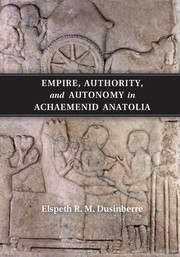
Empire, Authority, and Autonomy in Achaemenid Anatolia
The Achaemenid Persian Empire (550–330 BCE) was a vast and complex sociopolitical structure that encompassed much of modern-day Turkey, Syria, Jordan, Israel, Egypt, Iraq, Iran and Afghanistan and included two dozen distinct peoples who spoke different languages, worshipped different deities, lived in different environments and had widely differing social customs. This book offers a radical new approach to understanding the Achaemenid Persian Empire and imperialism more generally. Through a wide array of textual, visual and archaeological material, Elspeth R. M. Dusinberre shows how the rulers of the Empire constructed a system flexible enough to provide for the needs of different peoples within the confines of a single imperial authority and highlights the variability in response. This book examines the dynamic tensions between authority and autonomy across the Empire, providing a valuable new way of considering imperial structure and development.
eBook


Architecture and Landscape in Medieval Anatolia, 1100-1500
Anatolia was home to a large number of polities in the medieval period. Given its location at the geographical and chronological juncture between Byzantines and the Ottomans, its story tends to be read through the Seljuk experience. This obscures the multiple experiences and spaces of Anatolia under the Byzantine empire, Turko-Muslim dynasties contemporary to the Seljuks, the Mongol Ilkhanids, and the various beyliks of eastern and western Anatolia. This book looks beyond political structures and towards a reconsideration of the interactions between the rural and the urban; an analysis of the relationships between architecture, culture and power; and an examination of the region's multiple geographies. In order to expand historiographical perspectives it draws on a wide variety of sources (architectural, artistic, documentary and literary), including texts composed in several languages (Arabic, Armenian, Byzantine Greek, Persian and Turkish). Original in its coverage of this period from the perspective of multiple polities, religions and languages, this volume is also the first to truly embrace the cultural complexity that was inherent in the reality of daily life in medieval Anatolia and surrounding regions.
eBook

The pasts of Roman Anatolia : interpreters, traces, horizons
In this volume, Felipe Rojas examines how the inhabitants of Roman Anatolia interacted with the physical traces of earlier civilizations in their midst. Combining material and textual evidence, he shows that interest in and knowledge about pre-classical remains was deep and widespread. Indeed, ancient interaction with the remnants of even more ancient pasts was a vital part of life for many and diverse people in Roman Anatolia. Such interaction ranged from the purported translation of Bronze and Iron Age inscriptions to the physical manipulation of monuments and objects, including prehistoric earthen mounds and archaic statues. Occasionally, it even involved the production of fake antiquities. Offering new insights into both the archaeology and history of the Roman Mediterranean, Rojas's book is also an innovative contribution to the archaeology and anthropology of memory.
Book

Rum Seljuq Architecture, 1170-1220
This lavishly illustrated volume presents the major surviving monuments of the early period of the Rum Seljuqs, the first major Muslim dynasty to rule Anatolia. A much-needed overview of the political history of the dynasty provides the context for the study of the built environment which follows. The book addresses the most significant monuments from across the region: a palace, a minaret and a hospital are studied in detail, along with an overview of the decorative portals attached to a wide array of different building types. The case studies are used to demonstrate the key themes and processes of architectural synthesis and development that were under way at the time, and how they reflect the broader society.
eBook

Asia minor in the long sixth century : current research and future directions
Asia Minor is considered to have been a fairly prosperous region in Late Antiquity. It was rarely disturbed by external invasions and remained largely untouched by the continuous Roman-Persian conflict until very late in the period, was apparently well connected to the flourishing Mediterranean economy and, as the region closest to Constantinople, is assumed to have played an important part in the provisioning of the imperial capital and the imperial armies.0When exactly this prosperity came to an end - the late sixth century, the early, middle or even later seventh century - remains a matter of debate. Likewise, the impact of factors such as the dust veil event of 536, the impact of the bubonic plague that made its first appearance in AD 541/542, the costs and consequences of Justinian's wars, the Persian attacks of the early seventh century and, eventually the Arab incursions of around the middle of the seventh century, remains controversial. The more general living conditions in both cities and countryside have long been neglected. The majority of the population, however, did not live in urban but in rural contexts. Yet the countryside only found its proper place in regional overviews in the last two decades, thanks to an increasing number of regional surveys in combination with a more refined pottery chronology. Our growing understanding of networks of villages and hamlets is very likely to influence the appreciation of the last decades of Late Antiquity drastically. Indeed, it would seem that the sixth century in particular is characterised not only by a ruralisation of cities, but also by the extension and flourishing of villages in Asia Minor, the Roman Near East and Egypt.
Book

The Luwians of Western Anatolia
A study focussing on the Luwians of Western Anatolia, the geography of their habitat, and their neighbours and predecessors in the region. A reconstruction of western Luwian history and a sketch of their language is presented, based on linguistic data taken from hieroglyphic inscriptions and cuneiform script.
eBook


Fully organic compliant dry electrodes self-adhesive to skin for long-term motion-robust epidermal biopotential monitoring
Wearable dry electrodes are needed for long-term biopotential recordings but are limited by their imperfect compliance with the skin, especially during body movements and sweat secretions, resulting in high interfacial impedance and motion artifacts. Herein, we report an intrinsically conductive polymer dry electrode with excellent self-adhesiveness, stretchability, and conductivity. It shows much lower skin-contact impedance and noise in static and dynamic measurement than the current dry electrodes and standard gel electrodes, enabling to acquire high-quality electrocardiogram (ECG), electromyogram (EMG) and electroencephalogram (EEG) signals in various conditions such as dry and wet skin and during body movement. Hence, this dry electrode can be used for long-term healthcare monitoring in complex daily conditions. We further investigated the capabilities of this electrode in a clinical setting and realized its ability to detect the arrhythmia features of atrial fibrillation accurately, and quantify muscle activity during deep tendon reflex testing and contraction against resistance.
Reported wearable dry electrodes have limited long-term use due to their imperfect skin compliance and high motion artifacts. Here, the authors report an intrinsically conductive, stretchable polymer dry electrode with excellent self-adhesiveness for long-term high-quality biopotential detection.
Journal Article