
Catalogue Search | MBRL


Are you sure you want to remove the book from the shelf?

{{itemTitle}}
351
result(s) for
"To 1783"
Sort by:


A Revolutionary People At War
In this highly acclaimed book, Charles Royster explores the mental processes and emotional crises that Americans faced in their first national war. He ranges imaginatively outside the traditional techniques of analytical historical exposition to build his portrait of how individuals and a populace at large faced the Revolution and its implications. The book was originally published by UNC Press in 1980.
eBook

To begin the world over again : how the American revolution devastated the globe
The first exploration of the profound and often catastrophic impact the American Revolution had on the rest of the world. While the American Revolution led to domestic peace and liberty, it ultimately had a catastrophic global impact-it strengthened the British Empire and led to widespread persecution and duress. From the opium wars in China to anti-imperial rebellions in Peru to the colonization of Australia-the inspirational impact the American success had on fringe uprisings was outweighed by the influence it had on the tightening fists of oppressive world powers. Here Matthew Lockwood presents, in vivid detail, the neglected story of this unintended revolution. It sowed the seeds of collapse for the preeminent empires of the early modern era, setting the stage for the global domination of Britain, Russia, and the United States. Lockwood illuminates the forgotten stories and experiences of the communities and individuals who adapted to this new world in which the global balance of power had been drastically altered.--Adapted from jacket.
Book

Between two worlds : how the English became Americans
In the 1600s, over 350,000 intrepid English men, women, and children migrated to America, leaving behind their homeland for an uncertain future. Whether they settled in Jamestown, Salem, or Barbados, these migrants-entrepreneurs, soldiers, and pilgrims alike-faced one incontrovertible truth: England was a very, very long way away. In Between Two Worlds, celebrated historian Malcolm Gaskill tells the sweeping story of the English experience in America during the first century of colonization. Following a large and varied cast of visionaries and heretics, merchants and warriors, and slaves and rebels, Gaskill brilliantly illuminates the often traumatic challenges the settlers faced. The first waves sought to recreate the English way of life, even to recover a society that was vanishing at home. But they were thwarted at every turn by the perils of a strange continent, unaided by monarchs who first ignored then exploited them. As these colonists strove to leave their mark on the New World, they were forced-by hardship and hunger, by illness and infighting, and by bloody and desperate battles with Indians-to innovate and adapt or perish. As later generations acclimated to the wilderness, they recognized that they had evolved into something distinct: no longer just the English in America, they were perhaps not even English at all. These men and women were among the first white Americans, and certainly the most prolific. And as Gaskill shows, in learning to live in an unforgiving world, they had begun a long and fateful journey toward rebellion and, finally, independence.
eBook


Blues for Cannibals
Cultivated from the fierce ideas seeded in Blood Orchid, Blues for Cannibals is an elegiac reflection on death, pain, and a wavering confidence in humanity’s own abilities for self-preservation. After years of reporting on border violence, sex crimes, and the devastation of the land, Bowden struggles to make sense of the many ways in which we destroy ourselves and whether there is any way to survive. Here he confronts a murderer facing execution, sex offenders of the most heinous crimes, a suicidal artist, a prisoner obsessed with painting portraits of presidents, and other people and places that constitute our worst impulses and our worst truths. Painful, heartbreaking, and forewarning, Bowden at once tears us apart and yearns for us to find ourselves back together again.
eBook


In India and East Africa E-Indiya nase East Africa
In November 1949 D.D.T. Jabavu, the South African politician and professor of African languages at Fort Hare University, set out on a four-month trip to attend the World Pacifist Meeting in India. He wrote an isiXhosa account of his journey which was published in 1951 by Lovedale Press. This new edition republishes the travelogue in the original isiXhosa, with an English translation by the late anthropologist Cecil Wele Manona. The travelogue contains reflections on Jabavu’s social interactions during his travels, and on the conference itself, where he considered what lessons Gandhian principles might yield for South Africans engaged in struggles for freedom and dignity. His commentary on non-violent resistance, and on the dangers of nationalism and racism, enriches the existing archive of intellectual exchanges between Africa and India from a black South African perspective. The volume includes chapters by the editors that examine the networks of international solidarity – from post-independence India to the anti-colonial struggle in East Africa and the American civil rights movement – which Jabavu helped to strengthen, biographical sketches of Jabavu and of Manona, and an afterword that reflects on the historical and political significance of making African-language texts available to readers across Africa.In November 1949, Davidson Don Tengo (D.D.T.) Jabavu, the South African politician, Methodist lay preacher and retired professor of African languages and Latin at Fort Hare University in the Eastern Cape, set out on a four-month trip to attend the World Pacifist Meeting in India. The conference brought together delegates from over thirty countries to reflect on how Mahatma Gandhi’s life and teachings could inform pacifist work in the post-World War II era. Jabavu wrote an isiXhosa account of his journey up the east coast of Africa and to different parts of India which was first published in 1951 by Lovedale Press. His narrative contains wide-ranging reflections on the fauna and flora of the changing landscape, on intriguing social interactions during his travels, and on the conference itself, where he considered what lessons Gandhian principles might yield for oppressed South Africans engaged in struggles for freedom and dignity. He incorporates accounts of chance meetings with important figures of post-independence India and of the anti-colonial struggle in East Africa, as well as with members of the American civil rights movement. His commentary on non-violent resistance, and on the dangers of nationalism when coupled with militarism and racism, enriches the existing archive of intellectual and political exchange between Africa and India from a black South African perspective. This new edition includes Jabavu’s travelogue in the original isiXhosa, with an English translation by the late anthropologist Cecil Wele Manona. Tina Steiner’s introductory chapter examines the networks of international solidarity and friendship that Jabavu helped to strengthen in the course of his travels. A chapter by Mhlobo W. Jadezweni, whose updating of the original isiXhosa orthography has made Jabavu’s text accessible to new generations of readers, considers the richness of Jabavu’s isiXhosa style as a contribution to the archive of great African-language literature. Catherine Higgs provides biographical sketches of D.D.T. Jabavu and Cecil Wele Manona which situate this travelogue within the broader context of their lives. Evan M. Mwangi’s Afterword is a reflection on the historical and political significance of making African-language texts available to readers across Africa.
eBook

The cause : the American Revolution and its discontents, 1773-1783
\"A culminating work on the American Founding by one of its leading historians, The Cause rethinks the American Revolution as we have known it. George Washington claimed that anyone who attempted to provide an accurate account of the war for independence would be accused of writing fiction. At the time, no one called it the \"American Revolution\": former colonists still regarded themselves as Virginians or Pennsylvanians, not Americans, while John Adams insisted that the British were the real revolutionaries, for attempting to impose radical change without their colonists' consent. With The Cause, Ellis takes a fresh look at the events between 1773 and 1783, recovering a war more brutal than any in American history save the Civil War and discovering a strange breed of \"prudent\" revolutionaries, whose prudence proved wise yet tragic when it came to slavery, the original sin that still haunts our land. Written with flair and drama, The Cause brings together a cast of familiar and forgotten characters who, taken together, challenge the story we have long told ourselves about our origins as a people and a nation\"-- Provided by publisher.
BOOK
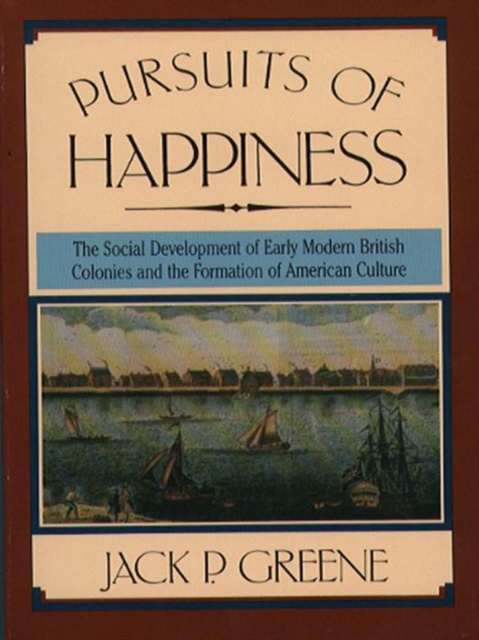
Pursuits of happiness : the social development of early modern British colonies and the formation of American culture
In this book, Jack Greene reinterprets the meaning of American social development. Synthesizing literature of the previous two decades on the process of social development and the formation of American culture, he challenges the central assumptions that have traditionally been used to analyze colonial British American history.Greene argues that the New England declension model traditionally employed by historians is inappropriate for describing social change in all the other early modern British colonies. The settler societies established in Ireland, the Atlantic island colonies of Bermuda and the Bahamas, the West Indies, the Middle Colonies, and the Lower South followed instead a pattern first exhibited in America in the Chesapeake. That pattern involved a process in which these new societies slowly developed into more elaborate cultural entities, each of which had its own distinctive features.Greene also stresses the social and cultural convergence between New England and the other regions of colonial British America after 1710 and argues that by the eve of the American Revolution Britain's North American colonies were both more alike and more like the parent society than ever before. He contends as well that the salient features of an emerging American culture during these years are to be found not primarily in New England puritanism but in widely manifest configurations of sociocultural behavior exhibited throughout British North America, including New England, and he emphasized the centrality of slavery to that culture.
eBook