
Catalogue Search | MBRL


Are you sure you want to remove the book from the shelf?

{{itemTitle}}
2,090
result(s) for
"To 1867"
Sort by:

A short history of Canada
Most of us know bits and pieces of our history but would like to be more sure of how it all fits together. The trick is to find a history that is so absorbing you will want to read it from beginning to end. With this expanded, seventh edition of A Short History of Canada, readers need look no further. Desmond Morton, one of Canada's most highly respected historians, is keenly aware of the ways in which our past informs the present, and in one compact and engrossing volume, he pulls off the remarkable feat of bringing it all together - from the First Nations before the arrival of the Europeans, to Confederation, to Stephen Harper's prime ministership, to Justin Trudeau's victory in the 2015 election. His acute observations on the Diefenbaker era, the effects of the post-war influx of immigrants, the Trudeau years and the constitutional crisis, the Quebec referendum, the rise of the Canadian Alliance, and Canada under Harper's governance, all provide an invaluable background to understanding the way Canada works today and its direction in years to come.
Book


Something of a Peasant Paradise?
Were Acadians better off than their rural counterparts in old regime France? Did they enjoy a Golden Age? To what degree did a distinct Acadian identity emerge before the wars and deportations of the mid-eighteenth century? In Something of a Peasant Paradise?, Gregory Kennedy compares Acadie in North America with a region of western France, the Loudunais, from which a number of the colonists originated. Kennedy considers the natural environment, the role of the state, the economy, the seigneury, and local governance in each place to show that similarities between the two societies have been greatly underestimated or ignored. The Acadian colonists and the people of the Loudunais were frontier peoples, with dispersed settlement patterns based on kin groups, who sought to make the best use of the land and to profit from trade opportunities. Both societies were hierarchical, demonstrated a high degree of political agency, and employed the same institutions of local governance to organize their affairs and negotiate state demands. Neither group was inherently more prosperous, egalitarian, or independent-minded than the other. Rather, the emergence of a distinct Acadian identity can be traced to the gradual adaptation of traditional methods, institutions, and ideas to their new environmental and political situations. A compelling comparative analysis based on archival evidence on both sides of the Atlantic, Something of a Peasant Paradise? Challenges the traditional historiography and demonstrates that Acadian society shared many of its characteristics with other French rural societies of the period.
eBook

The reluctant land : society, space, and environment in Canada before Confederation
Describes the evolving pattern of settlement and the changing relationships of people and land in Canada from the end of the 15th century to the late 1860s and early 1870s.
Book


Rural Protest on Prince Edward Island
Who has the more legitimate claim to land, settlers who occupy and improve it with their labour, or landlords who claim ownership on the basis of imperial grants? This question of property rights, and their construction, was at the heart of rural protest on Prince Edward Island for a century. Tenants resisted landlord claims by squatting and refusing to pay rent. They fought for their vision of a just rural order through petitions, meetings, rallies, electoral campaigns, and direct action. Landlords responded with their own collective action to protect their interests. In Rural Protest on Prince Edward Island Rusty Bittermann examines this conflict and the dynamic of rural protest on the Island from its establishment as a British colony in the 1760s to the early 1840s.
The focus of Bittermann's study is the remarkable mass movement known as the Escheat movement, which emerged in the 1830s in the context of growing popular challenges elsewhere in the Atlantic World. The Escheat movement aimed at resolving the land question in favour of tenants by having the state resume (escheat) the large grants of land that created landlordism on the Island. Although it ultimately gained control of the assembly in the late 1830s, the Escheat movement did not produce the land policies that tenants and their allies advocated. The movement did, however, synthesize years of rural protest and produce a persistent legacy of language and ideas concerning land, justice, and the rights of small producers that helped to make landlordism on the Island unsustainable in the long term. Rural Protest on Prince Edward Island is a comprehensive and fascinating examination of an important, but often overlooked, period in the history of Canada's smallest province.
eBook

Mapmaker : Philip Turnor in Rupert's Land in the Age of Enlightenment
\"As the first inland surveyor for the Hudson's Bay Company, Philip Turnor stands tall among the explorers and mapmakers of Canada. Accompanied by Cree guides and his Cree wife, Turnor travelled 15,000 miles by canoe and foot between 1778 and 1792 to produce ten maps, culminating in his magnum opus, a map that was the foundation of all northern geographic knowledge at that time. Barbara Mitchell's biography brings to life the man who taught David Thompson and Peter Fidler how to survey\"-- Provided by publisher.
Book
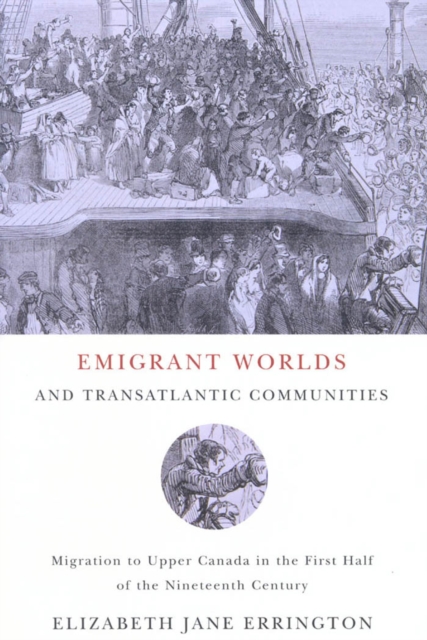
Emigrant Worlds and Transatlantic Communities
Emigrant Worlds and Transatlantic Communities gives voice to the Irish, Scottish, English, and Welsh women and men who negotiated the complex and often dangerous world of emigration between 1815 and 1845. Using \"information wanted\" notices that appeared in colonial newspapers as well as emigrants' own accounts, Errington illustrates that emigration was a family affair. Individuals made their decisions within a matrix of kin and community - their experiences shaped by their identities as husbands and wives, parents and children, siblings and cousins. The Atlantic crossing divided families, but it was also the means of reuniting kin and rebuilding old communities. Emigration created its own unique world - a world whose inhabitants remained well aware of the transatlantic community that provided them with a continuing sense of identity, home, and family.
eBook