
Catalogue Search | MBRL


Are you sure you want to remove the book from the shelf?

{{itemTitle}}
730
result(s) for
"Tobacco America History."
Sort by:

The golden leaf : how tobacco shaped Cuba and the Atlantic world
\"Through the rise and fall of empires, ideologies, and economies, tobacco grown on the tiny island of Cuba has remained an enduring symbol of pleasure and extravagance. Cultivated as one of the first reliable commodities for those inhabitants who remained after conquistadors moved on in search of a mythical wellspring of gold, tobacco quickly became crucial to the support of the swelling Spanish Empire in the 17th seventeenth and 18th eighteenth centuries. Eventually, however, tobacco became one of the final stabilizing forces in the empire, and it ultimately proved more resilient than the best laid plans of kings and queens. Tobacco, and those whose livelihoods depended on it, shrugged off the Empire's collapse and pressed on into the 20th century as an economic force any state or political power must reckon with. Cosner explores the history of this golden leaf through the personal narratives of farmers, bureaucrats, and laborers, all struggling to build an independent and lucrative economic engine. Through conquest, rebellion, colonial and imperial schemes, and the eventual Communist revolution, Cuban tobacco and cigars became a luxury item that commanded commanded loyalty that defied mere borders or embargoes. Ultimately, The Golden Leaf is a story of two carefully cultivated products: Cuban tobacco, and its lofty reputation\"-- Provided by publisher.
Book

The Golden Leaf
Through the rise and fall of empires, ideologies, and economies,
tobacco grown on the tiny island of Cuba has remained an enduring
symbol of pleasure and extravagance. Cultivated as one of the first
reliable commodities for those inhabitants who remained after
conquistadors moved on in search of a mythical wellspring of gold,
tobacco quickly became crucial to the support of the swelling
Spanish Empire in the seventeenth and eighteenth centuries.
Eventually, however, tobacco became one of the final stabilizing
forces in the empire, and it ultimately proved more resilient than
the best laid plans of kings and queens. Tobacco, and those whose
livelihoods depended on it, shrugged off the Empire's collapse and
pressed on into the twentieth century as an economic force any
state or political power must reckon with. Cosner explores the
history of this golden leaf through the personal narratives of
farmers, bureaucrats, and laborers, all struggling to build an
independent and lucrative economic engine. Through conquest,
rebellion, colonial and imperial schemes, and the eventual
Communist revolution, Cuban tobacco and cigars became a luxury item
that commanded loyalty that defied mere borders or embargoes.
Ultimately, The Golden Leaf is a story of two carefully
cultivated products: Cuban tobacco, and its lofty reputation.
eBook

Planting an empire : the early Chesapeake in British North America
\"Before the revolution, the Chesapeake made up one of the most prosperous and politically important regions in the mainland colonies. This book lays out the origins of, the source of earliest material success (tobacco exports) in, social developments in, and growing disparities and jealousies between the two 'sisters' of the Chesapeake: Virginia and Maryland. No one before has attempted this kind of twin 'biography,' and yet it helps enormously to see these two colonies and their growth in the same viewfinder. Protestant Virginia, the larger colony, claiming far reaches of North America, eventually believed itself the rightful leader in colonial politics, especially in resistance to Parliamentary violations of cherished liberties. Catholic-Protestant Maryland, a proprietary province, more diverse and ambitious in its own ways, soon developed along its own economic path and kept a watchful eye on the older sister while complaining also of Calvert-family restrictions and privileges. Differences aside, these colonies 'invented' staple-crop agriculture and African-American slavery in the mainland colonies. They thus contributed heavily to the formation of American interests and character\"-- Provided by publisher.
Book
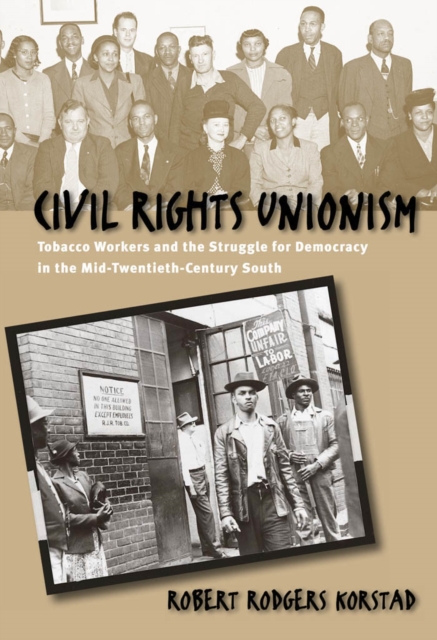
Civil rights unionism : tobacco workers and the struggle for democracy in the mid-twentieth-century South
Drawing on scores of interviews with black and white tobacco workers in Winston-Salem, North Carolina, Robert Korstad brings to life the forgotten heroes of Local 22 of the Food, Tobacco, Agricultural and Allied Workers of America-CIO. These workers confronted a system of racial capitalism that consigned African Americans to the basest jobs in the industry, perpetuated low wages for all southerners, and shored up white supremacy.
Galvanized by the emergence of the CIO, African Americans took the lead in a campaign that saw a strong labor movement and the reenfranchisement of the southern poor as keys to reforming the South - and a reformed South as central to the survival and expansion of the New Deal. In the window of opportunity opened by World War II, they blurred the boundaries between home and work as they linked civil rights and labor rights in a bid for justice at work and in the public sphere.
But civil rights unionism foundered in the maelstrom of the Cold War. Its defeat undermined later efforts by civil rights activists to raise issues of economic equality to the moral high ground occupied by the fight against legalized segregation and, Korstad contends, constrains the prospects for justice and democracy today.
eBook

Perry of London : a family and a firm on the seaborne frontier, 1615-1753
No detailed description available for \"Perry of London\".
eBook

El Lector
The practice of reading aloud has a long history, and the tradition still survives in Cuba as a hard-won right deeply embedded in cigar factory workers’ culture. In El Lector, Araceli Tinajero deftly traces the evolution of the reader from nineteenth-century Cuba to the present and its eventual dissemination to Tampa, Key West, Puerto Rico, and Mexico. In interviews with present-day and retired readers, she records testimonies that otherwise would have been lost forever, creating a valuable archive for future historians. Through a close examination of journals, newspapers, and personal interviews, Tinajero relates how the reading was organized, how the readers and readings were selected, and how the process affected the relationship between workers and factory owners. Because of the reader, cigar factory workers were far more cultured and in touch with the political currents of the day than other workers. But it was not only the reading material, which provided political and literary information that yielded self-education, that influenced the workers; the act of being read to increased the discipline and timing of the artisan’s job.
eBook

Golden holocaust
The cigarette is the deadliest artifact in the history of human civilization. It is also one of the most beguiling, thanks to more than a century of manipulation at the hands of tobacco industry chemists. In Golden Holocaust, Robert N. Proctor draws on reams of formerly-secret industry documents to explore how the cigarette came to be the most widely-used drug on the planet, with six trillion sticks sold per year. He paints a harrowing picture of tobacco manufacturers conspiring to block the recognition of tobacco-cancer hazards, even as they ensnare legions of scientists and politicians in a web of denial. Proctor tells heretofore untold stories of fraud and subterfuge, and he makes the strongest case to date for a simple yet ambitious remedy: a ban on the manufacture and sale of cigarettes.
eBook

Local smoke-free policy development in Santa Fe, Argentina
ObjectiveTo describe the process of approval and implementation of a comprehensive smoke-free law in the province of Santa Fe, Argentina, between 2005 and 2009.MethodsReview of the Santa Fe smoke-free legislation, articles published in local newspapers and documentation on two lawsuits filed against the law, and interviews with key individuals in Santa Fe.ResultsEfforts to implement smoke-free policies in Santa Fe began during the 1990s without success, and resumed in 2005 when the provincial Legislature approved the first 100% smoke-free subnational law in Argentina. There was no strong opposition during the discussions within the legislature. As in other parts of the world, pro-tobacco industry interests attempted to block the implementation of the law using well known strategies. These efforts included a controversy media campaign set up, the creation of a hospitality industry association and a virtual smokers' rights group, the introduction of a counterproposal seeking modification of the law, the challenge of the law in the Supreme Court, and the proposal of a weak national bill that would ‘conflict’ with the subnational law. Tobacco control advocates sought media attention as a strategy to protect the law.ConclusionsSanta Fe is the first subnational jurisdiction in Latin America to have enacted a comprehensive smoke-free policy following the recommendations of the World Health Organization (WHO) Framework Convention on Tobacco Control. After 3 years of implementation, pro-tobacco industry forces failed to undermine the law. Other subnational jurisdictions in Argentina, as well as in Mexico and Brazil are following the Santa Fe example.
Journal Article

The Impact of the Great Migration on Mortality of African Americans: Evidence from the Deep South
The Great Migration—the massive migration of African Americans out of the rural South to largely urban locations in the North, Midwest, and West—was a landmark event in US history. Our paper shows that this migration increased mortality of African Americans born in the early twentieth century South. This inference comes from an analysis that uses proximity of birthplace to railroad lines as an instrument for migration.
Journal Article

Remembering to Forget: The Historic Irresponsibility of U.S. Big Tobacco
Society increasingly demands corporations to be accountable for their past misbehaviours. Some corporations engage in forgetting work with the aim of avoiding responsibility for their wrongdoings. We argue that whenever social actors have their past actions called into question and engage in forgetting work, an ethics of remembering takes place. A collective project of social forgetting is contingent on the emergence of coordinated actions among players of an industry. Similarly, sustained efforts of forgetting work depend on the continuity of the project through various generations of employees, which presumes the existence of frameworks of remembering in place. We analysed this paradox through a historical case study of the U.S. tobacco industry. We conclude that forgetting work may be a double-edged sword. It might be beneficial in the short run, to the extent that corporations can successfully maintain the public ignorance about their deceitful pasts. In the long run, however, it creates additional layers of historical irresponsibility and may turn into a compounded liability in the event the memory of the collective strategy of social forgetting becomes public.
Journal Article