
Catalogue Search | MBRL


Are you sure you want to remove the book from the shelf?

{{itemTitle}}
7,076
result(s) for
"Tobacco Industry - legislation "
Sort by:

The cigarette : a political history
The Cigarette: A Political History offers a fresh interpretation of tobacco's role in the twentieth century. It argues that tobacco played a vital and emblematic role in the history of twentieth century political economy. Far from being unregulated, tobacco was the most controlled and supported commodity produced in the United States during the twentieth century. The federal tobacco program was remarkably long lived, lasting nearly seven decades and ending only in 2004. By the 1960s, criticisms of the Tobacco industry and its state support were ubiquitous. Under the banner of \"non-smokers' rights,\" by the mid-1970s activists began to rack up an impressive string of victories in curtailing public smoking at the local and state levels. By the final decades of the twentieth century, debates over tobacco were waged primarily on the terrain of its social cost. By placing tobacco at the center of American political economy, The Cigarette: A Political History joins the politics of the body to the American body politic.-- Provided by publisher.
Book

Effect of menthol cigarette and other menthol tobacco product bans on tobacco purchases in the RTI iShoppe virtual convenience store
ObjectiveTo test how a potential US ban of menthol products or replacement with ‘green’ products and ads could influence tobacco purchases.MethodsUS adult menthol smokers (N=1197) were recruited via an online panel and randomly assigned to complete a shopping task in one of four versions (experimental conditions) of the RTI iShoppe virtual store: (1) no ban, (2) replacement of menthol cigarettes and ads with green replacement versions, (3) menthol cigarette ban and (4) all menthol tobacco product ban. Logistic regressions assessed the effect of condition on tobacco purchases.ResultsParticipants in the menthol cigarette ban (OR=0.67, 95% CI 0.48 to 0.92) and all menthol product ban conditions (OR=0.60, 95% CI 0.43 to 0.83) were less likely to purchase cigarettes of any type than participants in the no ban condition. Participants in the green replacement (OR=1.74, 95% CI 1.13 to 2.70), menthol cigarette ban (OR=3.40, 95% CI 2.14 to 5.41) and all menthol product ban conditions (OR=3.14, 95% CI 1.97 to 5.01) were more likely to purchase a cigarette brand different from their usual brand than participants in the no ban condition.ConclusionsOur findings suggest that menthol bans could have great public health impact by reducing cigarette purchases. However, tobacco marketing strategies, such as creating green (or other replacement) versions of menthol cigarettes, may undermine public health benefits of a menthol ban by prompting purchases of non-menthol cigarettes. Our findings highlight the importance of taking tobacco marketing tactics into consideration in tobacco product regulation.
Journal Article

Framing Pictorial Cigarette Warning Labels to Motivate Young Smokers to Quit
The Family Smoking Prevention and Tobacco Control Act requires new pictorial warnings for U.S. cigarette packs, but enactment has been delayed by tobacco industry lawsuits. Research can inform implementation of the pictorial warning requirement and identify ways to optimize their public health impact post-implementation. This study investigated the impact of warning label message framing on young smokers' motivation to quit, examining cessation self-efficacy, and perceived risks as moderators of message framing impact.
Smokers ages 18-30 (n = 740) completed baseline measures and were randomized to view 4 images of cigarette packs with pictorial health warnings featuring gain- or loss-framed messages. Motivation to quit was assessed after participants viewed the pack images. Linear models accounting for repeated measures and adjusting for baseline covariates examined the impact of message framing and interactions with baseline self-efficacy to quit and perceived risks of smoking.
Loss-framed warnings prompted significantly greater motivation to quit among smokers with high self-efficacy compared with smokers with low self-efficacy. Among smokers with low self-efficacy, gain-framed messages were superior to loss-framed messages. Gain-framed warnings generated significantly greater motivation to quit among smokers with high perceived risks compared with smokers with low perceived risks. Among smokers with high perceived risks, gain-framed messages were superior to loss-framed messages.
A combination of pictorial warnings featuring risk-based (i.e., loss-framed) and efficacy-enhancing (i.e., gain-framed) information may promote better public health outcomes. Research is needed to investigate how strategically framed warning messages impact smokers' behaviors based on their pre-existing attitudes and beliefs in real-world settings.
Journal Article

Cigarette pack messages about toxic chemicals: a randomised clinical trial
BackgroundThe USA can require tobacco companies to disclose information about harmful and potentially harmful chemicals in cigarette smoke, but the impact of these messages is uncertain. We sought to assess the effect of placing messages about toxic chemicals on smokers’ cigarette packs.MethodsParticipants were 719 adult cigarette smokers from California, USA, recruited from September 2016 through March 2017. We randomly assigned smokers to receive either factual messages about chemicals in cigarette smoke and their health harms (intervention) or messages about not littering cigarette butts (control) on the side of their cigarette packs for 3 weeks. The primary trial outcome was intention to quit smoking.ResultsIn intent-to-treat analyses, smokers whose packs had chemical messages did not have higher intentions to quit smoking at the end of the trial than those whose packs had control messages (P=0.56). Compared with control messages, chemical messages led to higher awareness of the chemicals (28% vs 15%, P<0.001) and health harms (60% vs 52%, P=0.02) featured in the messages. In addition, chemical messages led to greater negative affect, thinking about the chemicals in cigarettes and the harms of smoking, conversations about the messages and forgoing a cigarette (all P<0.05).DiscussionChemical messages on cigarette packs did not lead to higher intentions to quit among smokers in our trial. However, chemical messages informed smokers of chemicals in cigarettes and harms of smoking, which directly supports their implementation and would be critical to defending the messages against cigarette company legal challenges.Trial registration number NCT02785484.
Journal Article
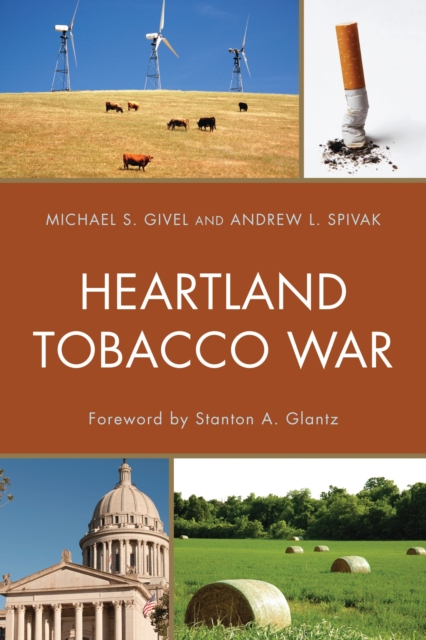
Heartland Tobacco War
Heartland Tobacco War chronicles the political and public relations battles between health advocates and forces supported by the tobacco industry in Oklahoma from the 1980s to the present. Michael S. Givel and Andrew L. Spivak draw on previously-suppressed tobacco insider documents and first-hand interviews with key players in the conflict. This story of pro- and anti-tobacco lobbying and legislation in the nation’s heartland especially highlights the unique role of Oklahoma’s “renegade” Department of Health Commissioner, Dr. Leslie Bietsch. After decades of political dominance by the tobacco industry, this single maverick bureaucrat in the early 2000s bypassed the usual insider politics of the legislature and employed aggressive public campaign strategies to bring about sweeping legal victories for clean indoor air and tobacco taxes in a very conservative state. The authors examine the Commissioner’s aggressive advocacy in the context of insider and outsider policy advocacy, public administration ethics, the politics of bureaucratic activism and administrative lawmaking, and direct democracy. Heartland Tobacco War tells a story that will be of great relevance to public health practitioners, historians, health activists, health policy scholars, sociologists, public administration scholars, social movement and public interest group scholars, political scientists, public policy scholars, and anyone else interested in the politics of the tobacco industry.
eBook

Attitudinal Spillover from Misleading Natural Cigarette Marketing: An Experiment Examining Current and Former Smokers’ Support for Tobacco Industry Regulation
This research examined the influence of natural cigarette advertising on tobacco control policy support, and the potential for misbeliefs arising from exposure to cigarette marketing to affect such support. Ample research indicates that natural cigarettes such as Natural American Spirit (NAS) are widely and erroneously perceived as safer than their traditional counterparts because of their marketed “natural” composition. Yet regulatory action regarding natural cigarette marketing has been limited in scope, and little research has examined whether misleading product advertising affects support for related policy, an important component of the policy process. Here, we administered a large-scale randomized experiment (n = 1128), assigning current and former smokers in the United States to an NAS advertising condition or a control group and assessing their support for tobacco industry regulation. Results show that exposure to NAS advertising reduces support for policies to ban potentially misleading terminology from cigarette advertising, and these effects are stronger for daily smokers. Further, misinformed beliefs about the healthy composition of NAS partially mediate effects on policy support. Yet interestingly, exposure to NAS marketing does not reduce support for policies to establish standards for when certain terms are permissible in cigarette advertising. The results of this analysis indicate potential spillover effects from exposure to NAS advertising in the realm of support for regulatory action pertaining to tobacco industry marketing.
Journal Article
Information to Improve Public Perceptions of the Food and Drug Administration (FDA’s) Tobacco Regulatory Role
While the Food and Drug Administration (FDA) has had regulatory authority over tobacco products since 2009, public awareness of this authority remains limited. This research examines several broad types of information about FDA tobacco regulatory mission that may improve the perceptions of FDA as a tobacco regulator. Using Amazon Mechanical Turk, 1766 adults, smokers and non-smokers, were randomly assigned to view a statement about FDA regulatory authority that varied three information types in a 2 × 2 × 2 between subjects experimental design: (1) FDA’s roles in regulating tobacco (yes/no); (2) The scientific basis of regulations (yes/no); and (3) A potential protective function of regulations (yes/no). Using factorial ANOVA, we estimated the main and interactive effects of all three types of information and of smoking status on the perceptions of FDA. Participants that were exposed to information on FDA roles reported higher FDA credibility and a greater perceived knowledge of FDA than those who did not. Exposure to information about the scientific basis of regulations led to more negative views of the tobacco industry. Participants who learned of the FDA’s commitment to protecting the public reported higher FDA credibility and more positive attitudes toward regulations than those who did not learn of this commitment. We observed no significant interaction effects. The findings suggest that providing information about the regulatory roles and protective characterization of the FDA’s tobacco regulatory mission positively influence public perceptions of FDA and tobacco regulations.
Journal Article

Bad acts : the racketeering case against the tobacco industry
On January 20, 1999, President Bill Clinton announced in his State of the Union address that the Justice Department was planning to sue the tobacco industry and assigned the task to Attorney General Janet Reno and the Justice Department. This book is the story of that case - the politics, the litigation, the behavior of the industry and its lawyers, the efforts by the Bush Administration to gut the case, and the ultimate victory in court. Bad Acts tells the story, not yet fully revealed, of what was happening behind the scenes at the Justice Department as the case approached victory, when the Bush Administration intervened, with some success, to protect Big Tobacco. The book examines the political influences and interferences of and by Clinton Democrats and George W. Bush Republicans. It is a candid behind-the-scenes account of how the case was put together, how the industry attempted to halt the case, and how it ultimately was won by the Justice Department.
eBook

Exposing and addressing tobacco industry conduct in low-income and middle-income countries
The tobacco industry's future depends on increasing tobacco use in low-income and middle-income countries (LMICs), which face a growing burden of tobacco-related disease, yet have potential to prevent full-scale escalation of this epidemic. To drive up sales the industry markets its products heavily, deliberately targeting non-smokers and keeps prices low until smoking and local economies are sufficiently established to drive prices and profits up. The industry systematically flaunts existing tobacco control legislation and works aggressively to prevent future policies using its resource advantage to present highly misleading economic arguments, rebrand political activities as corporate social responsibility, and establish and use third parties to make its arguments more palatable. Increasingly it is using domestic litigation and international arbitration to bully LMICs from implementing effective policies and hijacking the problem of tobacco smuggling for policy gain, attempting to put itself in control of an illegal trade in which there is overwhelming historical evidence of its complicity. Progress will not be realised until tobacco industry interference is actively addressed as outlined in Article 5.3 of the Framework Convention on Tobacco Control. Exemplar LMICs show this action can be achieved and indicate that exposing tobacco industry misconduct is an essential first step.
Journal Article