
Catalogue Search | MBRL


Are you sure you want to remove the book from the shelf?

{{itemTitle}}
849
result(s) for
"Tobacco industry -- United States -- History"
Sort by:


Golden holocaust
The cigarette is the deadliest artifact in the history of human civilization. It is also one of the most beguiling, thanks to more than a century of manipulation at the hands of tobacco industry chemists. In Golden Holocaust, Robert N. Proctor draws on reams of formerly-secret industry documents to explore how the cigarette came to be the most widely-used drug on the planet, with six trillion sticks sold per year. He paints a harrowing picture of tobacco manufacturers conspiring to block the recognition of tobacco-cancer hazards, even as they ensnare legions of scientists and politicians in a web of denial. Proctor tells heretofore untold stories of fraud and subterfuge, and he makes the strongest case to date for a simple yet ambitious remedy: a ban on the manufacture and sale of cigarettes.
eBook

Cigarettes, Inc. : an intimate history of corporate imperialism
Traditional narratives of capitalist change often rely on the myth of the willful entrepreneur from the global North who transforms the economy and delivers modernity--for good or ill--to the rest of the world. With Cigarettes, Inc., Nan Enstad upends this story, revealing the myriad cross-cultural encounters that produced corporate life before World War II. In this startling account of innovation and expansion, Enstad uncovers a corporate network rooted in Jim Crow segregation that stretched between the United States and China and beyond. Cigarettes, Inc. teems with a global cast--from Egyptian, American, and Chinese entrepreneurs to a multiracial set of farmers, merchants, factory workers, marketers, and even baseball players, jazz musicians, and sex workers. Through their stories, Cigarettes, Inc. accounts for the cigarette's spectacular rise in popularity and in the process offers nothing less than a sweeping reinterpretation of corporate power itself.
Book

El Lector
The practice of reading aloud has a long history, and the tradition still survives in Cuba as a hard-won right deeply embedded in cigar factory workers’ culture. In El Lector, Araceli Tinajero deftly traces the evolution of the reader from nineteenth-century Cuba to the present and its eventual dissemination to Tampa, Key West, Puerto Rico, and Mexico. In interviews with present-day and retired readers, she records testimonies that otherwise would have been lost forever, creating a valuable archive for future historians. Through a close examination of journals, newspapers, and personal interviews, Tinajero relates how the reading was organized, how the readers and readings were selected, and how the process affected the relationship between workers and factory owners. Because of the reader, cigar factory workers were far more cultured and in touch with the political currents of the day than other workers. But it was not only the reading material, which provided political and literary information that yielded self-education, that influenced the workers; the act of being read to increased the discipline and timing of the artisan’s job.
eBook

The cigarette : a political history
The Cigarette: A Political History offers a fresh interpretation of tobacco's role in the twentieth century. It argues that tobacco played a vital and emblematic role in the history of twentieth century political economy. Far from being unregulated, tobacco was the most controlled and supported commodity produced in the United States during the twentieth century. The federal tobacco program was remarkably long lived, lasting nearly seven decades and ending only in 2004. By the 1960s, criticisms of the Tobacco industry and its state support were ubiquitous. Under the banner of \"non-smokers' rights,\" by the mid-1970s activists began to rack up an impressive string of victories in curtailing public smoking at the local and state levels. By the final decades of the twentieth century, debates over tobacco were waged primarily on the terrain of its social cost. By placing tobacco at the center of American political economy, The Cigarette: A Political History joins the politics of the body to the American body politic.-- Provided by publisher.
Book

Making tobacco bright
How did Bright Flue-Cured Tobacco come to dominate the industry?
In her sweeping history of the American tobacco industry, Barbara Hahn traces the emergence of the tobacco plant's many varietal types, arguing that they are products not of nature but of economic relations and continued and intense market regulation.
Hahn focuses her study on the most popular of these varieties, Bright Flue-Cured Tobacco. First grown in the inland Piedmont along the Virginia–North Carolina border, Bright Tobacco now grows all over the world, primarily because of its unique—and easily replicated—cultivation and curing methods. Hahn traces the evolution of technologies in a variety of regulatory and cultural environments to reconstruct how Bright Tobacco became, and remains to this day, a leading commodity in the global tobacco industry.
This study asks not what effect tobacco had on the world market, but how that market shaped tobacco into types that served specific purposes and became distinguishable from one another more by technologies of production than genetics. In so doing, it explores the intersection of crossbreeding, tobacco-raising technology, changing popular demand, attempts at regulation, and sheer marketing ingenuity during the heyday of the American tobacco industry.
Combining economic theory with the history of technology, Making Tobacco Bright revises several narratives in American history, from colonial staple-crop agriculture to the origins of the tobacco industry to the rise of identity politics in the twentieth century.
eBook


Tobacco Merchant
Maurice Duke and Daniel P. Jordan vividly describe the colorful life and times of one of the South's -- and America's -- most important businesses and provide insight into how luck, management practices, and personalities helped the company rise to international prominence.
Universal Leaf Tobacco Company, the world's largest independent leaf tobacco dealer, is one of the major buying arms for tobacco manufacturers worldwide, selecting, purchasing, processing, and storing leaf tobacco. The story opens during the aftermath of the Civil War when Southerners realized once again the worldwide potential of their native crop.
The authors follow the company from its incorporation 1918 through one of the first hostile takeover attempts in American business, to its evolution in 1993 into Universal Corporation, a worldwide conglomerate with a number of products including tobacco.
Based on scholarly research and over two hundred interviews with past and present Universal employees, this objective saga reveals much about American business and economic history.
eBook

Planting an empire : the early Chesapeake in British North America
\"Before the revolution, the Chesapeake made up one of the most prosperous and politically important regions in the mainland colonies. This book lays out the origins of, the source of earliest material success (tobacco exports) in, social developments in, and growing disparities and jealousies between the two 'sisters' of the Chesapeake: Virginia and Maryland. No one before has attempted this kind of twin 'biography,' and yet it helps enormously to see these two colonies and their growth in the same viewfinder. Protestant Virginia, the larger colony, claiming far reaches of North America, eventually believed itself the rightful leader in colonial politics, especially in resistance to Parliamentary violations of cherished liberties. Catholic-Protestant Maryland, a proprietary province, more diverse and ambitious in its own ways, soon developed along its own economic path and kept a watchful eye on the older sister while complaining also of Calvert-family restrictions and privileges. Differences aside, these colonies 'invented' staple-crop agriculture and African-American slavery in the mainland colonies. They thus contributed heavily to the formation of American interests and character\"-- Provided by publisher.
Book
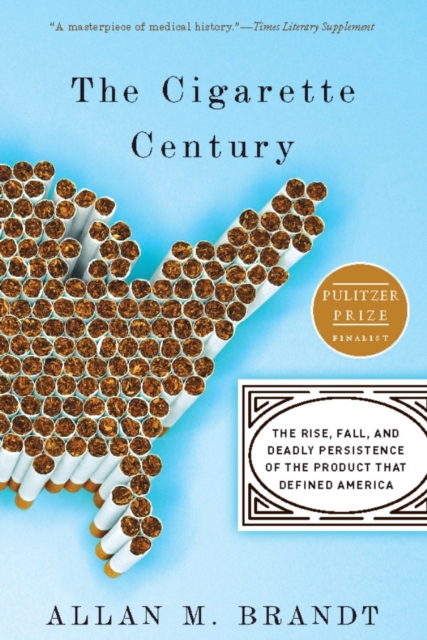
cigarette century
From agriculture to big business, from medicine to politics,The Cigarette Centuryis the definitive account of how smoking came to be so deeply implicated in our culture, science, policy, and law. No product has been so heavily promoted or has become so deeply entrenched in American consciousness.The Cigarette Centuryshows in striking detail how one ephemeral (and largely useless) product came to play such a dominant role in so many aspects of our lives-and deaths.
eBook