
Catalogue Search | MBRL


Are you sure you want to remove the book from the shelf?

{{itemTitle}}
3,062
result(s) for
"Toddlers Psychology."
Sort by:

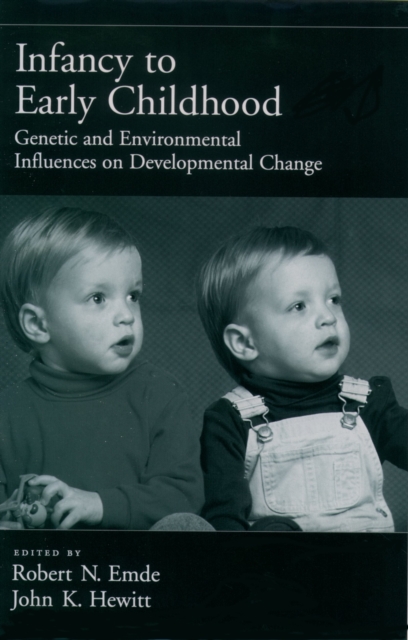
Infancy to Early Childhood
Behavioural genetics is a fast-growing, multidisciplinary field which attempts to explain the influence of genetic and environmental factors on behaviour through the lifespan. The preferred investigative technique for teasing out the differences between genetics and the environment is the longitudinal twin study. This book is the first complete publication from the MacArthur Longitudinal Twin Study (MALTS) that is by far the most ambitious and comprehensive logitudinal twin study to date. The goal of such an in-depth study was merely not to provide thorough descriptions of developmental change between the ages of one and three years, but to offer an original theoretical framework that explains how change occurs in different domains and how genetics and the environment influence those changes. In fact, this rigorous study will set the agenda for developmental psychology and behavioural genetics for decades to come.
eBook


Understanding Your One-Year-Old
Acknowledging the crucial role of relationships and parenting, Sarah Gustavus Jones offers guidance and reassurance in this sensitive exploration of the issues central to your child's developing physical and emotional needs.
eBook


Parenting cognitions → parenting practices → child adjustment? The standard model
In a large-scale (N = 317) prospective 8-year longitudinal multiage, multidomain, multivariate, multisource study, we tested a conservative three-term model linking parenting cognitions in toddlerhood to parenting practices in preschool to classroom externalizing behavior in middle childhood, controlling for earlier parenting practices and child externalizing behavior. Mothers who were more knowledgeable, satisfied, and attributed successes in their parenting to themselves when their toddlers were 20 months of age engaged in increased supportive parenting during joint activity tasks 2 years later when their children were 4 years of age, and 6 years after that their 10-year-olds were rated by teachers as having fewer classroom externalizing behavior problems. This developmental cascade of a “standard model” of parenting applied equally to families with girls and boys, and the cascade from parenting attributions to supportive parenting to child externalizing behavior obtained independent of 12 child, parent, and family covariates. Conceptualizing socialization in terms of cascades helps to identify points of effective intervention.
Journal Article

The design of childhood : how the material world shapes independent kids
\"From building blocks to city blocks, an eye-opening exploration of how children's playthings and physical surroundings affect their development. Parents obsess over their children's playdates, kindergarten curriculum, and every bump and bruise, but the toys, classrooms, playgrounds, and neighborhoods little ones engage with are just as important. These objects and spaces encode decades, even centuries of changing ideas about what makes for good child-rearing--and what does not. Do you choose wooden toys, or plastic, or, increasingly, digital? What do youngsters lose when seesaws are deemed too dangerous and slides are designed primarily for safety? How can the built environment help children cultivate self-reliance? In these debates, parents, educators, and kids themselves are often caught in the middle. Now, prominent design critic Alexandra Lange reveals the surprising histories behind the human-made elements of our children's pint-size landscape. Her fascinating investigation shows how the seemingly innocuous universe of stuff affects kids' behavior, values, and health, often in subtle ways. And she reveals how years of decisions by toymakers, architects, and urban planners have helped--and hindered--American youngsters' journeys toward independence. Seen through Lange's eyes, everything from the sandbox to the street becomes vibrant with buried meaning. Perfect for parents, educators, and anyone interested in design and architecture, [this book] will change the way you view the world--by showing it to you through children's eyes.\"--Jacket.
Book

An Expanded View of Joint Attention: Skill, Engagement, and Language in Typical Development and Autism
This study provides an expanded view of joint attention and its relation to expressive language development. A total of 144 toddlers (40 typically developing, 58 with autism spectrum disorder [ASD], 46 with developmental delay [DD]) participated at 24 and 31 months. Toddlers who screened positive for ASD risk, especially those subsequently diagnosed with ASD, had poorer joint attention skills, joint engagement during parent–toddler interaction, and expressive language. Findings highlight the dynamic relation between joint attention and language development. In the ASD and DD groups, joint engagement predicted later expressive vocabulary, significantly more than predictions based on joint attention skills. Joint engagement was most severely impacted when toddlers did not talk initially and improved markedly if they subsequently began to speak.
Journal Article

Early social-emotional development : your guide to promoting children's positive behavior
\"This book equips early childhood educators and service providers with tools to support emerging social-emotional development and positive behavior in the first five years of life. It begins by providing an overview of social-emotional development, including how this development is intertwined with other areas of growth, environmental influences, and short- and long-term child outcomes. The educator's influential role is discussed within the context of the Positive Behavioral Interventions and Supports (PBIS) framework and the Pyramid Model. Guiding principles and specific, research-based strategies for supporting children's success are presented, with numerous specific examples of how to foster healthy social-emotional development and adaptive behavior in center- and home-based settings. The final chapters discuss how teachers and service providers can overcome potential roadblocks to implementing PBIS, build and maintain positive relationships with families, and ensure good communication, consistency, and shared accountability across support networks. Included are numerous examples and vignettes, textboxes on collaborating with families, quotes from parents and educators, and supplemental exercises. These elements, along with the author's direct, user-friendly approach, make this content highly accessible for early childhood personnel seeking practical, engaging ways to support early social-emotional growth\"-- Provided by publisher.
Book
Trajectories and Predictors of Children's Early-Starting Conduct Problems: Child, Family, Genetic, and Intervention Effects
Several research teams have previously traced patterns of emerging conduct problems (CP) from early or middle childhood. The current study expands on this previous literature by using a genetically-informed, experimental, and long-term longitudinal design to examine trajectories of early-emerging conduct problems and early childhood discriminators of such patterns from the toddler period to adolescence. The sample represents a cohort of 731 toddlers and diverse families recruited based on socioeconomic, child, and family risk, varying in urbanicity and assessed on nine occasions between ages 2 and 14. In addition to examining child, family, and community level discriminators of patterns of emerging conduct problems, we were able to account for genetic susceptibility using polygenic scores and the study's experimental design to determine whether random assignment to the Family Check-Up (FCU) discriminated trajectory groups. In addition, in accord with differential susceptibility theory, we tested whether the effects of the FCU were stronger for those children with higher genetic susceptibility. Results augmented previous findings documenting the influence of child (inhibitory control [IC], gender) and family (harsh parenting, parental depression, and educational attainment) risk. In addition, children in the FCU were overrepresented in the persistent low versus persistent high CP group, but such direct effects were qualified by an interaction between the intervention and genetic susceptibility that was consistent with differential susceptibility. Implications are discussed for early identification and specifically, prevention efforts addressing early child and family risk.
Journal Article