
Catalogue Search | MBRL


Are you sure you want to remove the book from the shelf?

{{itemTitle}}
61
result(s) for
"Tombs -- America"
Sort by:

Funerary practices and models in the ancient Andes : the return of the living dead
\"This edited volume focuses on the funerary archaeology of the Pan-Andean area in the pre-Hispanic period. The contributors examine the treatment of the dead and provide an understanding of how these ancient groups coped with mortality, as well as the ways in which they strove to overcome the effects of death. The contributors also present previously unpublished discoveries and employ a range of academic and analytical approaches that have rarely--if ever--been utilised in South America before. The book covers the Formative Period to the end of the Inca Empire, and the chapters together comprise a state-of-the-art summary of all the best research on Andean funerary archaeology currently being carried out around the globe\"-- Provided by publisher.
Book

Exploring Ontologies of the Precontact Americas
Applying social theory and incorporating non-Western
perspectives in the interpretation of bioarchaeological
research
This volume demonstrates how researchers in bioarchaeology and
mortuary archaeology can work to better understand concepts of life
and death in past societies of the Indigenous Americas. Through
case studies that apply the \"ontological turn\" to human funerary
and skeletal remains, contributors set aside Western views of
reality, nature, and personhood to explore how people of various
cultures understood existence and the human body.
Contributors examine mortuary records from Inuit groups in
Labrador and Greenland, Hopewell culture in the Lower Illinois
River Valley, and Weeden Island and Puebloan traditions in the
United States Southeast and Southwest. They look at the Paquimé
community in Mexico, iconography of the Maya civilization, the
demographics of Inka populations, and an ancient village on the
Amazon River in Brazil. With attention to the viewpoints of these
cultures, these essays deconstruct the boundaries between human
remains and other interred artifacts, the living and the dead, and
other binaries rooted deeply in Western science.
Exploring Ontologies of the Precontact Americas reminds
readers that their own ontological perspectives affect how they
interpret the past. By considering diverse, non-Western worldviews
and engaging with novel social theories of the body, this volume
inspires new understandings of precontact societies.
Contributors: Gordon F. M. Rakita | Pamela
Geller | Jason L. King | Sarah Jackson | Jane Buikstra | Robert
Pickering | Peter Whitridge | John Krigbaum | Neill J. Wallis |
Adrianne Offenbecker | Avelino Gambim Júnior | Bethany L. Turner |
Mari Kleist | María Cecilia Lozada | Debra L. Martin | Kyle Waller
| James L. Fitzsimmons | J. Christina Freiberger
eBook

Death and the Classic Maya Kings
Like their regal counterparts in societies around the globe, ancient Maya rulers departed this world with elaborate burial ceremonies and lavish grave goods, which often included ceramics, red pigments, earflares, stingray spines, jades, pearls, obsidian blades, and mosaics. Archaeological investigation of these burials, as well as the decipherment of inscriptions that record Maya rulers' funerary rites, have opened a fascinating window on how the ancient Maya envisaged the ruler's passage from the world of the living to the realm of the ancestors.
Focusing on the Classic Period (AD 250-900), James Fitzsimmons examines and compares textual and archaeological evidence for rites of death and burial in the Maya lowlands, from which he creates models of royal Maya funerary behavior. Exploring ancient Maya attitudes toward death expressed at well-known sites such as Tikal, Guatemala, and Copan, Honduras, as well as less-explored archaeological locations, Fitzsimmons reconstructs royal mortuary rites and expands our understanding of key Maya concepts including the afterlife and ancestor veneration.
eBook

Tombstone cost and longevity: The San Pedro Cemetery Museum in Medellín in Colombia
Studies in the West suggest that tombstone cost is associated with longevity. The objective of this observational study was to investigate the association between tombstone cost and longevity in a large cemetery in Latin America.
Age at death was obtained from 2,273 consecutive death certificates held at the San Pedro Cemetery Museum in Medellín in Colombia. Subjects died in 2022, 2021, or 2020. Tombs are arranged in galleries in the cemetery and tombstone cost was based on the material from which the tombstone was made, its position in the gallery, and its ornamentation. Analysis of variance was used and the assumption of equal variance was not violated.
Approximately 77% of tombstones were of low cost, 21% of medium cost, and 2% of high cost. Data from 1,751 subjects were used to investigate differences in longevity according to tombstone cost while adjusting for sex, civil status, violent death, and year of death. Longevity was similar in the low-cost group and medium-cost group: 64.3 years (63.2, 65.3) versus 63.3 years (61.3, 65.3) [estimated mean (95% confidence interval)]. Longevity was lower in the high-cost group: 47.0 years (40.1, 53.9).
The inverse association between tombstone cost and longevity would suggest that people in Medellín are inclined to spend more on tombstones when commemorating the tragic death of a young person.
Journal Article

Mirrors and reflective objects at Kaminaljuyu
Slate disks have been reported from various excavations in the Maya Highlands. These artifacts have typically been described as supports or backings for iron-ore and pyrite mirrors. A number of these objects have been recovered in context at Kaminaljuyu, Guatemala. Whenever objects with reflective surfaces are identified in the field, they tend to be interpreted as mirrors, but they may have been worn as insignia on clothing. Recent finds at Kaminaljuyu, such as special deposits associated with Ballcourt B, suggest the use of reflective objects as part of the ballgame player's paraphernalia. The ballgame was an important ritual practice at Kaminaljuyu, as exemplified by the 13 ballcourts reported at the site. Archaeological evidence for this new interpretation will be presented, as well as a review of other examples excavated throughout the highlands, as part of an exploration of the exchange networks connected to regional trade in these exotic goods.
Journal Article
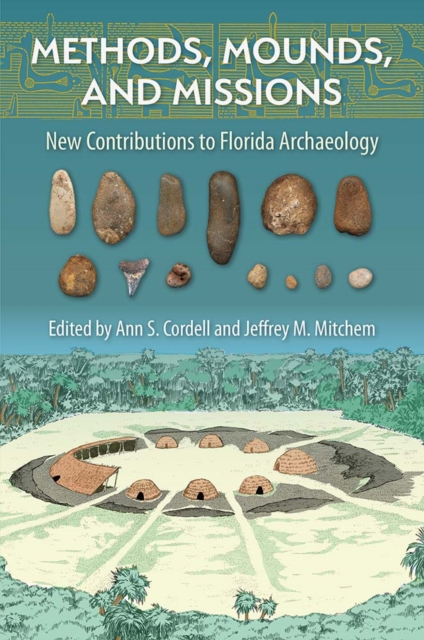
Methods, Mounds, and Missions
Offering innovative ways of looking at existing data, as well as compelling new information, about Florida's past, this volume updates current archaeological interpretations and demonstrates the use of new and improved tools to answer larger questions.
eBook

Mound Excavations at Moundville
How social and political power was wielded in order to build Moundville This work is a state-of-the-art, data-rich study of excavations undertaken at the Moundville site in west central Alabama, one of the largest and most complex of the mound sites of pre-contact North America. Despite the site's importance and sustained attention by researchers, until now it has lacked a comprehensive analysis of its modern excavations. Richly documented by maps, artifact photo-graphs, profiles of strata, and inventories of materials found, the present work explores one expression of social complexity; the significance of Moundville’s monumental architecture, including its earthen mounds; the pole-frame architecture that once occupied the summits of these mounds; and the associated middens that reveal the culture of Moundville’s elites. This book supplies a survey of important materials recovered in more than a decade of recent excavations of seven mounds and related areas under the author’s direction, as part of a long-term archaeological project consisting of new field work at the Mississippian political and ceremonial center of Moundville. Visitors to Moundville are immediately impressed with its monumentality. The expansiveness and grandness of that landscape are, of course, deliberate features that have a story to tell and this archaeological project reveals Moundville’s monumentality and its significance to the people whose capital town it was. Exactly how the social and political power symbolized by mound building was distributed is a question central to this work. It seems critical to ask to what extent this monumental landscape was the product of a chief’s ability to recruit and direct the labor of large groups of political subordinates, most of whom were presumably non-kin. At the onset of the present project, speculations regarding the paired orders of mounds and the timing of the formal structuring of space at Moundville were already suggested but were in need of further testing, confirmation, and refinement. The work reported in this volume is largely devoted to filling in such evidence and refining those initial insights. An excellent chapter by H. Edwin Jackson and Susan L. Scott, "Zooarchaeology of Mounds Q, G, E, F, and R," compliments this research. A Dan Josselyn Memorial Publication
eBook

Maize and Sociopolitical Complexity in the Ayacucho Valley, Peru
Stable isotope analysis of skeletal remains reveals that maize was the mainstay of diet in the Ayacucho Valley of Peru during two millennia of prehistory. One hundred and seven samples of collagen from 103 individuals have a mean δ13C value of
\\documentclass{aastex} \\usepackage{amsbsy} \\usepackage{amsfonts} \\usepackage{amssymb} \\usepackage{bm} \\usepackage{mathrsfs} \\usepackage{pifont} \\usepackage{stmaryrd} \\usepackage{textcomp} \\usepackage{portland,xspace} \\usepackage{amsmath,amsxtra} \\usepackage[OT2,OT1]{fontenc} \\newcommand\\cyr{ \\renewcommand\\rmdefault{wncyr} \\renewcommand\\sfdefault{wncyss} \\renewcommand\\encodingdefault{OT2} \\normalfont \\selectfont} \\DeclareTextFontCommand{\\textcyr}{\\cyr} \\pagestyle{empty} \\DeclareMathSizes{10}{9}{7}{6} \\begin{document} \\landscape $-10.2\\mbox{\\textperthousand} \\pm 1.5\\mbox{\\textperthousand} $ \\end{document}
. Samples of dental enamel from six individuals have a mean δ13C value of
\\documentclass{aastex} \\usepackage{amsbsy} \\usepackage{amsfonts} \\usepackage{amssymb} \\usepackage{bm} \\usepackage{mathrsfs} \\usepackage{pifont} \\usepackage{stmaryrd} \\usepackage{textcomp} \\usepackage{portland,xspace} \\usepackage{amsmath,amsxtra} \\usepackage[OT2,OT1]{fontenc} \\newcommand\\cyr{ \\renewcommand\\rmdefault{wncyr} \\renewcommand\\sfdefault{wncyss} \\renewcommand\\encodingdefault{OT2} \\normalfont \\selectfont} \\DeclareTextFontCommand{\\textcyr}{\\cyr} \\pagestyle{empty} \\DeclareMathSizes{10}{9}{7}{6} \\begin{document} \\landscape $-3.0\\mbox{\\textperthousand} \\pm 0.7\\mbox{\\textperthousand} $ \\end{document}
. Twelve accelerator mass spectrometry (AMS) radiocarbon dates from these skeletal remains indicate that they range in antiquity from ∼800 BC to AD ∼1100, a time span encompassing the Formative, Huarpa, and Wari periods. These stable isotope and AMS results represent the earliest securely dated evidence for maize as a dietary staple in the Central Andes. These findings indicate that maize agriculture was the economic foundation for the development of the Wari state.
Journal Article
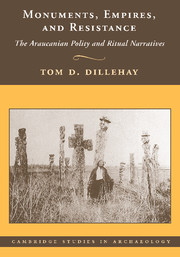
Monuments, Empires, and Resistance
From AD 1550 to 1850, the Araucanian polity in southern Chile was a center of political resistance to the intruding Spanish empire. In this 2007 book, Tom D. Dillehay examines the resistance strategies of the Araucanians and how they used mound building and other sacred monuments to reorganize their political and culture life in order to unite against the Spanish. Drawing on anthropological research conducted over three decades, Dillehay focuses on the development of leadership, shamanism, ritual, and power relations. His study combines developments in social theory with the archaeological, ethnographic, and historical records. Both theoretically and empirically informed, this book is a fascinating account of the only indigenous ethnic group to successfully resist outsiders for more than three centuries and to flourish under these conditions.
eBook

Time and Archaeological Traditions in the Lower Illinois Valley
The issue of time remains a crucial one in Lower Illinois Valley archaeology, and key problems remain unresolved. In this paper, new radiocarbon assays and published dates are used to test hypotheses concerning intra-site bluff top mound chronologies, timing and structure of valley settlement, and the emergence of regional symbolic communities during the Middle Woodland period (ca. 50 cal B.C.-cal A.D. 400). We show that within sites Middle Woodland mounds were constructed first on prominent, distal bluff ridges and subsequently in less-visible spaces, though additional dates are needed to fully understand intra-site chronology. Our analyses generally support previous studies suggesting a north-to-south settlement trajectory of the valley, though habitation site dates indicate a more complicated pattern of regional occupation that has yet to be fully explicated. In addition, floodplain regional symbolic communities also emerged along a north-to-south pattern, though not as rapidly as bluff crest mounds. Importantly, results indicate future areas of research necessary to elucidate regional chronology, resettlement of the valley, and community interactions.
Journal Article