
Catalogue Search | MBRL


Are you sure you want to remove the book from the shelf?

{{itemTitle}}
117
result(s) for
"Tombs Europe."
Sort by:

The megalithic architectures of Europe
\"Megalithic monuments are among the most striking remains of the Neolithic period of northern and western Europe and are scattered across landscapes from Pomerania to Portugal. Antiquarians and archaeologists early recognised the family resemblance of the different groups of tombs, attributing them to maritime peoples moving along the western seaways. More recent research sees them rather as the product of established early farming communities in their individual regions. Yet the diversity of the tombs, their chronologies and their varied cultural contexts complicates any straightforward understanding of their origins and distribution. Megalithic Architectures provides new insight by focusing on the construction and design of European megalithic tombs--on the tomb as an architectural project. It shows how much is to be learned from detailed attention to the stages and the techniques through which tombs were built, modified and enlarged, and often intentionally dismantled or decommissioned. The large slabs that were employed, often unshaped, may suggest an opportunistic approach by the Neolithic builders, but this was clearly far from the case. Each building project was unique, and detailed study of individual sites exposes the way in which tombs were built as architectural, social and symbolic undertakings. Alongside the manner in which the materials were used, it reveals a store of knowledge that sometimes differed considerably from one structure to another, even between contemporary monuments within a single region. The volume brings together regional specialists from Scandinavia, Germany, Britain, France, Belgium and Iberia to offer a series of uniquely authoritative studies. Results of recent fieldwork are fully incorporated and much of the material is published here for the first time in English. It provides an invaluable overview of the current state of research on European megalithic tombs\"--From publisher's website.
Book

The Megalithic Architectures of Europe
Megalithic monuments are among the most striking remains of the Neolithic period of northern and western Europe and are scattered across landscapes from Pomerania to Portugal. Antiquarians and archaeologists early recognized the family resemblance of the different groups of tombs, attributing them to maritime peoples moving along the western seaways. More recent research sees them rather as the product of established early farming communities in their individual regions. Yet the diversity of the tombs, their chronologies and their varied cultural contexts complicates any straightforward understanding of their origins and distribution. Megalithic Architectures provides new insight by focusing on the construction and design of European megalithic tombs – on the tomb as an architectural project. It shows how much is to be learned from detailed attention to the stages and the techniques through which tombs were built, modified and enlarged, and often intentionally dismantled or decommissioned. The large slabs that were employed, often unshaped, may suggest an opportunistic approach by the Neolithic builders, but this was clearly far from the case. Each building project was unique, and detailed study of individual sites exposes the way in which tombs were built as architectural, social and symbolic undertakings. Alongside the manner in which the materials were used, it reveals a store of knowledge that sometimes differed considerably from one structure to another, even between contemporary monuments within a single region. The volume brings together regional specialists from Scandinavia, Germany, Britain, France, Belgium and Iberia to offer a series of uniquely authoritative studies. Results of recent fieldwork are fully incorporated and much of the material is published here for the first time in English. It provides an invaluable overview of the current state of research on European megalithic tombs.
eBook

Neolithic Houses and Chambered Tombs of Western France
The Neolithic tombs of northern Europe have often been presented as built in the image of the hous e of the dead. We wish to discuss here the different terms of this proposition in the light of recent discoveries concerning the domestic habitat in western France, whence we draw most of the architectural examples — both funerary and domestic.
Journal Article

Poetical Dust
In the South Transept of Westminster Abbey in London, the bodies of more than seventy men and women, primarily writers, poets, and playwrights, are interred, with many more memorialized. From the time of the reburial of Geoffrey Chaucer in 1556, the space has become a sanctuary where some of the most revered figures of English letters are celebrated and remembered. Poets' Corner is now an attraction visited by thousands of tourists each year, but for much of its history it was also the staging ground for an ongoing debate on the nature of British cultural identity and the place of poetry in the larger political landscape.Thomas Prendergast's Poetical Dust offers a provocative, far-reaching, and witty analysis of Poets' Corner. Covering nearly a thousand years of political and literary history, the book examines the chaotic, sometimes fitful process through which Britain has consecrated its poetry and poets. Whether exploring the several burials of Chaucer, the politicking of Alexander Pope, or the absence of William Shakespeare, Prendergast asks us to consider how these relics attest to the vexed, melancholy ties between the literary corpse and corpus. His thoughtful, sophisticated discussion reveals Poets' Corner to be not simply a centuries-old destination for pilgrims and tourists alike but a monument to literary fame and the inevitable decay of the bodies it has both rejected and celebrated.
eBook

Bones of Contention
This book is about documenting and analyzing the living archive around the figure of Vasil Levski (1837–1873), arguably the major and only uncontested hero of the Bulgarian national pantheon. The processes described, although with a chronological depth of almost two centuries, are still very much in the making, and the living archive expands not only in size but constantly adding surprising new forms. The monograph is a historical study, taking as its narrative focus the life, death and posthumous fate of Levski. By exploring the vicissitudes of his heroicization, glorification, appropriations, reinterpretation, commemoration and, finally, canonization, it seeks to engage in several broad theoretical debates, and provide the basis for subsequent regional comparative research. The analysis of Levski's consecutive and simultaneous appropriations by different social platforms, political parties, secular and religious institutions, ideologies, professional groups, and individuals, demonstrates how boundaries within the framework of the nation are negotiated around accepted national symbols.
eBook

Assessing the quality of citizen science in archaeological remote sensing: results from the Heritage Quest project in the Netherlands
Volunteers are a key part of the archaeological labour force and, with the growth of digital datasets, these citizen scientists represent a vast pool of interpretive potential; yet, concerns remain about the quality and reliability of crowd-sourced data. This article evaluates the classification of prehistoric barrows on lidar images of the central Netherlands by thousands of volunteers on the Heritage Quest project. In analysing inter-user agreement and assessing results against fieldwork at 380 locations, the authors show that the probability of an accurate barrow identification is related to volunteer consensus in image classifications. Even messy data can lead to the discovery of many previously undetected prehistoric burial mounds.
Journal Article

At the beginnings of the funerary Megalithism in Iberia at Campo de Hockey necropolis
The excavations undertaken at the Campo de Hockey site in 2008 led to the identification of a major Neolithic necropolis in the former Island of San Fernando (Bay of Cadiz). This work presents the results of the latest studies, which indicate that the site stands as one of the oldest megalithic necropolises in the Iberian Peninsula. The main aim of this work is to present with precision the chronology of this necropolis through a Bayesian statistical model that confirms that the necropolis was in use from c. 4300 to 3800 cal BC. The presence of prestige grave goods in the earliest and most monumental graves suggest that the Megalithism phenomenon emerged in relation to maritime routes linked to the distribution of exotic products. We also aim to examine funerary practices in these early megalithic communities, and especially their way of life and the social reproduction system. As such, in addition to the chronological information and the Bayesian statistics, we provide the results of a comprehensive interdisciplinary study, including anthropological, archaeometric and genetic data.
Journal Article
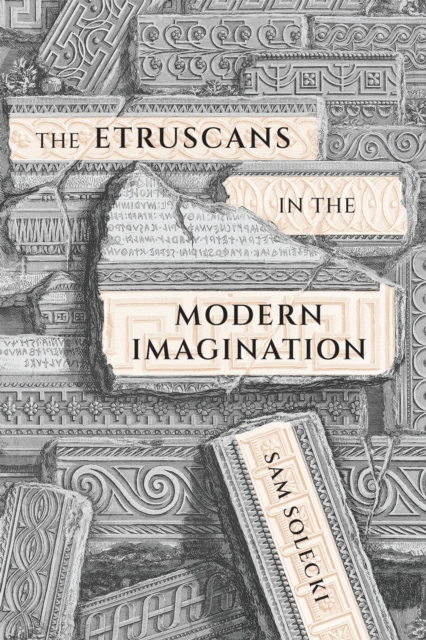
The Etruscans in the Modern Imagination
The Etruscans, a revenant and unusual people, had an Italian
empire before the Greeks and Romans did. By the start of the
Christian era their wooden temples and writings had vanished, the
Romans and the early church had melted their bronze statues, and
the people had assimilated. After the last Etruscan augur served
the Romans as they fought back the Visigoths in 408 CE, the
civilization disappeared but for ruins, tombs, art, and vases. No
other lost culture disappeared as completely and then returned to
the same extent as the Etruscans. Indeed, no other ancient
Mediterranean people was as controversial both in its time and in
posterity. Though the Greeks and Romans tarred them as
superstitious and decadent, D.H. Lawrence praised their way of life
as offering an alternative to modernity. In The Etruscans in
the Modern Imagination Sam Solecki chronicles their unexpected
return to intellectual and cultural history, beginning with
eighteenth-century scholars, collectors, and archaeologists. The
resurrection of this vanished kingdom occurred with remarkable
vigour in philosophy, literature, music, history, mythology, and
the plastic arts. From Wedgwood to Picasso, Proust to Lawrence,
Emily Dickinson to Anne Carson, Solecki reads the disembodied
traces of Etruscan culture for what they tell us about cultural
knowledge and mindsets in different times and places, for the way
that ideas about the Etruscans can serve as a reflection or foil to
a particular cultural moment, and for the creative alchemy whereby
artists turn to the past for the raw materials of contemporary
creation. The Etruscans are a cultural curiosity because of their
disputed origin, unique language, and distinctive religion and
customs, but their destination is no less worthy of our curiosity.
The Etruscans in the Modern Imagination provides a
fascinating meditation on cultural transmission between ancient and
modern civilizations.
eBook

Crop growing and gathering in the northern German Neolithic: a review supplemented by new results
New archaeobotanical results from 15 Neolithic sites in northern Germany are presented in a review of the Neolithic plant economy in northern and north-western Europe. Available archaeobotanical data from north-western Europe are evaluated and compared with our new results. In the whole region, barley and emmer were the main crops. Regional and diachronic differences are observed in the cultivation of einkorn, spelt and naked wheat. For oil plants and pulses only rare information from macro remains is available, as we mainly deal with charred material. It is noticeable that gathered plants played an important role in the Funnel Beaker economy. Plant choice, especially the relevance of cultivated versus gathered plants is discussed, based on new and existing data. Based on a structural comparison of charred plant assemblages from domestic sites and tombs, we develop a research hypothesis that settlement finds provide insight into production and consumption of food from crops, while tombs mainly yield evidence of plants gathered in the wild or in semi-wild areas in the vicinity of former settlements. Therefore, we suggest a model of different purposes and meanings of plants, depending on whether primarily an economic or a social/ritual sphere is regarded. But, for all evaluations and interpretations, it is essential to consider the taphonomic processes and conditions. Therefore, further research is necessary to verify our hypothesis, which derives from first insights into new material.
Journal Article
Archaeological mineralised textiles from the Iron Age tumulus of Creney-le-Paradis support its elite status
Looting and plough damage to the eighth–fifth centuries BC tumulus of Creney-le-Paradis, France, hinders interpretation of this potentially significant site. Nevertheless, application of novel microtomographic techniques in combination with optical and scanning electron microscopy allows the first detailed examination of 99 textile fragments recovered from the central pit. The authors argue that the diversity of textiles revealed—at least 16 different items—and the quality of weaving involved confirm earlier interpretations of the high status of this burial, which is comparable, at least in terms of textiles and metal urns, with other ‘aristocratic’ tombs of the European Iron Age.
Journal Article