
Catalogue Search | MBRL


Are you sure you want to remove the book from the shelf?

{{itemTitle}}
1,977
result(s) for
"Tonga"
Sort by:


Creating a Nation with Cloth
Tongan women living outside of their island homeland create and use hand-made, sometimes hybridized, textiles to maintain and rework their cultural traditions in diaspora. Central to these traditions is an ancient concept of homeland or nation-fonua-which Tongans retain as an anchor for modern nation-building. Utilizing the concept of the \"multi-territorial nation,\" the author questions the notion that living in diaspora is mutually exclusive with authentic cultural production and identity. The globalized nation the women build through gifting their barkcloth and fine mats, challenges the normative idea that nations are always geographically bounded or spatially contiguous. The work suggests that, contrary to prevalent understandings of globalization, global resource flows do not always primarily involve commodities. Focusing on first-generation Tongans in New Zealand and the relationships they forge across generations and throughout the diaspora, the book examines how these communities centralize the diaspora by innovating and adapting traditional cultural forms in unprecedented ways.
eBook

Early childhood development in Tonga : baseline results from the Tongan early human capability index
Offers a comprehensive assessment of early child development across Tonga using the Tongan Early Human Capability Index instrument. The data has information on more than 6,600 children, ages three to five, living across 36 inhabited islands, and reported for 129 communities. On the basis of population figures from the Tongan census data collection provided by the Tonga Department of Statistics, 81 percent of three- to five-year-olds participated in the Tongan Early Human Capability Index. The report details the development of the instrument used to collect the child development data to ensure cultural validity and local relevance, while still capturing the fundamental aspects of child development that are consistent across countries and cultures. As well as the development of the instrument, other countries will also be interested in learning about h the method of data collection across a country with remote and isolated islands using an innovative partnership between health and education. Using existing systems and community governance structures, the data was not only collected but also disseminated back to communities to raise awareness and prompt community and government mobilization to support early child development. The process of developing and implementing the Tongan Early Human Capability Index across Tonga helped build national and district capacity, and is encouraging the establishment of community-based supports for children. Researchers, policy makers, and practitioners as well as advocates for the development and enhancement of systems to monitor early child development worldwide will find this publication highly significant.
Book
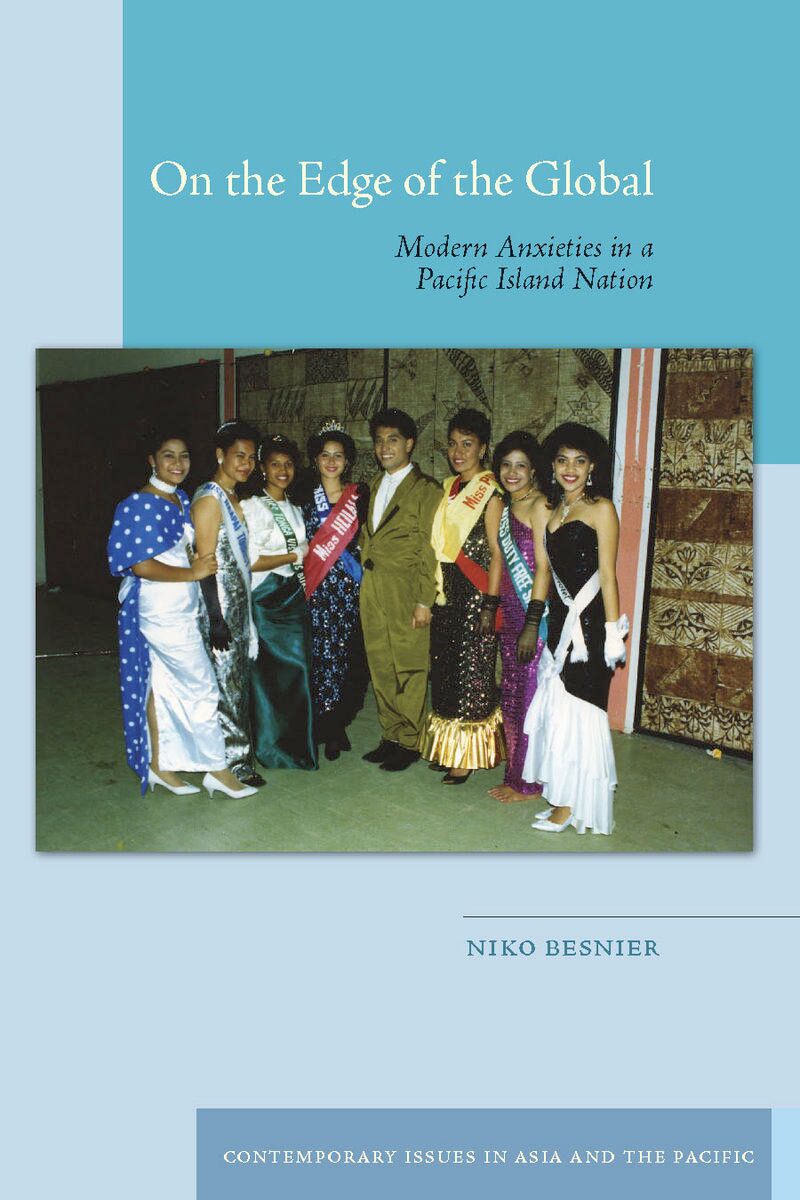
On the edge of the global : modern anxieties in a Pacific island nation
Life in twenty-first century Tonga is rife with uncertainties. Though the postcolonial island kingdom may give the appearance of stability and order, there is a malaise that pervades everyday life, a disquiet rooted in the feeling that the twin forces of \"progress\" and \"development\"—and the seemingly inevitable wealth distribution that follows from them—have bypassed the society. Niko Besnier's illuminating ethnography analyzes the ways in which segments of this small-scale society grapple with their growing anxiety and hold on to different understandings of what modernity means. How should it be made relevant to local contexts? How it should mesh with practices and symbols of tradition? In the day-to-day lives of Tongans, the weight of transformations brought on by neoliberalism and democracy press not in the abstract, but in individually significant ways: how to make ends meet, how to pay lip service to tradition, and how to present a modern self without opening oneself to ridicule. Adopting a wide-angled perspective that brings together political, economic, cultural, and social concerns, this book focuses on the interface between the different forms that modern uncertainties take.
eBook

Early childhood development in Tonga
Early Childhood Development in Tonga offers a comprehensive assessment of early child development across Tonga using the Tongan Early Human Capability Index instrument. The data has information on more than 6,600 children, ages three to five, living across 36 inhabited islands, and reported for 129 communities. On the basis of population figures from the Tongan census data collection provided by the Tonga Department of Statistics, 81 percent of three- to five-year-olds participated in the Tongan Early Human Capability Index. The report details the development of the instrument used to collect the child development data to ensure cultural validity and local relevance, while still capturing the fundamental aspects of child development that are consistent across countries and cultures. As well as the development of the instrument, other countries will also be interested in learning about h the method of data collection across a country with remote and isolated islands using an innovative partnership between health and education. Using existing systems and community governance structures, the data was not only collected but also disseminated back to communities to raise awareness and prompt community and government mobilization to support early child development. The process of developing and implementing the Tongan Early Human Capability Index across Tonga helped build national and district capacity, and is encouraging the establishment of community-based supports for children. Researchers, policy makers, and practitioners as well as advocates for the development and enhancement of systems to monitor early child development worldwide will find this publication highly significant.
eBook

Engaging environments in Tonga : cultivating beauty and nurturing relations in a changing world
\"On March 11, 2011, a tsunami warning was issued for Tonga in Polynesia. On the low and small island of Kotu, people were unperturbed in the face of impending catastrophe. The book starts out from the puzzle of peoples' responses and reactions to this warning as well as their attitudes to a gradual rise of sea level and questions why people seemed so unconcerned about this and the accompanying loss of land. The book is an ethnography of the relationship between people and their environment based on fieldwork over three decades\"-- Provided by publisher.
Book
Electromagnetic conjugacy of ionospheric disturbances after the 2022 Hunga Tonga-Hunga Ha’apai volcanic eruption as seen in GNSS-TEC and SuperDARN Hokkaido pair of radars observations
To elucidate the characteristics of electromagnetic conjugacy of traveling ionospheric disturbances just after the 15 January 2022 Hunga Tonga-Hunga Ha’apai volcanic eruption, we analyze Global Navigation Satellite System-total electron content data and ionospheric plasma velocity data obtained from the Super Dual Auroral Radar Network Hokkaido pair of radars. Further, we use thermal infrared grid data with high spatial resolution observed by the Himawari 8 satellite to identify lower atmospheric disturbances associated with surface air pressure waves propagating as a Lamb mode. After 07:30 UT on 15 January, two distinct traveling ionospheric disturbances propagating in the westward direction appeared in the Japanese sector with the same structure as those at magnetically conjugate points in the Southern Hemisphere. Corresponding to these traveling ionospheric disturbances with their large amplitude of 0.5 – 1.1 × 10¹⁶ el/m2 observed in the Southern Hemisphere, the plasma flow direction in the F region changed from southward to northward. At this time, the magnetically conjugate points in the Southern Hemisphere were located in the sunlit region at a height of 105 km. The amplitude and period of the plasma flow variation are ~ 100–110 m/s and ~ 36–38 min, respectively. From the plasma flow perturbation, a zonal electric field is estimated as ~ 2.8–3.1 mV/m. Further, there is a phase difference of ~ 10–12 min between the total electron content and plasma flow perturbations. This result suggests that the external electric field variation generates the traveling ionospheric disturbances observed in both Southern and Northern Hemispheres. The origin of the external electric field is an E-region dynamo driven by the neutral wind oscillation associated with atmospheric acoustic waves and gravity waves. Finally, the electric field propagates to the F region and magnetically conjugate ionosphere along magnetic field lines with the local Alfven speed, which is much faster than that of Lamb mode waves. From these observational facts, it can be concluded that the E-region dynamo electric field produced in the sunlit Southern Hemisphere is a main cause of the two distinct traveling ionospheric disturbances appearing over Japan before the arrival of the air pressure disturbances.
Journal Article


Oral Literature and Moral Education among the Lakeside Tonga of Northern Malawi
This is a book about the Tonga of Northern Malawi, sometimes called the Lakeshore Tonga to distinguish them from other ethnic groups with the same name further west in Central Africa. The Lakeshore Tonga were the first ethnic group to identify themselves with the Christian faith. The purpose of the research was to investigate the use of Tonga myths, folktales, proverbs and rituals for their role in Moral Education and assess and evaluate their contribution towards value formation for the youth. Each chapter in the book aims to discuss some ideas in the anthropology of religion and to illustrate them with specific case studies formed primarily through conversation with friends, both young and old, over some years.
eBook