
Catalogue Search | MBRL


Are you sure you want to remove the book from the shelf?

{{itemTitle}}
9
result(s) for
"Tonga Civilization."
Sort by:

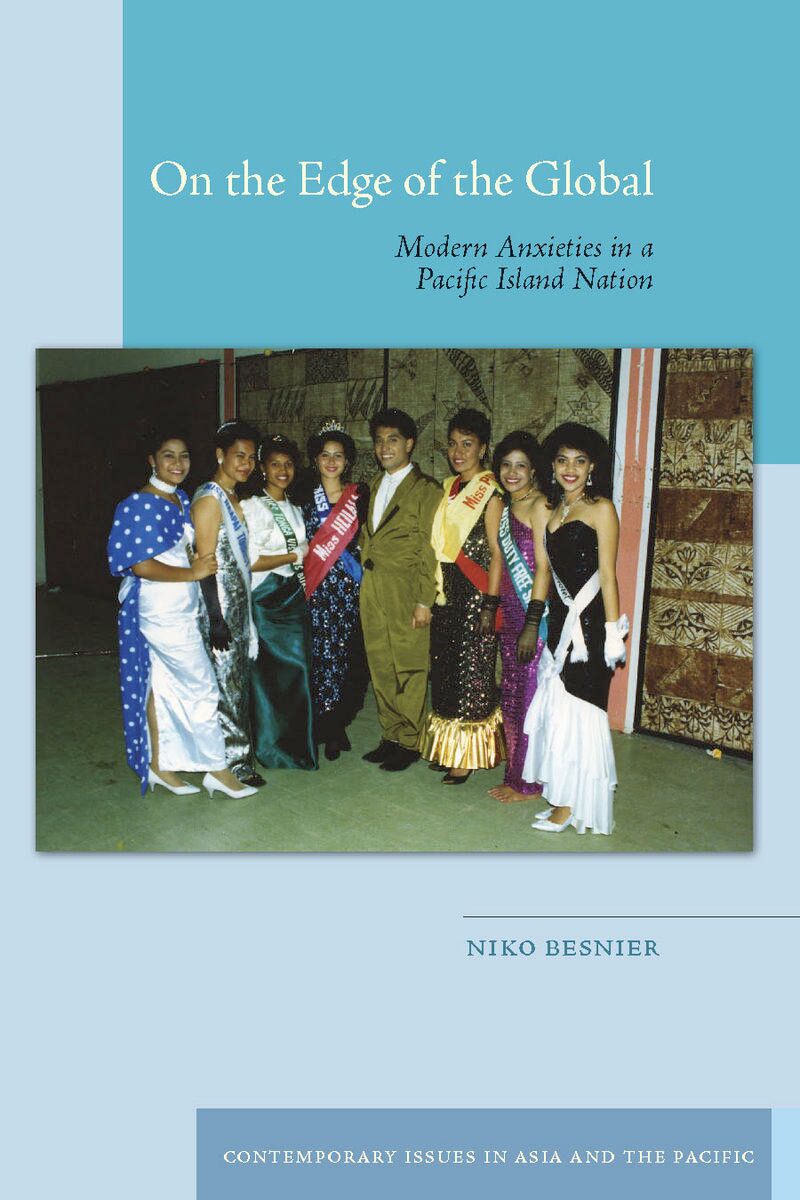
On the edge of the global : modern anxieties in a Pacific island nation
Life in twenty-first century Tonga is rife with uncertainties. Though the postcolonial island kingdom may give the appearance of stability and order, there is a malaise that pervades everyday life, a disquiet rooted in the feeling that the twin forces of \"progress\" and \"development\"—and the seemingly inevitable wealth distribution that follows from them—have bypassed the society. Niko Besnier's illuminating ethnography analyzes the ways in which segments of this small-scale society grapple with their growing anxiety and hold on to different understandings of what modernity means. How should it be made relevant to local contexts? How it should mesh with practices and symbols of tradition? In the day-to-day lives of Tongans, the weight of transformations brought on by neoliberalism and democracy press not in the abstract, but in individually significant ways: how to make ends meet, how to pay lip service to tradition, and how to present a modern self without opening oneself to ridicule. Adopting a wide-angled perspective that brings together political, economic, cultural, and social concerns, this book focuses on the interface between the different forms that modern uncertainties take.
eBook


Mortuary practices of the first Polynesians: formative ethnogenesis in the Kingdom of Tonga
Ancestral Polynesian Society has been argued to represent a formative stage in Polynesian ethnogenesis. Recently discovered human burials at the Talasiu midden site in Tonga, dating to c. 2650 cal BP, now provide the earliest known evidence for Ancestral Polynesian mortuary behaviour. This article presents and evaluates the burials, comparing archaeological evidence for Talasiu mortuary practices with those of older Lapita and more recent Tongan burials, as well as with Ancestral Polynesian Society funerary activities inferred through linguistic reconstruction. These comparisons emphasise that several socio-cultural behaviours that are important to contemporary Polynesian societies were expressed very differently in the past.
Journal Article
Prehistoric Marine Resource Use in the Indo-Pacific Regions
Although historic sources provide information on recent centuries, archaeology can contribute longer term understandings of pre-industrial marine exploitation in the Indo-Pacific region, providing valuable baseline data for evaluating contemporary ecological trends. This volume contains eleven papers which constitute a diverse but coherent collection on past and present marine resource use in the Indo-Pacific region, within a human-ecological perspective. The geographical focus extends from Eastern Asia, mainly Japan and Insular Southeast Asia (especially the Philippines) to the tropical Pacific (Micronesia, Melanesia, and Polynesia) and outlying sites in coastal Tanzania (Indian Ocean) and coastal California (North Pacific). The volume is divided thematically and temporally into four parts: Part 1, Prehistoric and historic marine resource use in the Indo-Pacific Region; Part 2, Specific marine resource use in the Pacific and Asia; Part 3, Marine use and material culture in the Western Pacific; and Part 4, Modern marine use and resource management.
eBook

Tonga Orature as Historical Record: An Afrocentric Exegesis of the Dialectics Between African Human Factor Agency and the European Enslavement of Place
The article critically examines the history of the Tonga people's experiences of civilization and displacement from their life-affirming geographical location as enunciated through their oral forms, particularly, songs and other forms of reminiscence. The experiences of the Tonga people of Zimbabwe are largely overlooked in scholarship because they are considered one of the so-called minority groups, meriting little or no attention at all. Informed by an Afrocentric approach, in which it is \"valid to posit Africa as a geographical and cultural starting base in the study of peoples [of Africa and] of African descent,\" the article brings out an understanding of African orature as a redoubtable expression of the African classical past and the subsequent subversion and decimation of African human factor agency as a result of the European enslavement of place. In this regard, the authors contend that Africologists would do well to study African people's orature, as it often reflects their story from their own perspective.
Journal Article

Voyages : from Tongan villages to American suburbs
In Voyages, Cathy A. Small offers a view of the changes in migration, globalization, and ethnographic fieldwork over three decades. The second edition shows how immigration and globalization have affected family, economy, tradition, and identity.
eBook

Colonial and Postcolonial Circumstances in the Education of Pacific Peoples
A historical dialectic exists between colonial powers and indigenous populations in the Pacific, where education is perceived by local elites and colonialists as the key to economic development. A major factor determining the nature of the present-day relation between traditional and Western forms of schooling is the actual colonial status of the population in question. In newly independent nations, indigenous forms of internal social differentiation and highly valued intellectual traditions play a significant role in shaping educational systems in a way they no longer do for peoples who have been incorporated into colonizing nations.
Journal Article

The making of a modern chiefdom state; The case of Tonga
Among the increasing number of copra traders were many Germans, and of course their colonial hope was aimed at Germany. [...]the external threats to Tonga's very young state power were already outlined: annexation by one of the then increasingly aggressive, expanding European colonial powers. After Taufa'ahau went back to Tonga, St Julian repeated his offer in a series of letters. Since the missionaries in Tonga had little experience in legal affairs, Taufa'ahau welcomed the advice. By the time of Baker's departure, the political situation in Tonga was chaotic. [...]in 1890, the copra price decreased, so the government was not able to pay its own civil servants, nor to pay off other debts. The political domain showed western modelling of kingship, law, and accompanying state government. [...]there are many examples of direct intervention in Tongan state government from the outside, when western powers decided that things were going wrong.
Journal Article