
Catalogue Search | MBRL


Are you sure you want to remove the book from the shelf?

{{itemTitle}}
30
result(s) for
"Tools, Prehistoric -- Middle East"
Sort by:

Stone tools in the Paleolithic and Neolithic near East : a guide /
\"Stone Tools in the Paleolithic and Neolithic Near East: A Guide surveys the lithic record for the East Mediterranean Levant (Lebanon, Syria, Israel, Jordan, and adjacent territories) from the earliest times to 6,500 years ago. It is intended both as an introduction to this lithic evidence for students and as a resource for researchers working with Paleolithic and Neolithic stone tool evidence. Written by a lithic analyst and professional flintknapper, this book systematically examines variation in technology, typology and industries for the Lower, Middle and Upper Paleolithic; the Epipaleolithic; and Neolithic periods in the Near East. It is extensively illustrated with drawings of stone tools. In addition to surveying the lithic evidence, the book also considers ways in which archaeological treatment of this evidence could be changed to make it more relevant to major issues in human origins research. A final chapter shows how change in stone tool designs points to increasing human dependence on stone tools across the long sweep of Stone Age prehistory\"-- Provided by publisher.
Book

Stone Tools in the Paleolithic and Neolithic Near East
Stone Tools in the Paleolithic and Neolithic Near East: A Guide surveys the lithic record for the East Mediterranean Levant (Lebanon, Syria, Israel, Jordan, and adjacent territories) from the earliest times to 6,500 years ago. It is intended both as an introduction to this lithic evidence for students and as a resource for researchers working with Paleolithic and Neolithic stone tool evidence. Written by a lithic analyst and professional flintknapper, this book systematically examines variation in technology, typology, and industries for the Lower, Middle, and Upper Paleolithic; the Epipaleolithic; and Neolithic periods in the Near East. It is extensively illustrated with drawings of stone tools. In addition to surveying the lithic evidence, the book also considers ways in which archaeological treatment of this evidence could be changed to make it more relevant to major issues in human origins research. A final chapter shows how change in stone tool designs points to increasing human dependence on stone tools across the long sweep of Stone Age prehistory.
eBook

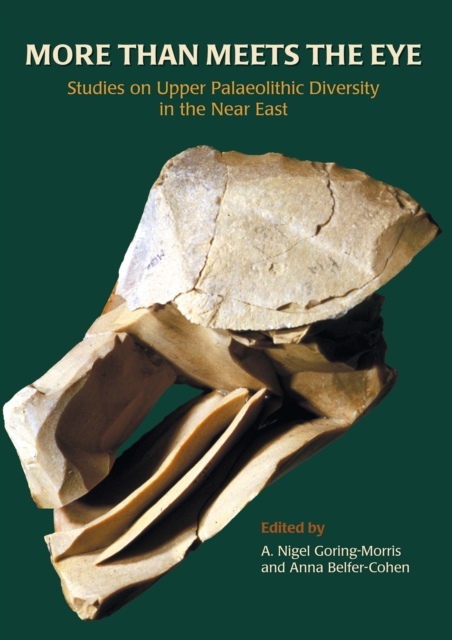
More than Meets the Eye
These twenty-three papers focus on recent research into the Upper Palaeolithic of the Levant, a murky period of human history (ca 45,000 to 20,000 years ago) during which modern patterns of human behaviour and communication became the norm. The vast majority of archaeological data from this period relates to chipped stone tools and most contributors focus on defining and distinguishing the two main traditions in lithic technology - the Levantine 'Aurignacian' and the 'Ahmarian'. Some papers report on recent fieldwork, others seek to define and explain reasons for variation and change in material culture. Do lithic traditions represent different corporate groups of hunter-gatherers, or can variation be explained by other factors, such as adaptations to local landscapes and environments or changing patterns of mobility? An appendix provides a comprehensive list of available Upper Palaeolithic 14C dates in the Near East. Most of the papers derive from a conference session on the Levantine Upper Palaeolithic, held as part of the Society for American Archaeology annual meeting in 2000.
eBook

On Variability and Complexity
A century of research has led to the recognition of multiple levels of technological variability in the Levantine Middle Paleolithic (MP) that cannot be resolved through single-cause explanatory models. Recent ecological models argue for continual occupation of the region and competitive coexistence of Neanderthal and modern human populations. Current paleogenetic studies underline the feasibility of the latter scenario. The Levantine MP offers a perspective on the interface of historical circumstances and long-term evolutionary mechanisms that structured in-tandem trajectories of technological and behavioral changes as well as insights into the dynamics of nondirectional behavioral complexities in the archaeological record.
Journal Article

The Southern Route \Out of Africa\: Evidence for an Early Expansion of Modern Humans into Arabia
The timing of the dispersal of anatomically modern humans (AMH) out of Africa is a fundamental question in human evolutionary studies. Existing data suggest a rapid coastal exodus via the Indian Ocean rim around 60,000 years ago. We present evidence from Jebel Faya, United Arab Emirates, demonstrating human presence in eastern Arabia during the last interglacial. The tool kit found at Jebel Faya has affinities to the late Middle Stone Age in northeast Africa, indicating that technological innovation was not necessary to facilitate migration into Arabia. Instead, we propose that low eustatic sea level and increased rainfall during the transition between marine isotope stages 6 and 5 allowed humans to populate Arabia. This evidence implies that AMH may have been present in South Asia before the Toba eruption (1).
Journal Article

Neanderthal Shell Tool Production: Evidence from Middle Palaeolithic Italy and Greece
The vast majority of tools recovered from Palaeolithic sites are made of stone varieties. Only rarely do non-lithic implements come to light, let alone tools produced on marine mollusc shell. Interestingly, a good number of shell implements made on Callista chione and Glycymeris sp. valves have been reported from 13 Middle Palaeolithic (Mousterian) sites in southern peninsular Europe. Of these, more than 300 specimens display evidence of deliberate edge retouch. They are all considered products of Neanderthals and date from ∼110 ka BP to perhaps ∼50 ka BP. In this paper, we review the evidence for Mousterian shell tool production in Italy and Greece—the only two countries in which such tools have been securely identified—and present experimental results obtained in the effort to understand the production process and typo-functional role(s) of the artefacts. We examine the general provisioning pattern of raw materials, as well as the typological, species-related and chronological data pertinent to the production of shell tools by Neanderthals. The data suggest that the Mousterian shell scrapers are a response to poor availability of lithic raw material in the areas of occurrence, and may be best described as an extension of chipped stone technologies to specific types of marine shell, their form defined by an existing mental template. As such, they constitute evidence for refined adaptation strategies and advanced provisioning of resources amongst Neanderthals, and may lend further support to the idea that these hominids displayed a degree of complex behaviour.
Journal Article
Tree-Felling, Woodworking, and Changing Perceptions of the Landscape during the Neolithic and Chalcolithic Periods in the Southern Levant
Examination of 206 Neolithic and Chalcolithic bifaces from the southern Levant revealed that changes in form during the emergence of agropastoralism correlated with evolving land use practices, but new biface types also expressed altered social identities and perceptions of the environment. Nonfunctional groundstone pre-pottery Neolithic A (PPNA) bifaces seem to have served as social and status symbols, while flaked flint PPNAtranchetaxes and chisels were used for carpentry rather than tree-felling. This pattern continued during the following early pre-pottery Neolithic B (EPPNB) period, but a new sharpening method, polishing, was used on a unique flint tranchet ax to strengthen its edge. By the MPPNB and LPPNB, heavier polished flint axes were used to clear forests for fields, grazing lands, wood fuel, and lumber. Sustainable forest management continued until the cumulative effects of tree-felling may have led to landscape degradation at the end of the PPNC. Adzes replace axes as heavy woodworking tools during the pottery Neolithic A (PNA) period, but by the PNB period, once again there are more carpentry tools than tree-felling bifaces. The trend is reversed again during the Chalcolithic, when the demand for fire wood, lumber, and cleared land seems to have increased during a time of emerging socioeconomic complexity.
Journal Article

The Nordic razor and the Mycenaean lifestyle
The bronze razor with the horse-head handle appeared in Scandinavia in the fifteenth century BC. Where did it come from and what did it mean? The author shows that the razor had some antecedents in the Aegean, although none of these objects were imported to the north. He argues that the Scandinavian warrior class consciously adopted elements of the Mycenaean warrior package, including a clean-shaven face. This vividly exposes new aspects of the busy and subtle nature of international communication in the Bronze Age.
Journal Article

The Magnitude of a Practice: Collection and Recycling of Patinated ‘Old’ Flint Items During the Levantine Late Lower Paleolithic
This study examines the prevalent practice of recycling patinated flint tools (“double patina”) of 18 lithic assemblages from three Late Lower Paleolithic sites in Israel. Determined as recycled from ‘old’ patinated items using visual observation, these tools, bearing both old, patinated surfaces and new modifications, offer insights into lithic strategies, cultural behaviors, and memory preservation. The study shows that the collection and recycling of ‘old’ patinated items into new tools was ubiquitously practiced, ranging from 41% at Late Acheulian Jaljulia and 11–17% at Acheulo-Yabrudian Qesem Cave. Two main recycling methods were identified, with variations across sites reflecting diverse cultural norms and functional needs (Type A–B). The type-B recycling trajectory was found to be the most prominent, as it prioritizes the preservation of the tool’s original appearance, patinated surfaces, and old scars. Following these features, the study additionally suggests that type-B recycling likely stemmed from necessity, cultural preferences, and a choice to connect with the past and preserve it, thus emphasizing the complex interplay of practicality, culture, and memory in the Late Lower Paleolithic period.
Journal Article