
Catalogue Search | MBRL


Are you sure you want to remove the book from the shelf?

{{itemTitle}}
1,641
result(s) for
"Torture -- United States"
Sort by:


Transnational Torture
Evidence of torture at Abu Ghraib prison in Iraq and harsh interrogation techniques at Guantanamo Bay beg the question: has the war on terror forced liberal democracies to rethink their policies and laws against torture? Transnational Torture focuses on the legal and political discourses on torture in India and the United States--two common-law based constitutional democracies--to theorize the relationship between law, violence, and state power in liberal democracies.Analyzing about one hundred landmark Supreme Court cases on torture in India and the United States, memos and popular imagery of torture, Jinee Lokaneeta compellingly demonstrates that even before recent debates on the use of torture in the war on terror, the laws of interrogation were much more ambivalent about the infliction of excess pain and suffering than most political and legal theorists have acknowledged. Rather than viewing the recent policies on interrogation as anomalous or exceptional, Lokaneeta effectively argues that efforts to accommodate excess violence--a constantly negotiated process--are long standing features of routine interrogations in both the United States and India, concluding that the infliction of excess violence is more central to democratic governance than is acknowledged in western jurisprudence.
eBook

Civilizing torture : an American tradition
\"The pilgrims and merchants who first came to America from Europe professed an intention to create a society free of the barbarism of Old World tyranny and New World savagery. But over the centuries Americans have turned to torture during moments of crisis at home and abroad and have debated its legitimacy in defense of law and order. From the Indian wars to Civil War POW prisons and early penitentiaries, from \"the third degree\" in police stations and racial lynchings to the War on Terror, US institutions have proven to be far more amenable to torture than the nation's professed commitment to liberty would suggest. Legal and racial inequality fostered many opportunities for state agents to wield excessive power, which they justified as essential for American safety and well-being. Reconciling state violence with the aspirations of Americans for social and political justice is an enduring challenge. By tracing the historical debates about the efficacy of torture and the attempt to adapt it to democratic values, Civilizing Torture reveals the recurring struggle to decide what limits Americans are willing to impose on the power of the state. At a time of escalating rhetoric aimed at cleansing the nation of the undeserving, as well as ongoing military involvement in conflicts around the world, the debate over torture remains a critical and unresolved part of America's tradition.\"-- Provided by publisher
Book

Torture, Intelligence and Sousveillance in the War on Terror
Torture, Intelligence and Sousveillance in the War on Terror examines the communication battles of the Bush and Blair political administrations (and those of their successors in America and Britain) over their use of torture, first-hand or second-hand, to gain intelligence for the War on Terror. Exploring key agenda-building drivers that exposed the torture-intelligence nexus and presenting detailed case studies of key media events from the UK and USA, this insightful volume exposes dominant political discourses on the torture-for-intelligence policy. Whether in the form of unauthorized leaks, official investigations, investigative journalism, real-time reporting, or Non-Governmental Organisation activity, this timely study evaluates various modes of resistance to governments' attempts at strategic political communication, with particular attention to 'sousveillance': community-based recording from first-person perspectives. A rigorous exposition of the power-knowledge relationships constituting the torture-intelligence nexus, which re-evaluates agenda-building models in the digital age and assesses the strength of the public sphere across the Third, Fourth and Fifth Estates, Torture, Intelligence and Sousveillance in the War on Terror will appeal to scholars across the social sciences with interests in media and communication, sociology and social theory, politics and political communication, international relations, and journalism.
eBook

How the gloves came off : lawyers, policy makers, and norms in the debate on torture
\"The treatment of detainees at Abu Ghraib prison, Guantánamo Bay, and far-flung CIA 'black sites' after the attacks of 9/11 included cruelty that defied legal and normative prohibitions in U.S. and international law. The antitorture stance of the United States was brushed aside. Since then, the guarantee of American civil liberties and due process for POWs and detainees has grown muddled, threatening the norms that sustain modern democracies. 'How the Gloves Came Off' considers the legal and political arguments that led to this standoff between civility and chaos and their significant consequences for the strategic interests and standing of the United States. Unpacking the rhetoric surrounding the push for unitary executive action in wartime, 'How the Gloves Came Off' traces the unmaking of the consensus against torture. It implicates U.S. military commanders, high-level government administrators, lawyers, and policy makers from both parties, exposing the ease with which powerful actors manipulated ambiguities to strip detainees of their humanity. By targeting the language and logic that made torture thinkable, this book shows how future decision makers can craft an effective counternarrative and set a new course for U.S. policy toward POWs and detainees. Whether leaders use their influence to reinforce a prohibition of cruelty to prisoners or continue to undermine long-standing international law will determine whether the United States retains a core component of its founding identity.\"--Provided by publisher.
Book

Understanding torture
Prohibiting torture will not end it. In Understanding Torture, John T. Parry explains that torture is already a normal part of the state coercive apparatus. Torture is about dominating the victim for a variety of purposes, including public order; control of racial, ethnic, and religious minorities; and— critically—domination for the sake of domination. Seen in this way, Abu Ghraib sits on a continuum with contemporary police violence in U.S. cities; violent repression of racial minorities throughout U.S. history; and the exercise of power in a variety of political, social, and interpersonal contacts. Creating a separate category for an intentionally narrow set of practices labeled and banned as torture, Parry argues, serves to normalize and legitimate the remaining practices that are \"not torture.\" Consequently, we must question the hope that law can play an important role in regulating state violence. No one who reads this book can fail to understand the centrality of torture in modern law, politics, and governance.
eBook

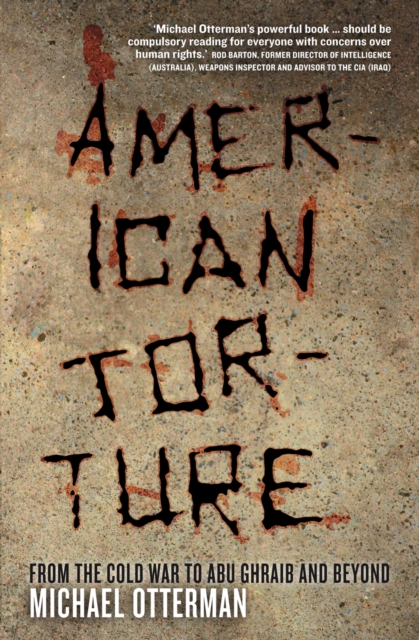
American torture : from the Cold War to Abu Ghraib and beyond
George W. Bush calls them an 'alternative set of procedures', vital tools needed 'to protect the American people and our allies'. American Torture reveals how torture became standard practice in today's War on Terror. 'Tools' including being forced standing for up to forty hours, sleep deprivation for weeks on end and dousing naked prisoners with ice are undeniably torture, and they are used by the United States of America. Long before Abu Ghraib became a household name, the US military and CIA used torture with impunity at home and abroad. Billions of dollars were spent during the Cold War studying, refining, then teaching these techniques to American interrogators and to foreign officers charged with keeping Communism at bay. This book writes the history of these methods and their invention and adoption by US military personnel.
eBook

Torture, terror, and trade-offs : philosophy for the White House
\"Torture, Terror, and Trade-offs Jeremy Waldron has been a challenging and influential voice in the moral, political and legal debates surrounding the response to terrorism since 9/11. His contributions have spanned the major controversies of the War on Terror including the morality and legality of torture, whether security can be 'balanced' with liberty, and the relationship between public safety and individual rights. He has also tackled underlying questions essential to understanding the practical debates - including what terrorism is, and what a right to security would entail. This volume collects all Waldron's work on these issues, including six published essays and two previously unpublished essays. It also includes a new introduction in which Waldron presents an overview of his contribution, and looks at the problems currently facing the Obama administration and the UK Government in dealing with the legacy of the Bush White House. The volume will be essential reading for all those engaged with contemporary politics, security law, and the continuing struggle for an ethical response to terrorism\"-- Provided by publisher.
Book

Rendition to Torture
Universally condemned and everywhere illegal, torture goes on in democracies as well as in dictatorships. Nonetheless, many Americans were surprised following the attacks of 9/11 at how easily the United States embraced torture as well as the supposedly lesser evil of cruel, inhuman, and degrading treatment. Nothing seemed extreme when it came to questioning real and imagined terrorists. Extraordinary rendition-sending people captured in the \"war on terror\" to nations long counted among the world's worst human rights violators-hid from the public eye cruel and bloody interrogations. \"Torture lite\" or \"torture without marks\" became the norm for those in American custody.InRendition to Torture, Alan W. Clarke explains how the United States adopted torture as a matter of official policy; how and why it turned to extraordinary rendition as a way to outsource more extreme, mutilating forms of torture; and outlines the steps the United States took to hide its abuses. Many adverse consequences attended American use of torture. False information gleaned from torture was used to justify the Iraq war, adding potency to the charge that the war was illegal under international law. Moreover, European nations and Canada aided, abetted, and became thoroughly enmeshed in U.S.-led torture and renditions, thereby spreading both the problem and the blame for this practice. Clarke offers an extended critique of these activities, placing them in historical and legal context as well as in transnational and comparative perspective.
eBook