
Catalogue Search | MBRL


Are you sure you want to remove the book from the shelf?

{{itemTitle}}
18
result(s) for
"Toynbee, Arnold, 1889-1975"
Sort by:

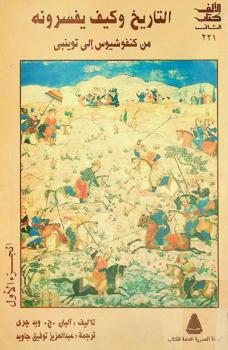
المذاهب الكبرى في التاريخ من كونفوشيوس إلى توينبي
ما هي طبيعة التاريخ البشري؟ وما هو مغزاه أو مغازيه إذا كان له ثمة من مغزى؟ إن اليان ويدجيري يبحث في هذا الكتاب مذاهب التاريخ الكبرى منذ العصور القديمة حتى أيامنا محاولا أن يجيب على ذلك. فهذا الكتاب يقدم نظرة كاملة لمختلف المذاهب التي اعتنت بتفسير التاريخ، إنطلاقا من أمهات كتب الحكمة الصينية والهندوكية، وكبار فلاسفة اليونان والعصور الوسطى، ومن النهضة إلى نظريات القرن التاسع عشر الكبرى. وفضلا عن أهمية هذا الكتاب الفكرية في الأوساط الفكرية العالمية، فان المكتبة العربية ما زالت تفتقر لا إلى مثل هذا الكتاب فحسب، وإنما إلى معالجة فكرة التاريخ وتفسيره نفسها.
BOOK

'Time of Troubles': Arnold J. Toynbee's twentieth century
Arnold J. Toynbee (1889–1975) has long been neglected or discounted by scholars of international relations and historians of international thought. Yet his contributions to International Affairs, as well as his Surveys of international affairs and his A study of history demonstrate both his capacity for acute interpretation of contemporary events and the depth of his learning about past international societies. This article examines his analysis of mid-twentieth century international relations, that 'Time of Troubles' which he believed would only be escaped through a recovery of 'creativity' and profound change in the ways in which world politics were practised. It explores the foundations of his approach to the field, demonstrated both in his Surveys of international affairs and his twelve volume magnum opus, A study of history, as well as his essays in journals. It analyses his diagnosis of the causes of our contemporary 'Time of Troubles', in the light of past episodes in world history Toynbee thought analogous to that present condition of international relations. And it traces his retreat from political solutions to the challenges faced in the twentieth century and his movement towards religious responses as a putative alternative. It concludes by arguing that Toynbee deserves recognition, not simply as a pioneering world historian or a controversial interpreter of the politics of the Middle East, but as an acute commentator on the international relations of a troubled age.
Journal Article

President's Address: Toynbee as Environmental Historian
McNeill argues that Arnold J. Toynbee (1889-1975) ought to be counted among the environmental history's first practitioners. Toynbee primarily focused on the rise and fall of civilizations and was known for his drive to globalize the study of history. The historian frequently incorporated geography and climate as well as politics and economics into his analyses of historical change. Here, he suggests that although obscured by his own ponderousness and pretentiousness, and the enormity of his output, Toynbee pointed the way to environmental history. Moreover, he challenges historians to reconsider the origins of their field and to broaden the spectrum of who and what makes history environmental.
Journal Article

Community Resilience and the Cosmopolitan Role in the Environmental Challenge-Response Novels of Ghosh, Grace, and Sinha
Murphy discusses three key components: resilience, cosmopolitanism, and challenge-response. The designation of the texts considered are--Patricia Grace's Potiki , Amitav Ghosh's The Hungry Tide, and Indra Sinha's Animal's People--as challenge-response novels is loosely based on Arnold Toynbee's theory of the rise and fall of civilizations. Here, he revises Toynbee's concept, however, by focusing on the orientation that he took regarding the minorities within a society, which leads to a focus on microsocial units of local communities, whose actions Toynbee envisioned as being the key factor in whether a society would evolve into a civilization, collapse, or decay. Unlike Toynbee, he views cultural integrity as an important issue in the challenge-response model because the general inhabitability of the biosphere is threatened by an economic drive toward global homogeneity and attendant loss of biotic diversity.
Journal Article

Debates with Toynbee: Herzog, Talmon, Friedman
The article focuses on three separate debates held between Arnold Toynbee and Yaacov Talmon, Yaacov Herzog, and Isaiah Friedman. Unlike the first two, who argued with Toynbee in general terms over his evaluation of the Jewish people and Zionism, Isaiah Friedman's debate with Toynbee was held on different grounds and along other lines. Friedman's debate was not ideological, but professional, academic, historical, and based upon diplomatic documents as his chief tools. He aimed to undermine the historical claims made by a great historian who had also filled a marginal role in the process of shaping the new Middle East after the First World War.
Journal Article

Regret
In the autobiography of the historian Arnold Toynbee, the author discussed his choice at sixteen to give up mathematics altogether and spend the time saved from it on reading Greek and Latin literature more widely. Calculus, even a taste of it, would have given him an important and illuminating additional outlook on the Universe, whereas, by the time at which the choice was presented to him, he had already gone far enough in Latin and Greek to have been able to go farther with them unaided.
Journal Article

Toynbee and Ibn Khaldun
A restricted examination of the relationship between Arnold Toynbee's \"A Study of History\" and Ibn Khaldun's \"Muqaddima\" provides a framework for thinking about a range of important issues in Islamic history.
Journal Article
Arnold Toynbee: Pro-Arab or Pro-Zionist?
Arnold J. Toynbee favored Zionism early in the 20th century, but changed his mind by the early 1950s. He originally felt propaganda promoted by the Western powers would help the world accept establishing a nation for Jews. Toynbee did not allow his political beliefs to interfere with personal friendships.
Journal Article
