
Catalogue Search | MBRL


Are you sure you want to remove the book from the shelf?

{{itemTitle}}
85
result(s) for
"Tractor trailer combinations."
Sort by:


Simulation Analysis of the Semi-Trailer Steered Wheels Control Algorithm
As part of improving road safety around trucks, a solution was proposed to reduce the swept path width of a moving tractor–semi-trailer. This article presents a mathematical analysis of the movement of a tractor unit with a traditional semi-trailer with fixed axles and steered wheels. A simulation analysis of both presented vehicles was carried out. The core of the algorithm controlling the steering angle of the semi-trailer wheels is presented. The influence of controlling the semi-trailer’s swivel wheels on the swept path width of a tractor–trailer with a semi-trailer equipped with swivel wheels is discussed. The assumptions for building the control algorithm are presented. The article presents the advantages of the solution used along with the control algorithm. Measurable benefits resulting from the use of the presented solution are presented, such as increasing cargo space, reducing cargo transport costs, and reducing aerodynamic resistance and fuel consumption. It is worth emphasizing that reducing fuel consumption is very important because it reduces the emission of harmful exhaust gases into the atmosphere. The swept path width is important especially in the case of vehicles moving in a limited area, for example in the parking lots of transhipment and logistics centers, between urban buildings. Vehicles admitted to traffic meet the minimum conditions imposed by homologation regulations, but reducing the swept path width allows for improving the operational properties of the tractor–semi-trailer. The use of the proposed control algorithm to control the turn of the semi-trailer’s steered wheels brings tangible benefits both in improving road safety and in reducing the emission of harmful substances into the environment.
Journal Article

Big rigs : a first look
\"Big rigs can have eighteen wheels, sometimes more! With all the goods they carry around, they have to be big. Full-color photographs and leveled text give readers a peek inside these huge vehicles\"-- Provided by publisher.
BOOK

High-speed lateral stability and trajectory tracking performance for a tractor-semitrailer with active trailer steering
An active trailer steering (ATS) controller is investigated to improve the lateral stability and trajectory tracking performance of the tractor-semitrailer. First of all, a linear yaw-roll dynamic model of the tractor-semitrailer with steerable trailer wheels is established, and the model accuracy is verified. Then a linear quadratic regulator (LQR) for actively steering the trailer’s wheels is designed. For the LQR controller, the lateral acceleration and the sideslip angle at the center of gravity (CG) of the trailer are taken as the optimization objectives, and the steering angle of the wheel on the middle axle of the trailer is set as the control input. Finally, the effectiveness of the designed controller is tested based on the co-simulation platform under the single lane-change (SLC) maneuver at the speed of 100 km/h and the double lane-change (DLC) maneuver at the speed of 80 km/h and 88km/h. Research results show that under the high-speed SLC maneuver, the designed LQR controller can significantly improves the lateral stability and trajectory tracking performance of the trailer, and cannot affect apparently the trajectory and dynamic responses of the tractor. Under the high-speed DLC maneuver, the designed controller can still make the tractor-semitrailer reach a new steady state in a short time, and improve the vehicle lateral stability and the trajectory tracking performance of the trailer at the same time.
Journal Article
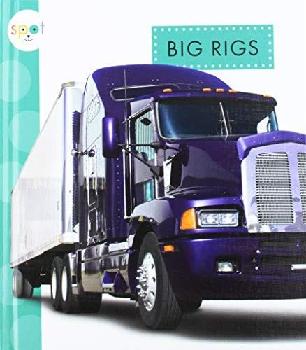
Big rigs
\"This search-and-find book invites early readers to look for new vocabulary words and pictures while giving simple facts about semi trucks and how they are used to haul deliveries across the country\"--Provided by publisher.
Book

Branch-and-Price-and-Cut for the Truck-and-Trailer Routing Problem with Time Windows
In this paper, we present a new branch-and-price-and-cut algorithm to solve the truck-and-trailer routing problem with time windows (TTRPTW) and two real-world extensions. In all TTRPTW variants, the fleet consists of one or more trucks that may attach a trailer. Some customers are not accessible with a truck-and-trailer combination, but can however be serviced by one if the trailer is previously detached and parked at a suitable location. In the first extension, the planning horizon comprises two days and customers may be visited either on both days or only once, in which case twice the daily supply must be collected. The second extension incorporates load transfer times depending on the quantity moved from a truck to its trailer. The exact branch-and-price-and-cut algorithm for the standard variant and the two new extensions is based on a set-partitioning formulation in which columns are routes describing the movement of a truck and its associated trailer. Linear relaxations of this formulation are solved by column generation where new routes are generated with a dynamic programming labeling algorithm. The effectiveness of this pricing procedure can be attributed to the adaptation of techniques such as bidirectional labeling, the
ng
-neighborhood, and heuristic pricing using dynamically reduced networks and relaxed dominance. The cutting component of the branch-and-price-and-cut adds violated subset-row inequalities to strengthen the linear relaxation. Computational studies show that our algorithm outperforms existing approaches on TTRP and TTRPTW benchmark instances used in the literature.
The online appendix is available at
https://doi.org/10.1287/trsc.2017.0765
.
Journal Article

On-Road Measurements and Modelling of Disc Brake Temperatures and Brake Wear Particle Number Emissions on a Heavy-Duty Tractor Trailer
In this paper, results are presented for an on-road measurement campaign for measuring the brake wear particles of disc brakes on a heavy-duty tractor trailer during the EU P012101 Pilot Project funded by the European Parliament. A novel approach was adopted using a fully open sampling system with minimal influence on air flow around the brake and brake disc temperatures. Models for brake disc heating and cooling were developed, as well as a model for the particle number emissions. It was concluded that brake wear emissions per kilometre were the highest on urban roads and the lowest on the motorway. Furthermore, when modelling heating during braking actions, the best results were seen when introducing dependencies on both the braking work and initial brake temperatures. When modelling the brake cooling, a non-linear dependence on the difference between the brake disc temperature and ambient air temperature was empirically observed. For the particle number emissions, a relationship was established between the braking work applied to the disc during the braking action and the particle number emissions of the braking action.
Journal Article

Numerical Investigation on Handling Stability of a Heavy Tractor Semi-Trailer under Crosswind
Due to the large lateral area of the trailer and variable road conditions, the handling stability of a heavy tractor semi-trailer under crosswind is very important for road safety. In this present work, numerical simulation is performed to study the crosswind effects on handling stability of a tractor semi-trailer. The aerodynamic characteristics of the tractor semi-trailer under different crosswind were computed by computational fluid dynamics (CFD). Then, mathematical models to reveal the relationship between the aerodynamic forces and crosswind were constructed to serve as inputs of the multi-body dynamics to analyze the handling stability under crosswind. The performance of crosswind stability is evaluated by the response of lateral acceleration, yaw rate and the lateral displacement. The lateral acceleration and yaw rate were decreased by a maximum of 14.6% and 16.5% compared to the truck without the deflector, which showed that the crosswind aerodynamics and stability were obviously improved.
Journal Article

Review of the U.S. Department of Energy's Heavy Vehicle Technologies Program
As national priorities have been focused both on reducing fuel consumption and improving air quality, attention has increased on reducing emissions from many types of vehicles, including light-duty, medium-duty, and heavy-duty diesel-powered vehicles. Meeting the recently promulgated (and proposed) emission standards and simultaneously increasing fuel economy will pose especially difficult challenges for diesel-powered vehicles and will require the development of new emission-reduction technologies.
In response to a request from the director of OHVT, the National Research Council formed the Committee on Review of DOE's Office of Heavy Vehicle Technologies to conduct a broad, independent review of its research and development (R&D) activities.
eBook

Review of the U. S. Department of Energy's Heavy Vehicle Technologies Program
As national priorities have been focused both on reducing fuel consumption and improving air quality, attention has increased on reducing emissions from many types of vehicles, including light-duty, medium-duty, and heavy-duty diesel-powered vehicles.
eBook