
Catalogue Search | MBRL


Are you sure you want to remove the book from the shelf?

{{itemTitle}}
20,477
result(s) for
"Trade secrets."
Sort by:

Top secret science in transportation
\"Automobile companies and the military must keep secret the development of cutting-edge transportation technology to stay one step ahead of competitors and enemies. Readers will love this awesome book which describes car labs where researchers develop the latest super-secret models, and how technology experts in the military develop new ways for vehicles to go undetected.\"--Provided by publisher.
Book

Trade Secrets Law and Corporate Disclosure: Causal Evidence on the Proprietary Cost Hypothesis
This study exploits the staggered adoption of the inevitable disclosure doctrine (IDD) by U.S. state courts as an exogenous shock that generates variations in the proprietary costs of disclosure. We find that firms respond to IDD adoption by reducing the level of disclosure regarding their customers' identities, supporting the proprietary cost hypothesis. Our results are stronger for firms in industries with a higher degree of entry threats, for firms in more volatile industries, and for firms with a lower degree of external financing dependence. Overall, this study represents one of the first efforts in identifying the causal effect of proprietary costs of disclosure on the supply of disclosure.
Journal Article


Defining Trade Secrets in the United States: Past and Present Challenges – A Way Forward?
When approaching an analysis of a particular area of law, one must initially locate and understand the definition of its core concept. Yet in trade secret law serious obstacles impede the process. Unlike other intellectual property (IP) regimes, such as copyright and patent law, the core concepts of which are subject to unitary definitions governed by international treaties or domestic statutes, the trade secret concept has received no parallel treatment and, until recently in the United States, remained mainly defined under common law. Subtle differences in the way trade secrets were judicially conceived often generated conflicts between courts, opening the door for the application of divergent rules on similar points. This confusing background prompted the individual U.S. jurisdictions to gradually orient towards implementing statutory provisions in defining trade secrets. Despite the fact that U.S. trade secret law has since seen several statutory interventions at state and federal level, the precise meaning and definitional parameters of the concept remain elusive. This paper probes the existing trade secret definitions applicable in the U.S. via analysis of the divergent sources of law that underscored their formulation from the past until the present and identifies the challenges pertinent to their application in practice. Its aim is to analyze and compare these legal sources: first, to determine whether the current definition for the concept of a trade secret is adequate, or whether perhaps the existence of the multi-tier system impedes a party’s ability to identify trade secrets in a cross-border context; and second, to investigate whether a unanimously accepted definition under a pre-emptive statute complementary to one under an elaborated internationally binding treaty might remedy this issue.
Journal Article
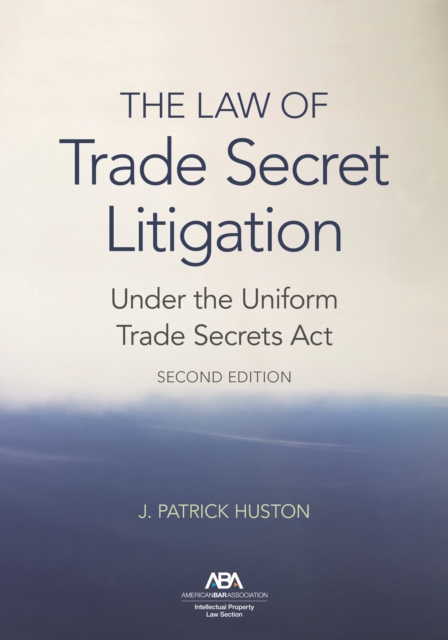
The Law of Trade Secret Litigation under the Uniform Trade Secrets Act, Second Edition
Includes online access to more than 7,500 pages of case synopses.Out-of-state cases under the Uniform Trade Secrets Act (UTSA) can help win UTSA cases, and courts are frequently required to consider out-of-state UTSA cases in state UTSA actions and in federal actions under the Defend Trade Secrets Act, where UTSA claims are often asserted. But finding out-of-state UTSA cases supporting one's claims can be daunting.This updated edition makes out-of-state UTSA cases readily accessible by analyzing all of the first 40 years of state and federal UTSA published cases (1979–2018) from the 49 UTSA adopting states, which discuss three important issues:Is the information at issue a trade secret under the UTSA?Did the defendant’s conduct constitute trade secret misappropriation under the UTSA?Is the plaintiff entitled to an injunction, damages, and/or attorney’s fees under the UTSA?The comprehensive analysis is accompanied by a clear synthesis of the UTSA case law determining the three trade secret issues above, as well as online synopses of each of the UTSA cases, organized by the type of the alleged trade secret (software, customer list, etc.), the industry involved (software, medical, etc.), and whether the trade secret owner won or lost.The Law of Trade Secret Litigation Under the Uniform Trade Secrets Act, Second Edition is a \"must-have\" resource for trade secret litigators seeking the best published cases supporting their UTSA claims, and for others seeking to better understand UTSA case law.Praise for The Law of Trade Secret Litigation Under the Uniform Trade Secrets Act\"I recently discovered one most impressive publication on trade secrets law entitled The Law of Trade Secret Litigation Under the Uniform Trade Secrets Act by J. Patrick Huston. The academic effort to compile this treatise far surpasses research and resources on UTSA law and case law developments. But it is much more than a treatise or a collection of trade secret cases. It is a trade secret litigator's guide to case law and analysis on the three overriding substantive issues in trade secret litigation: (1) is the information at issue a trade secret under the UTSA; (2) did the defendant’s conduct constitute misappropriation under the UTSA, and (3) what are the appropriate remedies for misappropriation under the UTSA.This will be a go-to resource for developing federal law under the new Defend Trade Secrets Act which became effective on May 11, 2016 because the DTSA builds upon the UTSA. Trade secret litigators and Judges can now readily access and cite leading UTSA cases in emergency trade secret lawsuits by immediate reference to earlier analogous trade secret decisions readily accessible (organized by both state and type of trade secret). As a trade secret litigator and a professor teaching trade secret law for the past 23 years, I highly recommend the purchase of this phenomenal publication on trade secrets law.\"-- R. Mark Halligan, FisherBroyles, Co-author of the Defend Trade Secrets Act of 2016 Handbook
eBook
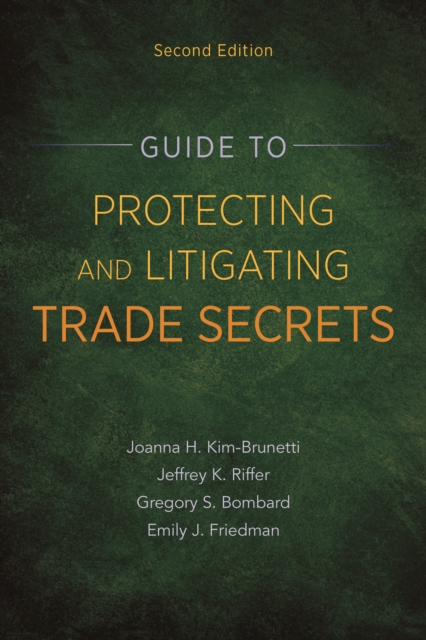
Guide to protecting and litigating trade secrets
Trade secrets are of great and increasing importance to the U.S. economy, representing the vast majority of U.S. intellectual property. Corporations spend billions of dollars to protect their trade secrets, but with data breaches on the rise, the scenario of the ever-increasing threats to trade secret protection is bleaker than ever. Because of this, trade secret litigation is increasing at a phenomenal rate. As a result of the ever-increasing number of trade secret lawsuits, litigants have paid and juries have awarded hundreds of millions—even billions—of dollars. This book is intended to help business executives and in-house counsel take control of and protect what may be their business's most valuable asset—its trade secrets. In addition to a broader, more academic look at trade secret law, the book also draws on current, real-life examples of trade secret nightmares and the litigation experience of its primary authors to provide practical advice to the business owner, small legal department or firm, and solo practitioner.
eBook

Trade secret laws and initial public offering underpricing
This paper examines the impact of trade secret laws on the underpricing of initial public offerings (IPOs) in the United States, where we focus on the Uniform Trade Secret Act and/or the inevitable disclosure doctrine. Given that trade secret laws help firms protect their know-how in the form of trade secrets, we propose that trade secrets protected by these laws may result in increased corporate opacity, leading to greater IPO underpricing. Empirically, the average first-day returns of IPOs in states with trade secret laws are 12.7% higher than those in states without such laws. Using the information disclosed in the 10-K report on whether the firm owns trade secrets, we suggest that the existence of trade secret laws enhances the protection effect of firm maintenance of trade secrets, which leads to greater IPO underpricing. Further analyses show that the effect of trade secret laws is reinforced for IPO firms operating in complex industries, IPO firms with R&D investments, and large IPO firms, suggesting that trade secret laws increase the difficulties investors face in assessing the intrinsic value of such firms.
Journal Article

Trade Secrets
During the first decades of America's existence as a nation, private citizens, voluntary associations, and government officials encouraged the smuggling of European inventions and artisans to the New World. At the same time, the young republic was developing policies that set new standards for protecting industrial innovations. This book traces the evolution of America's contradictory approach to intellectual property rights from the colonial period to the age of Jackson.
During the seventeenth and early eighteenth centuries Britain shared technological innovations selectively with its American colonies. It became less willing to do so once America's fledgling industries grew more competitive. After the Revolution, the leaders of the republic supported the piracy of European technology in order to promote the economic strength and political independence of the new nation. By the middle of the nineteenth century, the United States became a leader among industrializing nations and a major exporter of technology. It erased from national memory its years of piracy and became the world's foremost advocate of international laws regulating intellectual property.
eBook

Bidirectional Privacy Preservation in Web Services
In web-based services, users are often required to submit personal data, which may be shared with third parties. Although privacy regulations mandate the disclosure of intended recipients in privacy policies, this does not fully alleviate users’ privacy concerns. The presence of a privacy policy does not ensure compliance, since users must assess the trustworthiness of all parties involved in data sharing. On the other hand, service providers want to minimize the costs associated with preserving user privacy. Indeed, service providers may have their own privacy preservation requirements, such as hiding the identities of third-party suppliers. We present a novel framework designed to tackle the dual challenges of bidirectional privacy preservation and cost-effectiveness. Our framework safeguards the privacy of service users, providers, and various layers of intermediaries in data-sharing environments, while also reducing the costs incurred by service providers related to data privacy. This combination makes our solution a practical choice for web services. We have implemented our solution and conducted a performance analysis to demonstrate its viability. Additionally, we prove its privacy and security within a Universal Composability (UC) framework.
Journal Article