
Catalogue Search | MBRL


Are you sure you want to remove the book from the shelf?

{{itemTitle}}
1,305
result(s) for
"Traditional ecological knowledge."
Sort by:


Cultural Forests of the Amazon
Cultural Forests of the Amazon is a comprehensive and diverse account of how indigenous people transformed landscapes and managed resources in the most extensive region of tropical forests in the world. Until recently, most scholars and scientists, as well as the general public, thought indigenous people had a minimal impact on Amazon forests, once considered to be total wildernesses. William Balée’s research, conducted over a span of three decades, shows a more complicated truth. In Cultural Forests of the Amazon , he argues that indigenous people, past and present, have time and time again profoundly transformed nature into culture. Moreover, they have done so using their traditional knowledge and technology developed over thousands of years. Balée demonstrates the inestimable value of indigenous knowledge in providing guideposts for a potentially less destructive future for environments and biota in the Amazon. He shows that we can no longer think about species and landscape diversity in any tropical forest without taking into account the intricacies of human history and the impact of all forms of knowledge and technology. Balée describes the development of his historical ecology approach in Amazonia, along with important material on little-known forest dwellers and their habitats, current thinking in Amazonian historical ecology, and a narrative of his own dialogue with the Amazon and its people.
eBook


Confronting biopiracy
'Biopiracy' refers either to the unauthorised extraction of biological resources, such as plants with medicinal properties, and associated traditional knowledge from indigenous peoples and local communities, or to the patenting of spurious 'inventions' based on such knowledge or resources without compensation. Biopiracy cases continue to emerge in the media and public eye, yet they remain the source of considerable disagreement, confusion, controversy and grief. The aim of this book is to provide the most detailed, coherent analysis of the issue of biopiracy to date.
The book synthesises the rise of the issue and increasing use of the term by activists and negotiators in the World Trade Organization (WTO) and the Convention on Biological Diversity (CBD), to form a critical understanding of the themes, implications and politics of biopiracy. Taking a case-study based approach, derived from interviews and fieldwork with researchers, government, industry, local farmers, healers and indigenous people, the author sequentially documents events that have occurred in biopiracy and bioprospecting controversies. Implications and ethical dilemmas are explored, particularly relating to work with local communities, and the power relations entailed. Detailing international debates from the WTO, CBD and other fora in an accessible manner, the book provides a unique overview of current institutional limitations and suggests ways forward. Options and solutions are suggested which are relevant for local communities, national governments, international negotiators, NGO and interest groups, researchers and industry.
eBook

Traditional ecological knowledge : learning from indigenous practices for environmental sustainability
This book examines the importance of Traditional Ecological Knowledge (TEK) and how it can provide models for a time-tested form of sustainability needed in the world today. The essays, written by a team of scholars from diverse disciplinary backgrounds, explore TEK through compelling cases of environmental sustainability from multiple tribal and geographic locations in North America and beyond. Addressing the philosophical issues concerning indigenous and ecological knowledge production and maintenance, they focus on how environmental values and ethics are applied to the uses of land. Grounded in an understanding of the profound relationship between biological and cultural diversity, this book defines, interrogates, and problematizes, the many definitions of traditional ecological knowledge and sustainability. It includes a holistic and broad disciplinary approach to sustainability, including language, art, and ceremony, as critical ways to maintain healthy human-environment relations.
Book

Revenant Ecologies
Engaging a broad spectrum of ecological thought to
articulate the ethical scale of global extinction
As global rates of plant and animal extinctions mount, anxieties
about the future of the earth's ecosystems are fueling ever more
ambitious efforts at conservation, which draw on Western scientific
principles to manage species and biodiversity. In Revenant
Ecologies , Audra Mitchell argues that these responses not only
ignore but also magnify powerful forms of structural violence like
colonialism, racism, genocide, extractivism, ableism, and
heteronormativity, ultimately contributing to the destruction of
unique life forms and ecosystems.
Critiquing the Western discourse of global extinction and
biodiversity through the lens of diverse Indigenous philosophies
and other marginalized knowledge systems, Revenant
Ecologies promotes new ways of articulating the ethical
enormity of global extinction. Mitchell offers an ambitious
framework-(bio)plurality-that focuses on nurturing unique,
irreplaceable worlds, relations, and ecosystems, aiming to
transform global ecological-political relations, including through
processes of land return and critically confronting discourses on
\"human extinction.\"
Highlighting the deep violence that underpins ideas of
\"extinction,\" \"conservation,\" and \"biodiversity,\" Revenant
Ecologies fuses political ecology, global ethics, and violence
studies to offer concrete, practical alternatives. It also
foregrounds the ways that multi-life-form worlds are actively
defying the forms of violence that drive extinction-and that shape
global efforts to manage it.
Retail e-book files for this title are screen-reader
friendly with images accompanied by short alt text and/or extended
descriptions.
eBook

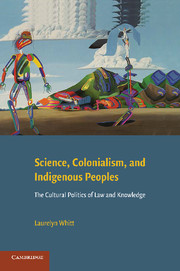
Science, Colonialism, and Indigenous Peoples
At the intersection of indigenous studies, science studies, and legal studies lies a tense web of political issues of vital concern for the survival of indigenous nations. Numerous historians of science have documented the vital role of late-eighteenth- and nineteenth-century science as a part of statecraft, a means of extending empire. This book follows imperialism into the present, demonstrating how pursuit of knowledge of the natural world impacts, and is impacted by, indigenous peoples rather than nation-states. In extractive biocolonialism, the valued genetic resources, and associated agricultural and medicinal knowledge, of indigenous peoples are sought, legally converted into private intellectual property, transformed into commodities, and then placed for sale in genetic marketplaces. Science, Colonialism, and Indigenous Peoples critically examines these developments, demonstrating how contemporary relations between indigenous and Western knowledge systems continue to be shaped by the dynamics of power, the politics of property, and the apologetics of law.
eBook


Traditions, Traps and Trends
The transfer of knowledge is a key issue in the North as Indigenous Peoples meet the ongoing need to adapt to cultural and environmental change. In eight essays, experts survey critical issues surrounding the knowledge practices of the Inuit of northern Canada and Greenland and the Northern Sámi of Scandinavia, and the difficulties of transferring that knowledge from one generation to the next. Reflecting the ongoing work of the Research Group Circumpolar Cultures, these multidisciplinary essays offer fresh understandings through history and across geography as scholars analyze cultural, ecological, and political aspects of peoples in transition. Traditions, Traps and Trends is an important book for students and scholars in anthropology and ethnography and for everyone interested in the Circumpolar North. Contributors: Cunera Buijs, Frédéric Laugrand, Barbara Helen Miller, Thea Olsthoorn, Jarich Oosten, Willem Rasing, Kim van Dam, Nellejet Zorgdrager
eBook