
Catalogue Search | MBRL


Are you sure you want to remove the book from the shelf?

{{itemTitle}}
96
result(s) for
"Trail of Tears"
Sort by:


Their Determination to Remain
The remarkable story of a North Carolina Cherokee
community who avoided forced removal on the Trail of
Tears During the 1838 forced Cherokee removal by
the US government, a number of close-knit Cherokee communities in
the Southern Appalachian Mountains refused to relinquish their
homelands, towns, and way of life. Using a variety of tactics,
hundreds of Cherokees avoided the encroaching US Army and
remained in the region. In his book
Their Determination to Remain: A Cherokee Community’s
Resistance to the Trail of Tears in North Carolina, Lance
Greene explores the lives of wealthy plantation owners Betty and
John Welch who lived on the southwestern edge of the Cherokee
Nation. John was Cherokee and Betty was White. Although few
Cherokees in the region participated in slavery, the Welches held
nine African Americans in bondage. During removal, the Welches
assisted roughly 100 Cherokees hiding in the steep mountains.
Afterward, they provided land for these Cherokees to rebuild a
new community, Welch’s Town. Betty became a wealthy and
powerful plantation mistress because her husband could no longer
own land. Members of Welch’s Town experienced a
transitional period in which they had no formal tribal government
or clear citizenship yet felt secure enough to reestablish a
townhouse, stickball fields, and dance grounds. Greene’s
innovative study uses an interdisciplinary approach,
incorporating historical narrative and archaeological data, to
examine how and why the Welches and members of Welch’s Town
avoided expulsion and reestablished their ways of life in the
midst of a growing White population who resented a continued
Cherokee presence. The Welch strategy included Betty’s
leadership in demonstrating outwardly their participation in
modern Western lifestyles, including enslavement, as John
maintained a hidden space—within the boundaries of their
land—for the continuation of traditional Cherokee cultural
practices.
Their Determination to Remain explores the complexities
of race and gender in this region of the antebellum South and the
real impacts of racism on the community.
eBook

Trail of tears
This title examines the events leading up to the removal of the Cherokee from their native lands, the suffering endured on the Trail of Tears, and the struggles they faced once reaching their new land in present-day Oklahoma. The book also includes information about the Cherokee nation today.
Book

From Federal Indian Law to Indigenous Rights: Legal Discourse and the Contemporary Native American Novel on the Indian Removal
My contrapuntal readings of the indigenous rights debates that took place in the United Nations in the 1990s and two Native American historical novels on the Indian Removal published in the United States around the same time reveal that Native American literary production has been deeply inflected by the law. Robert Conley's Mountain Windsong: A Novel of the Trail of Tears (1992) needs to be read as a critique of the idea that Native American rights can be secured from within the United States' legal order. Through the jarring juxtaposition of historical legal documents and a romantic plot, the novel deconstructs the idea of domestic law as an agent of change and introduces the language of human rights as an alternative normative framework for Native resistance. Diane Glancy's Pushing the Bear: A Novel of the Trail of Tears (1996) engages with a question that figured prominently in the debates about indigenous rights, namely whether these rights can be realized within the context of a human rights regime that puts the individual center stage. On closer scrutiny, the novel opens up an alternative way of thinking about the relationship between individual and group rights. It thereby contributes to closing the theoretical gap between individual and group rights, which stymied indigenous rights debates considerably.
Journal Article
The Trail of Tears
The Removal of the Five Tribes from what is now the Southeastern part of the United States to the area that would become the state of Oklahoma is a topic widely researched and studied. In this annotated bibliography, Herman A. Peterson has gathered together studies in history, ethnohistory, ethnography, anthropology, sociology, rhetoric, and archaeology that pertain to the Removal. The focus of this bibliography is on published, peer-reviewed, scholarly secondary source material and published primary source documents that are easily available.
The period under closest scrutiny extends from the passage of the Indian Removal Act in 1830 to the end of the Third Seminole War in 1842. However, works directly relevant to the events leading up to the Removal, as well as those concerned with the direct aftermath of Removal in Indian Territory, are also included.This bibliography is divided into six sections, one for each of the tribes, as well as a general section for works that encompass more than one tribe or address Indian Removal as a policy. Each section is further divided by topic, and within each section the works are listed chronologically, showing the development of the literature on that topic over time. The Trail of Tears: An Annotated Bibliography of Southeastern Indian Removal is a valuable resource for anyone researching this subject.
eBook

Epistolary Estrangement: Mission, Marriage, and Missives in the Cherokee Nation
This essay uses an epistolary studies framework to examine the correspondence of Ann Paine with a male administrator of the American Board of Commissioners of Foreign Missions. Over the course of 1819-1820, Paine used letters to secure a position as a missionary in the Cherokee Nation. Missionary service enabled her to separate from her husband while retaining custody of her children and maintaining her public identity as a pious Christian woman. Testing the limits of marriage through the possibilities opened up to white women by global evangelical movements, this exchange demonstrates the unique flexibility of the letter as an exploratory space to navigate and renegotiate larger questions of personal agency in relation to social institutions. Because historians have used Paine's writings describing her time in the Cherokee Nation as primary sources for their work on the pivotal period preceding the Trail of Tears, her epistolary archive bears significance in understanding the gendered efficacy of letter writing, the fluidity and constraints of marriage, and white women's early engagements with globalized Protestant missionary causes.
Journal Article

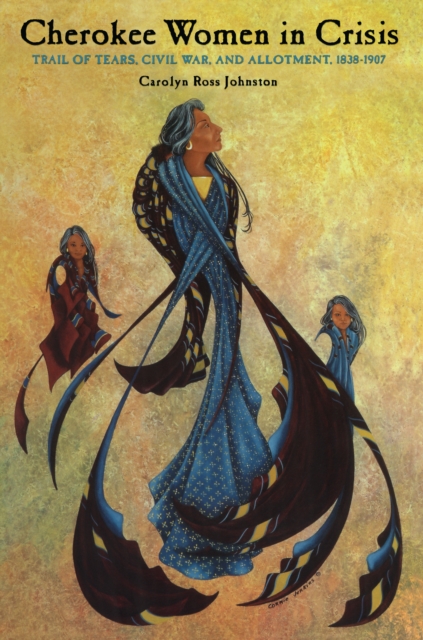
Cherokee women in crisis: Trail of Tears, Civil War, and allotment, 1838-1907
Explains how traditional Cherokee women's roles were destabilized, modified, recovered, and in some ways strengthened during three periods of great turmoil.American Indian women have traditionally played vital roles in social hierarchies at the family, clan, and tribal levels. In the Cherokee Nation, specifically, women and men are considered equal contributors to the culture. With this study, however, we learn that three key historical events in the 19th and early 20th centuries-removal, the Civil War, and allotment of their lands-forced a radical renegotiation of gender roles and relations in Cherokee society.Carolyn Johnston (who is related to John Ross, principal chief of the Nation) looks at how Cherokee women navigated these crises in ways that allowed them to retain their traditional assumptions, ceremonies, and beliefs and to thereby preserve their culture. In the process, they both lost and retained power. The author sees a poignant irony in the fact that Europeans who encountered Native societies in which women had significant power attempted to transform them into patriarchal ones and that American women struggled for hundreds of years to achieve the kind of equality that Cherokee women had enjoyed for more than a millennium.Johnston examines the different aspects of Cherokee women's power: authority in the family unit and the community, economic independence, personal autonomy, political clout, and spirituality. Weaving a great-grandmother theme throughout the narrative, she begins with the protest of Cherokee women against removal and concludes with the recovery of the mother town of Kituwah and the elections of Wilma Mankiller and Joyce Dugan as principal chiefs of the Cherokee Nation and the Eastern Band of Cherokees.
eBook

The Legal Ideology of Removal
This study is the first to show how state courts enabled the mass expulsion of Native Americans from their southern homelands in the 1830s. Our understanding of that infamous period, argues Tim Alan Garrison, is too often molded around the towering personalities of the Indian removal debate, including President Andrew Jackson, Cherokee leader John Ross, and United States Supreme Court Justice John Marshall. This common view minimizes the impact on Indian sovereignty of some little-known legal cases at the state level.
Because the federal government upheld Native American self-dominion, southerners bent on expropriating Indian land sought a legal toehold through state supreme court decisions. As Garrison discusses Georgia v. Tassels (1830), Caldwell v. Alabama (1831), Tennessee v. Forman (1835), and other cases, he shows how proremoval partisans exploited regional sympathies. By casting removal as a states' rights, rather than a moral, issue, they won the wide support of a land-hungry southern populace. The disastrous consequences to Cherokees, Creeks, Choctaws, Chickasaws, and Seminoles are still unfolding.
Important in its own right, jurisprudence on Indian matters in the antebellum South also complements the legal corpus on slavery. Readers will gain a broader perspective on the racial views of the southern legal elite, and on the logical inconsistencies of southern law and politics in the conceptual period of the anti-Indian and proslavery ideologies.
eBook

The Routledge Introduction to Native American Literature
This Introduction makes available for student, instructor, and aficionado a refined set of tools for decolonizing our approaches prior to entering the unfamiliar landscape of Native American literatures. This book will introduce indigenous perspectives and traditions as articulated by indigenous authors whose voices have been a vital, if often overlooked, component of the American dialogue for more than 400 years. Paramount to this consideration of Native-centered reading is the understanding that literature was not something bestowed upon Native peoples by the settler culture, either through benevolent interventions or violent programs of forced assimilation. Native literature precedes colonization, and Native stories and traditions have their roots in both the precolonized and the decolonizing worlds. As this far-reaching survey of Native literary contributions will demonstrate, almost without fail, when indigenous writers elected to enter into the world of western letters, they did so with the intention of maintaining indigenous culture and community. Writing was and always remains a strategy for survival.
eBook