
Catalogue Search | MBRL


Are you sure you want to remove the book from the shelf?

{{itemTitle}}
404
result(s) for
"Trajan"
Sort by:


PLINY, TRAJAN AND THE INTRODUCTION OF THE ISELASTICVM FOR VICTORIOUS ATHLETES
In two letters, Pliny and Trajan discuss a petition sent to the governor by the guild of athletes concerning their rewards after winning contests (Plin. Ep. 10.118–19). In his request, Pliny refers to a regulation by which Trajan had settled the rights of the victorious athletes in regard to their home cities. In his response, Trajan repeats the case with slight variations. The two letters pose both philological and historical difficulties, which this article aims to solve. The relevant passage in Trajan's letter is corrupt. As scholarship has misunderstood the historical background of the letters, no satisfying solution for the restoration of the text has been found to date. The argumentation of this article is twofold. First, it offers a new reading of the corrupt passage in the emperor's letter which respects both the textual transmission and the historical situation. Second, it is argued that the two letters refer to a Trajanic law which settled the regulations of iselastic contests for the first time, but left some details undecided. In sum, this article proposes a new reading of a damaged passage in Plin. Ep. 10.119 as well as offering a historical commentary on agonistic activities in imperial Asia Minor.
Journal Article
TRAJAN’S NOSE: ANTHOLOGIA PALATINA 11.418 AND PLUTARCH’S REGVM ET IMPERATORVM APOPHTHEGMATA 172E
Anth. Pal. 11.418 is traditionally attributed to Trajan. The distich mocks a man’s large nose and is a typical example of a scoptic epigram. Even though the attribution to Trajan looks suspicious, scholarship has been inclined to accept his authorship. However, it is possible that the poem was written about the emperor instead, which would also explain the misattribution. This hypothesis, if correct, sheds light on the surprising opening anecdote of Plutarch’s Regum et imperatorum apophthegmata (172E), which is dedicated to Trajan.
Journal Article
TWO NOTES ON AURELIUS VICTOR'S LIBER DE CAESARIBVS (10.5 LAVTVSQVE AND 13.3 SATISQVE)
At Aur. Vict. Caes. 10.5, the reading lautus should be retained; -que is a dittography and should be deleted. At 13.3, satis should be emended into sagatis. This article also provides a brief analysis of Victor's references to clothing and attempts to explain why he comments on the Dacian costume at 13.3, the only ethnographic reference to clothing in the entire work.
Journal Article

Rome Fellowships: Villa pulcherrima imminet litori: maritime villas, ports and Africa Proconsularis in Trajan's Mediterranean politics
Imperial villas, far from being just luxurious leisurely retreats or mere locales for conspicuous consumption, played a crucial role in the daily life of the Roman imperial court, as emerges from a wealth of archaeological, epigraphic and literary evidence. My doctoral research (Oxford, 2022) examined the use of imperial villas as centres for the government of the empire, and investigated the extent to which the activities that emperors performed in fulfilment of their role impacted on the design of the spaces allocated to them (reception halls, entertainment buildings, bathing facilities and dining halls).
Journal Article

Rome's zenith commemorated
Following four centuries of Roman expansion, the Emperor Trajan led the Empire to its greatest extent by annexing Dacia (Transylvania), north-western Arabia and Sinai and, briefly, all of Armenia and Mesopotamia. He bolstered imperial administration, reformed provincial government, clarified certain principles of justice and encouraged a system of welfare, the alimenta (Bennett 2001). Last year, 2017, was the nineteen-hundredth anniversary of Trajan's death. The occasion was marked in various ways across Europe, and the opportunity to reflect on Trajan's legacy was particularly poignant in view of the continent's present troubles.
Journal Article

A Tripod ‘Worth Seeing’ in the Olympieion at Athens (Paus. 1.18.8)
This study proposes a new reconstruction of the tripod that Pausanias (1.18.8) recorded in the Olympieion at Athens. According to his brief description, the bronze tripod was supported by Persians made from Phrygian marble. A sculptor's sketch found during the excavations of the Athenian Agora is identified as a representation of that monument. The sketch, carved from poros limestone, depicts a standing male figure dressed in eastern attire supporting the foot of a tripod. The figural type finds its closest parallels among the colossal statues from the Forum of Trajan in Rome, suggesting a new date and context for the monument in the Olympieion. The scenario favoured here is that the tripod was dedicated following Trajan's victories in Parthia, perhaps completed or commissioned by Hadrian. Cassius Dio (68.17.2) records that Trajan departed for his Parthian campaigns from Athens, where memories of Persian defeat were actively curated.
Journal Article
Divine Representation in Documentary Style: Gods on the Columns of Trajan and Marcus Aurelius
This article examines the important roles played by gods in the friezes of the Columns of Trajan and Marcus Aurelius and argues that they are treated in a distinctive ‘documentary’ style, comparable in certain ways to accounts of divine action in Roman historiography and designed to produce a compelling narrative effect. First, the Columns and the deities they depict are discussed. The article then looks at cognate descriptions of gods in historiographical texts. Finally, other contemporary monuments that portray the gods are briefly examined to bring out further the distinctive character of the gods on the Columns. This analysis will be seen to have wider implications for our understanding of ‘historical narrative reliefs’ and imperial representation.
Journal Article

Dalmatians and Dacians—Forms of Belonging and Displacement in the Roman Empire
Inspired by the catalyst papers, this essay traces the impact of displacement on existing and emerging identities of groups and individuals which were relocated to ‘frontier’ areas in the aftermath of conflict and conquest by Rome during the reign of emperor Trajan. The Dacian Wars, ending in 106 CE with the conquest of Dacia by Roman armies, not only resulted in the deliberate destruction of settlements and the society of the conquered, but also the removal of young Dacian men by forced recruitment into the Roman army, some serving the emperor in the Eastern Egyptian Desert. In turn, the wealth in gold and silver of the newly established Roman province of Dacia was exploited by mining communities arriving from Dalmatia. As a result of these ‘displacements’ caused by war and the shared experience of mining in the remote mountains of Dacia or guarding roads through the desert east of the Nile, we can trace the emergence of new senses of belonging alongside the retainment of fixed group identities.
Journal Article
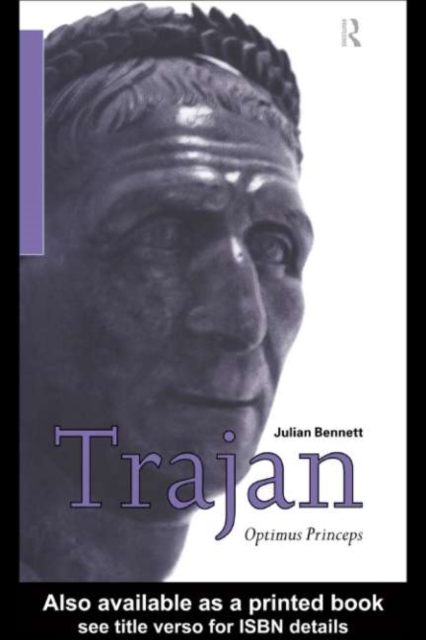
Trajan
Did Trajan really deserve his reputation as the embodiment of all imperial virtues? Why did Dante, writing in the Middle Ages, place him in the sixth sphere of Heaven among the Just and Temperate rulers? In this, the only biography of Trajan available in English, Julian Bennett rigorously tests the substance of this glorious reputation. Surprisingly, for a Roman emperor, Trajan comes through the test with his reputation relatively intact.
eBook