
Catalogue Search | MBRL


Are you sure you want to remove the book from the shelf?

{{itemTitle}}
8
result(s) for
"Transatlantic cables."
Sort by:

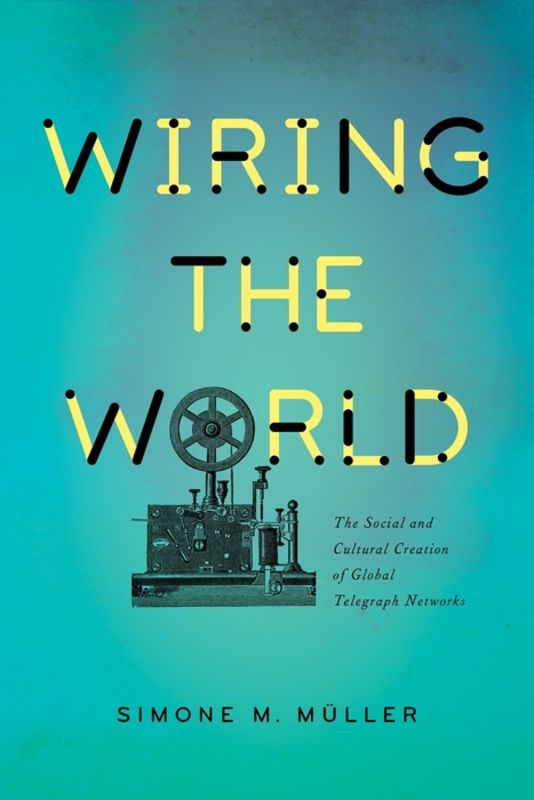
Wiring the world
The successful laying of a transatlantic cable in 1866 remade world communications. A message could travel across the ocean in minutes, shrinking the space between continents, cultures, and nations. An eclectic group of engineers, entrepreneurs, politicians, and media visionaries then developed this technology into a telecommunications system that spread a particular vision of civilization-but not everyone wanted to wire the world the same way.
Wiring the Worldis a cultural and social history that explores how the large Anglo-American cable companies won out over alternative visions. Bitter rivalries emerged over telegram prices, visions for world peace, scientific innovation, and the role of the nation-state. Such struggles determined the growth of cable technology, which in turn influenced world history. Filled with fascinating characters and new insights into pivotal events,Wiring the Worldtraces globalization's diverse paths and close ties to business and politics.
eBook

Cyrus Field's big dream : the daring effort to lay the first transatlantic telegraph cable
\"In this nonfiction middle-grade title, award-winning author Mary Morton Cowan explores the extraordinary achievement of Cyrus Field and one of the greatest engineering feats of the 19th century: laying a transatlantic telegraph cable to create instant communication between two continents.\"-- Provided by publisher.
Book


Constituting Europe
This chapter offers a way of focusing the theoretical perspectives outlined earlier by exploring, in more detail, the role of communications in the constitution of empires, nations, and regions. The struggle for control over communications and transport links was central to the First World War: indeed, Britain's cutting of the transatlantic cables that linked Germany to the West was one of the first official acts of that war. In France, after the revolution, the state was particularly concerned to universalize the customs and language of the nation so as to break down the barriers created by specific local cultures and thus solidify national unity. In all of this, communication technologies played a crucial role. The European Union has also made considerable effort to achieve greater Euro‐integration by means of the standardization and synchronization of all major transport services.
Book Chapter

Thread' a fascinating history lesson
[John Steele Gordon]'s book tells a fascinating tale. The challenge of laying a cable across the North Atlantic between the closest points -- Valentia Bay in southwest Ireland and Trinity Bay in Newfoundland -- was daunting. The distance was more than 2,000 miles, and the ocean bottom was sometimes 15,000 feet deep.
Newspaper Article

The Man Who Shrank the Ocean
Walker. 240 pp. $26On July 27, 1866, an immense vessel called the Great Eastern approached the shore of a hamlet in Newfoundland with the memorable name of Heart's Content. The ship had slowly made its way there from England, playing out mile upon mile of copper cable encased in a rubber-like substance harvested in Malaya called gutta- percha. The cable was brought ashore and spliced to cable already in place that linked Newfoundland to New York. Thereupon Cyrus Field, whose unstinting labors and vast financial outlay over a dozen years had made the enterprise possible, cabled the Associated Press. \"We arrived here at nine o'clock this morning. All well. Thank God, the cable is laid, and is in perfect working order.\" So Field and his partners in the New York, Newfoundland, and London Telegraph Co., formed in March 1854, were either visionaries or fools. For much of the following decade the latter seemed the more likely, though initially prospects seemed bright. Newfoundland had been chosen as the North American landing site because, as a contemporary oceanographer wrote, \"From Newfoundland to Ireland, the distance between the nearest points is about sixteen hundred miles; and the bottom of the sea between the two places is a plateau, which seems to have been placed there especially for the purpose of holding the wires of a submarine telegraph, and of keeping them out of harm's way.\"
Newspaper Article

Book Review; Ingenuity, Capitalism in the Quest to Link Continents
Into \"A Thread Across the Ocean\" [John Steele Gordon] weaves many engaging snapshots of men and technology in the rapidly developing industrial world during the great European peace of 1815-1914. There is William Thompson, later Lord Kelvin, who first articulated the Second Law of Thermodynamics. He came into the picture because of his interest on electric currents, then not fully understood but necessary to the transmission of electric impulses across a copper cable under the sea. There is, on the American side, Peter Cooper, successful New York entrepreneur, investor in the transatlantic cable and, incidentally, founder of the Cooper Union for the free education of New York working men. There is the fascinating, towering British engineer Isambard Brunel, who designed the Great Western Railway from London's Paddington Station to Bristol and suspension bridges, water towers, prefabricated field hospitals, tunnels and ships. It was Brunel who drew the plans for the colossal ship the Great Eastern, launched in 1857, the largest ship afloat until the launching of the ill-fated Lusitania in 1907. And it was the Great Eastern that finally laid the cable that tied together Europe and North America.
Book Review