
Catalogue Search | MBRL


Are you sure you want to remove the book from the shelf?

{{itemTitle}}
29,553
result(s) for
"Transformations (Mathematics)"
Sort by:


Spaces of PL manifolds and categories of simple maps
Since its introduction by Friedhelm Waldhausen in the 1970s, the algebraic K-theory of spaces has been recognized as the main tool for studying parametrized phenomena in the theory of manifolds. However, a full proof of the equivalence relating the two areas has not appeared until now. This book presents such a proof, essentially completing Waldhausen's program from more than thirty years ago.
The main result is a stable parametrized h-cobordism theorem, derived from a homotopy equivalence between a space of PL h-cobordisms on a space X and the classifying space of a category of simple maps of spaces having X as deformation retract. The smooth and topological results then follow by smoothing and triangulation theory.
The proof has two main parts. The essence of the first part is a \"desingularization,\" improving arbitrary finite simplicial sets to polyhedra. The second part compares polyhedra with PL manifolds by a thickening procedure. Many of the techniques and results developed should be useful in other connections.
eBook


Merge-and-Shrink: A Compositional Theory of Transformations of Factored Transition Systems
The merge-and-shrink framework has been introduced as a general approach for defining abstractions of large state spaces arising in domain-independent planning and related areas. The distinguishing characteristic of the merge-and-shrink approach is that it operates directly on the factored representation of state spaces, repeatedly modifying this representation through transformations such as shrinking (abstracting a factor of the representation), merging (combining two factors), label reduction (abstracting the way in which different factors interact), and pruning (removing states or transitions of a factor). We provide a novel view of the merge-and-shrink framework as a “toolbox” or “algebra” of transformations on factored transition systems, with the construction of abstractions as only one possible application. For each transformation, we study desirable properties such as conservativeness (overapproximating the original transition system), inducedness (absence of spurious states and transitions), and refinability (reconstruction of paths in the original transition system from the transformed one). We provide the first complete characterizations of the conditions under which these desirable properties can be achieved. We also provide the first full formal account of factored mappings, the mechanism used within the merge-and-shrink framework to establish the relationship between states in the original and transformed factored transition system. Unlike earlier attempts to develop a theory for merge-and-shrink, our approach is fully compositional: the properties of a sequence of transformations can be entirely understood by the properties of the individual transformations involved. This aspect is key to the use of merge-and-shrink as a general toolbox for transforming factored transition systems. New transformations can easily be added to our theory, with compositionality taking care of the seamless integration with the existing components. Similarly, new properties of transformations can be integrated into the theory by showing their compositionality and studying under which conditions they are satisfied by the building blocks of merge-and-shrink.
Journal Article

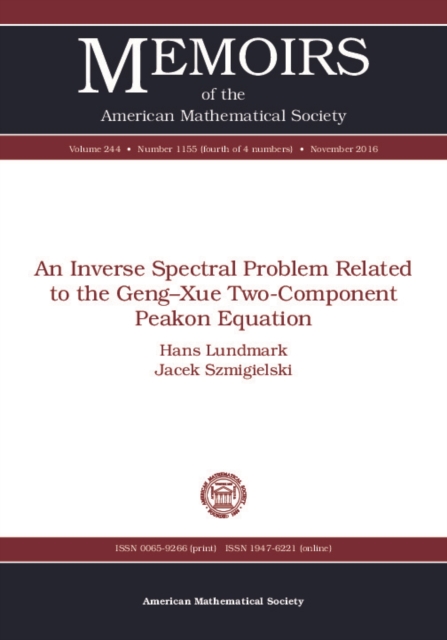
An Inverse Spectral Problem Related to the Geng–Xue Two-Component Peakon Equation
We solve a spectral and an inverse spectral problem arising in the computation of peakon solutions to the two-component PDE derived
by Geng and Xue as a generalization of the Novikov and Degasperis–Procesi equations. Like the spectral problems for those equations,
this one is of a ‘discrete cubic string’ type – a nonselfadjoint generalization of a classical inhomogeneous string – but presents some
interesting novel features: there are two Lax pairs, both of which contribute to the correct complete spectral data, and the solution to
the inverse problem can be expressed using quantities related to Cauchy biorthogonal polynomials with two different spectral measures.
The latter extends the range of previous applications of Cauchy biorthogonal polynomials to peakons, which featured either two
identical, or two closely related, measures. The method used to solve the spectral problem hinges on the hidden presence of oscillatory
kernels of Gantmacher–Krein type implying that the spectrum of the boundary value problem is positive and simple. The inverse spectral
problem is solved by a method which generalizes, to a nonselfadjoint case, M. G. Krein’s solution of the inverse problem for the
Stieltjes string.
eBook

On Pseudoconformal Blow-Up Solutions to the Self-Dual Chern-Simons-Schrödinger Equation: Existence, Uniqueness, and Instability
We consider the self-dual Chern-Simons-Schrödinger equation (CSS), also known as a gauged nonlinear Schrödinger equation (NLS). CSS
is
We are inspired by
works in the
eBook

Ramanujan-type series for , revisited
In this note, we revisit Ramanujan-type series for$\\frac {1}{\\pi }$and show how they arise from genus zero subgroups of$\\mathrm {SL}_{2}(\\mathbb {R})$that are commensurable with$\\mathrm {SL}_{2}(\\mathbb {Z})$. As illustrations, we reproduce a striking formula of Ramanujan for$\\frac {1}{\\pi }$and a recent result of Cooper et al., as well as derive a new rational Ramanujan-type series for$\\frac {1}{\\pi }$. As a byproduct, we obtain a Clausen-type formula in some general sense and reproduce a Clausen-type quadratic transformation formula closely related to the aforementioned formula of Ramanujan.
Journal Article