
Catalogue Search | MBRL


Are you sure you want to remove the book from the shelf?

{{itemTitle}}
379
result(s) for
"Translanguaging (Linguistics)"
Sort by:


Transgressing linguistic supremacy: Reimagining public speaking through culturally sustaining pedagogy
This essay reimagines public speaking education through a culturally sustaining and transgressive lens that challenges dominant norms of language, professionalism, and communication competence. It critiques the ways in which public speaking courses often reinforce linguistic supremacy by privileging standardized English and marginalizing multilingual and culturally grounded speech practices. Drawing on concepts such as translanguaging, Culturally Sustaining Pedagogy (CSP), and transgressive pedagogies, the author calls for a shift in pedagogy that centers students' lived experiences, community-rooted knowledge, and linguistic norms. Rather than asking students to conform to hegemonic standards, this approach empowers them to speak on their own terms, resist assimila- tionist pressures, and use language as a tool for identity, resistance, and liberation. By transforming the public speaking classroom into a space for critical reflection and empowerment, educators can cultivate more inclusive and equitable models of communication instruction.
Journal Article


Second language and heritage learners in mixed classrooms
\"This book addresses the complexity of mixed language classroom learning environments in which heritage learners and second language learners are concurrently exposed to language learning in the same physical space. It offers best practices and reproducible pedagogical initiatives and methodologies for different levels of instruction\"-- Provided by publisher.
BOOK

Translanguaging, Coloniality and Decolonial Cracks
In this linguistic ethnography of bilingual science learning in a South African high school, the author connects microanalyses of classroom discourse to broader themes of de/coloniality in education. The book challenges the deficit narrative often used to characterise the capabilities of linguistically-minoritised youth, and explores the challenges and opportunities associated with leveraging students' full semiotic repertoires in learning specific concepts. The author examines the linguistic landscape of the school and the beliefs and attitudes of staff and students which produce both coloniality and cracks in the edifice of coloniality. A critical translanguaging lens is applied to analyse multilingual and multimodal aspects of students' science meaning-making in a traditional classroom and a study group intervention. Finally, the book suggests implications for decolonial pedagogical translanguaging in Southern multilingual classrooms.
eBook
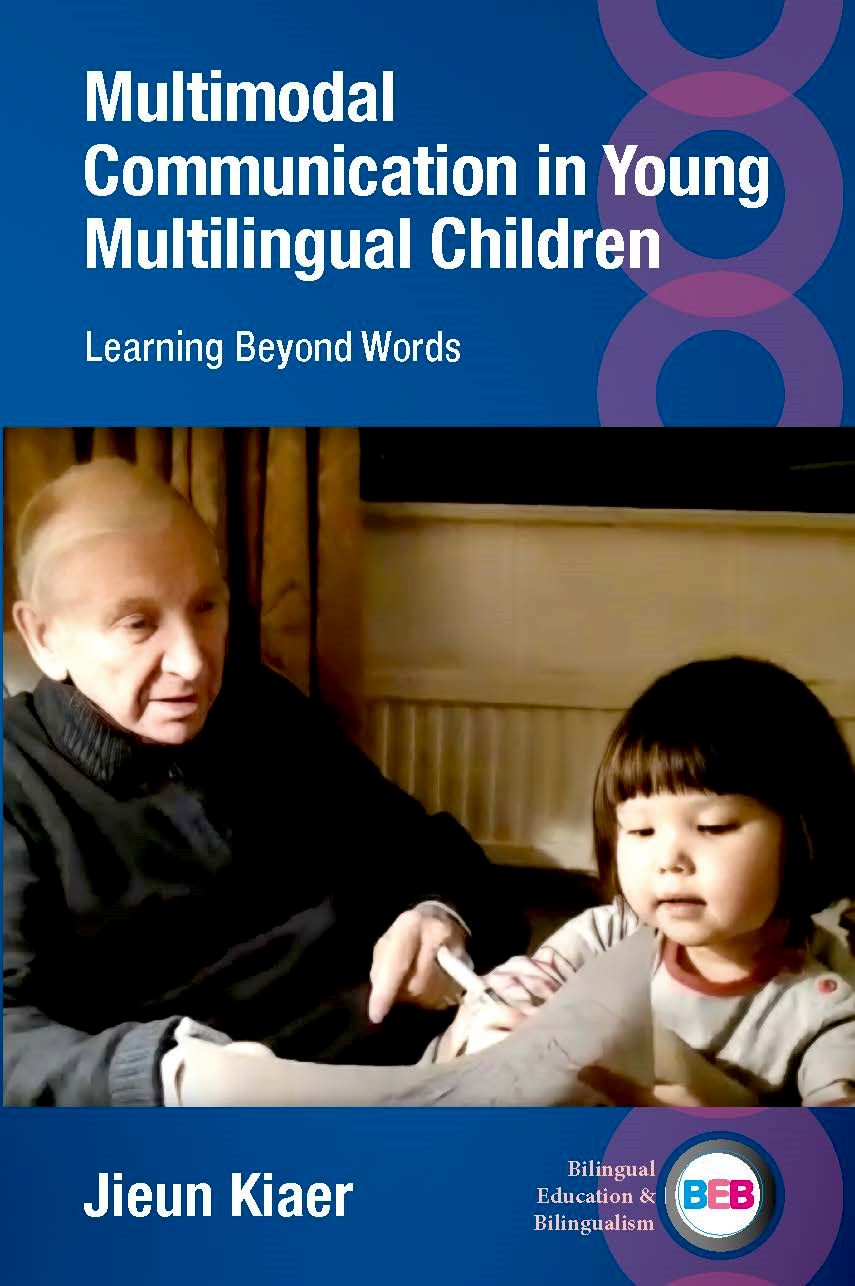
Multimodal Communication in Young Multilingual Children
This book explores young children's language acquisition in multilingual households through an original longitudinal study of the author's own children and interviews with members of other Korean-English families. The study investigates how multilingual children not only acquire multiple languages (verbal communication) but also acquire multiple strategies of non-verbal communication.In the process, it is also revealed that parents learn from children, collaboratively shaping the language of their family together in a manner that is between and beyond languages and cultures.The book explores the different types and frequency of non-verbal behaviours acquired by multilingual children and reveals how multilingual families use a range of multimodal resources to communicate effectively in a way that creates solidarity. The results of this longitudinal study are discussed within the paradigm of translanguaging and provide insight into an underrepresented multilingual population. With accompanying online videos, this book offers rich multimodal family interaction data for students and researchers interested in multilingualism, family language practices, and first and second language acquisition.
eBook

Supporting English teaching in Thailand by accepting translanguaging: Views from Thai university teachers
Translanguaging pedagogy has recently been given a lot of attention within tertiary institutions; however, there has been a paucity of research on Thai teachers' perceptions of this issue. This study therefore adds to existing literature by examining Thai university EFL teachers' views on classroom translanguaging and its adoption at tertiary institutions. Data was collected from 10 Thai EFL teachers across 5 universities in Thailand through classroom observation, field notes and semi-structured interviews, and analysed using qualitative content analysis. The data revealed that the teachers all showed a generally positive attitude towards classroom translanguaging practices (i.e. the use of learners' L1 in the classroom) for L2 and content learning. Moreover, they reported that it is seemingly difficult to completely dismiss the learners' L1 (Thai) in Thai classrooms where English is used as the medium of instruction. Implications for practice, policy and research are highlighted, as well as limitations.
Journal Article