
Catalogue Search | MBRL


Are you sure you want to remove the book from the shelf?

{{itemTitle}}
20,484
result(s) for
"Translations into English"
Sort by:

On spoken French : an Ashby reader
This scholarly edition invites us to reconsider our assumptions about the French language, by showcasing the oeuvre of one of the pioneers of diachronic Spoken French corpus linguistics, William J. Ashby, and the ground-breaking findings to come out of his influential Tours corpora (1976 & 1995).
eBook

Fleas, Flies, and Friars
Medieval children lived in a world rich in poetry, from lullabies, nursery rhymes, and songs to riddles, tongue twisters, and nonsensical verses. They read or listened to stories in verse: ballads of Robin Hood, romances, and comic tales. Poems were composed to teach them how to behave, eat at meals, hunt game, and even learn Latin and French. InFleas, Flies, and Friars, Nicholas Orme, an expert on childhood in the Middle Ages, has gathered a wide variety of children's verse that circulated in England beginning in the 1400s, providing a way for modern readers of all ages to experience the medieval world through the eyes of its children.
In his delightful treasury of medieval children's verse, Orme does a masterful job of recovering a lively and largely unknown tradition, preserving the playfulness of the originals while clearly explaining their meaning, significance, or context. Poems written in Latin or French have been translated into English, and Middle English has been modernized.Fleas, Flies, and Friarshas five parts. The first two contain short lyrical pieces and fragments, together with excerpts from essays in verse that address childhood or were written for children. The third part presents poems for young people about behavior. The fourth contains three long stories and the fifth brings together verse relating to education and school life.
eBook


Classical Samaritan Poetry
No detailed description available for \"Classical Samaritan Poetry\".
eBook


The footprints of the Buddha : the text and the language
This book deals with Chinese and Japanese inscriptions (8th century AD) about the footprints of Buddha. The language of the Japanese inscription reflects the contemporary dialect of Nara. Its writing system presents a special interest being practically monophonic.
eBook

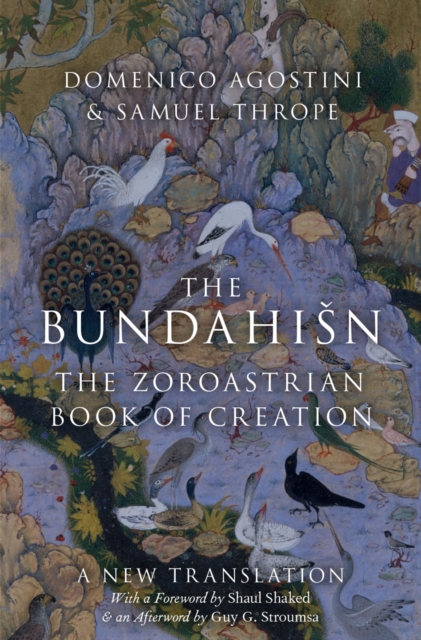
The Bundahišn : the Zoroastrian book of Creation
The Bundahišn, meaning primal or foundational creation, is the central Zoroastrian account of creation, cosmology, and eschatology and one of the most important of the surviving testaments to Zoroastrian literature and pre-Islamic Iranian culture. Touching on geography, cosmogony, anthropology, zoology, astronomy, medicine, legend, and myth, the Bundahišn can be considered a concise compendium of Zoroastrian knowledge.
The Bundahišn is well known in the field as an essential primary source for the study of ancient Iranian history, religions, literature, and languages. It is one of the most important texts composed in Zoroastrian Middle Persian, also known as Zoroastrian Book Pahlavi, in the centuries after the fall of the Sasanian Empire to the invading Arab and Islamic forces in the mid seventh century. The Bundahišn provides scholars with a particularly profitable window on Zoroastrianism’s intellectual and religious history at a crucial transitional moment: centuries after the composition of the Avesta, the Zoroastrian sacred scriptures, and before the transformation of Zoroastrianism into a minority religion within Iran and adherents’ dispersion throughout Central and South Asia. However, the Bundahišn is not only a scholarly tract. It is also a great work of literature in its own right and ranks alongside the creation myths of other ancient traditions: Genesis, the Babylonian Emunah Elish, Hesiod’s Theogony, and others. Informed by the latest research in Iranian Studies, this translation aims to bring to the fore the aesthetic quality, literary style, and complexity of this important work.
eBook