
Catalogue Search | MBRL


Are you sure you want to remove the book from the shelf?

{{itemTitle}}
4,152
result(s) for
"Transportation engineering Decision making."
Sort by:

International handbook on mega-projects
The expert contributors explore how decisions are made at different stages in mega-projects and the multi-actor relationships between public and private partners. They evaluate the perspectives and pitfalls in determining the costs and benefits of a mega-project ex ante, and examine the wider impacts of mega-projects, including issues such as regional growth, energy transition and climate change. Although the focus is on the advanced economies of North America, Europe, and Australia, much of the material is useful for other parts of the world where large transport infrastructure projects are currently underway or will be developed in the coming years. Providing crucial background information for those who want to understand decision-making processes on large transport infrastructure projects, this fascinating Handbook will prove an important source of information for academics, researchers and students in the fields of transport, infrastructure, project management, management science, economic analysis (cost-benefit analysis), public policy, environmental policy and ethics. Practitioners, politicians and policymakers involved in large transport infrastructure projects will also find this book to be an invaluable reference tool. -- Publisher description.
Book

A method to evaluate equitable accessibility: combining ethical theories and accessibility-based approaches
In this paper, we present the case that traditional transport appraisal methods do not sufficiently capture the social dimensions of mobility and accessibility. However, understanding this is highly relevant for policymakers to understand the impacts of their transport decisions. These dimensions include the distribution of mobility and accessibility levels over particular areas or for specific population groups, as well as how this may affect various social outcomes, including their levels of participation, social inclusion and community cohesion. In response, we propose a method to assess the socially relevant accessibility impacts (SRAIs) of policies in some of these key dimensions. The method combines the use of underlying ethics principles, more specifically the theories of
egalitarianism
and
sufficientarianism
, in combination with accessibility-based analysis and the Lorenz curve and Gini index. We then demonstrate the method in a case study example. Our suggestion is that policymakers can use these ethical perspectives to determine the equity of their policies decisions and to set minimum standards for local transport delivery. This will help them to become more confident in the development and adoption of new decision frameworks that promote accessibility over mobility and which also disaggregate the costs and benefits of transport policies over particular areas or for specific under-served population groups.
Journal Article
Travel mode choice and travel satisfaction: bridging the gap between decision utility and experienced utility
Over the past decades research on travel mode choice has evolved from work that is informed by utility theory, examining the effects of objective determinants, to studies incorporating more subjective variables such as habits and attitudes. Recently, the way people perceive their travel has been analyzed with transportation-oriented scales of subjective well-being, and particularly the satisfaction with travel scale. However, studies analyzing the link between travel mode choice (i.e., decision utility) and travel satisfaction (i.e., experienced utility) are limited. In this paper we will focus on the relation between mode choice and travel satisfaction for leisure trips (with travel-related attitudes and the built environment as explanatory variables) of study participants in urban and suburban neighborhoods in the city of Ghent, Belgium. It is shown that the built environment and travel-related attitudes—both important explanatory variables of travel mode choice—and mode choice itself affect travel satisfaction. Public transit users perceive their travel most negatively, while active travel results in the highest levels of travel satisfaction. Surprisingly, suburban dwellers perceive their travel more positively than urban dwellers, for all travel modes.
Journal Article
Understanding California wildfire evacuee behavior and joint choice making
For evacuations, people must make the critical decision to evacuate or stay followed by a multi-dimensional choice composed of concurrent decisions of their departure time, transportation mode, route, destination, and shelter type. These choices have important impacts on transportation response and evacuation outcomes. While extensive research has been conducted on hurricane evacuation behavior, little is known about wildfire evacuation behavior. To address this critical research gap, particularly related to joint choice-making in wildfires, we surveyed individuals impacted by the 2017 December Southern California Wildfires (n = 226) and the 2018 Carr Wildfire (n = 284). Using these data, we contribute to the literature in two key ways. First, we develop two latent class choice models (LCCMs) to evaluate the factors that influence the decision to evacuate or stay/defend. We find an evacuation keen class and an evacuation reluctant class that are influenced differently by mandatory evacuation orders. This nuance is further supported by different membership of people to the classes based on demographics and risk perceptions. Second, we develop two portfolio choice models (PCMs), which jointly model choice dimensions to assess multi-dimensional evacuation choice. We find several similarities between wildfires including a joint preference for within-county and nighttime evacuations and a joint dislike for within-county and highway evacuations. Altogether, this paper provides evidence of heterogeneity in response to mandatory evacuation orders for wildfires, distinct membership of populations to different classes of people for evacuating or staying/defending, and clear correlation among key wildfire evacuation choices that necessitates joint modeling to holistically understanding wildfire evacuation behavior.
Journal Article
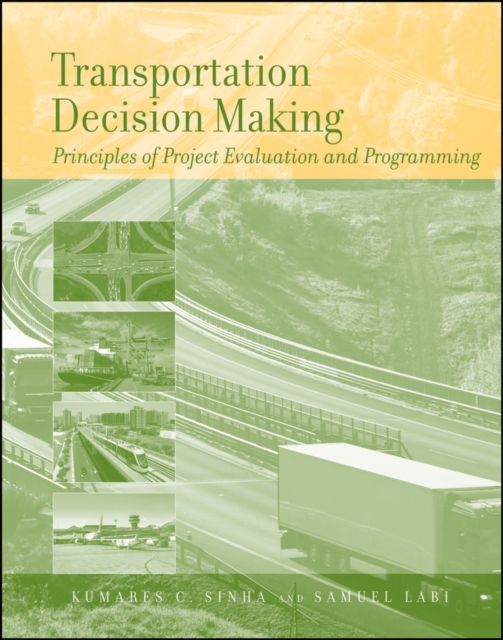
Transportation decision making
Transportation Decision Making A GUIDE TO EFFECTIVE DECISION MAKING WRITTEN JUST FOR TRANSPORTATION PROFESSIONALS This pioneering text provides a holistic approach to decision making in transportation project development and programming, which can help transportation professionals to optimize their investment choices. The authors present a proven set of methodologies for evaluating transportation projects that ensures that all costs and impacts are taken into consideration. The text's logical organization gets readers started with a solid foundation in basic principles and then progressively builds on that foundation. Topics covered include: Developing performance measures for evaluation, estimating travel demand, and costing transportation projects Performing an economic efficiency evaluation that accounts for such factors as travel time, safety, and vehicle operating costs Evaluating a project's impact on economic development and land use as well as its impact on society and culture Assessing a project's environmental impact, including air quality, noise, ecology, water resources, and aesthetics Evaluating alternative projects on the basis of multiple performance criteria Programming transportation investments so that resources can be optimally allocated to meet facility-specific and system-wide goals Each chapter begins with basic definitions and concepts followed by a methodology for impact assessment. Relevant legislation is discussed and available software for performing evaluations is presented. At the end of each chapter, readers are provided resources for detailed investigation of particular topics. These include Internet sites and publications of international and domestic agencies and research institutions. The authors also provide a companion Web site that offers updates, data for analysis, and case histories of project evaluation and decision making. Given that billions of dollars are spent each year on transportation systems in the United States alone, and that there is a need for thorough and rational evaluation and decision making for cost-effective system preservation and improvement, this text should be on the desks of all transportation planners, engineers, and educators. With exercises in every chapter, this text is an ideal coursebook for the subject of transportation systems analysis and evaluation.
eBook
Exploring passengers’ choice of transfer city in air-to-rail intermodal travel using an interpretable ensemble machine learning approach
The transfer city is a key point in air-to-rail intermodal travel (ARIT) that directly influences the service level of the entire system. Although some studies have investigated factors that influence passengers’ ARIT preferences based on subjective surveys, an in-depth understanding of their nonlinear and interactive impacts on passengers’ actual behavior is still lacking. Using passengers’ online booking data in China, this study implements an interpretable ensemble machine learning framework that incorporates decision-making theory to unveil feature importance and the complex nonlinear and interactive effects of various attributes on passengers’ choice of transfer city in the crucial ARIT scenario. The results show that (1) the extreme gradient boosting (XGBoost) model achieves better performance in predicting ARIT transfer city choice than the conventional discrete choice model; (2) attributes related to intermodal services (e.g., ticket price, in-vehicle duration, transfer duration, quantities of flights and trains) are more important than personal demographic characteristics (e.g., age and gender); (3) factors related to service economy and efficiency display nonlinear impacts with fluctuations and critical thresholds; and (4) individuals with different characteristics present heterogeneous preferences for ARIT transfer cities. These findings can provide useful managerial implications for policymakers.
Journal Article
Opening out and closing down: the treatment of uncertainty in transport planning’s forecasting paradigm
Since the 1960s, development of the transport system has been framed by the notion of forecasting future demand. Yet the past decade or more appears to signal some significant changes to the role of travel in society which are having a material impact on how much people travel (and may travel in the future). Coupled with the potential for major technological changes and a range of climate adaptation scenarios, the future of mobility presents today’s decision making on transport strategy and investment with a broader set of uncertainties than has previously been considered. This paper examines current mainstream practice for incorporating uncertainty into decision-making, through an illustrative case study of the highly codified approaches of the Department for Transport in England. It deconstructs the issue by first focussing on different ways in which there is an opening out or acceptance of new uncertainties and how this creates a (wider) set of potential futures. It then turns to consider how this set of futures is used, or not, in decision-making, i.e. the process of closing down uncertainty to arrive at or at least inform a decision. We demonstrate that, because the range of uncertainties has broadened in scope and scale, the traditional technocratic approach of closing down decisions through sensitivity testing is at odds with the greater breadth now being called for at the opening out stage. We conclude that transport decision-making would benefit from a rebalancing of technical depth with analytical breadth. The paper outlines a plausible new approach to opening out and closing down that is starting to be applied in practice. This approach must be accompanied by an opening up of the processes by which technical advice for decisions are reached and how uncertainties are understood and negotiated.
Journal Article
User expectations and perceptions towards new public transport infrastructure: evaluating a cable car in Bogotá
Cable cars are a viable alternative to improve citizens’ accessibility in zones with limitations on urban public transport supply due to the topography. In Latin America, such systems have recently been implemented in zones with high levels of poverty and vulnerability. Although the social implications of their implementation are relevant, individual expectations of these systems and how current changes in travel conditions and quality of life are perceived have not been widely reported in the literature. This paper aims to evaluate users’ expectations and perceptions of a new cable car in the southern periphery of Bogotá (Colombia). We conducted a panel survey before (n = 341) and after (n = 301) the cable car started operations to evaluate the ranking of preferences toward a set of possible benefits of the project. We estimated discrete choice models to analyze the statistical differences between the expectations and perceptions before and after changes. Results suggest that travel time reductions, comfort improvements, and in-vehicle security are the benefits most valued by the users. Even though the project meets expectations of these aspects, it seems to fall short in expectations of reductions of pollution. Individuals’ experience with the cable car shapes their perceptions of the system. We found that perceptions differ between those who have used the service at least once and those who never did. Policy implications derived from this study might be of interest to decision-makers seeking to guarantee the public acceptability of urban projects.
Journal Article
Reducing traffic congestion and increasing sustainability in special urban areas through one-way traffic reconfiguration
In the contemporary sustainable urban set up, one of the critical issues adversely affecting the quality of life in urban areas and inflicting immense costs on cities is traffic congestion. Traffic congestion is an outgrowth of increased traffic flow in certain locations of large cities. Recently, urban decision-makers and transportation planners resort to one-way traffic system as an effective traffic management strategy, which has a profound effect on reducing traffic congestion and improving traffic flow, leading to urban sustainability. In the present paper, the authors endeavored to develop a novel methodological framework based on optimization techniques in order to mitigate traffic congestion through one-way traffic network reconfiguration. To test the efficacy of the proposed methodological framework, two cases were analyzed and evaluated: the Sioux Falls transportation network as a medium-sized one and a real-world large-scale transportation network of the city of Isfahan in Iran. Through the first instance, it can be seen that the proposed method can effectively reduce the total travel time in the area of interest by approximately 9%. The numerical results for the transportation network of Isfahan, justified the practical value of the model and solution method through converting proper links to one-way. As the calculation results of two cases have demonstrated, the solution can effectively reduce the total travel time of travelers in a certain congested urban area.
Journal Article
Data-driven analysis and modeling of individual longitudinal behavior response to fare incentives in public transport
Incentive-based public transport demand management (PTDM) can effectively mitigate overcrowding issues in crowded urban rail systems. Analyzing passengers’ behavioral responses to the incentive can guide the design, implementation, and update of PTDM strategies. Though several studies reported passengers’ responses to fare incentives, they focused on passengers’ short-term behavioral responses. Limited studies explore passengers’ longitudinal behavioral responses for different types of adopters, which is important for policy assessment and adjustment. This paper explores and models passengers’ longitudinal behavior response to a pre-peak fare discount incentive using 18 months of smartcard data in public transport in Hong Kong. We classified adopters into six types based on their temporal travel pattern changes before and after the promotion. The longitudinal analysis reveals that among all adopters, 19% of users change their departure times to take advantage of fare discounts but do not contribute to the goal of reducing peak-hour travel. However, these adopters are more likely to sustain their changed behavior in a long term which is not desired by the incentive program. The spatial analysis shows that the origin station distribution of late adopters is relatively more diverse than the early adopters with more trips starting from distant areas. The diffusion modeling shows that the majority adopters are innovators and the word-of-mouth diffusion effect (imitators) is marginal. The discrete choice model results highlight the heterogeneous impact of factors on different types of adopters and their values of time changes. The significant factors common to adopters are: departure time flexibility, the expected money savings, the required departure time changes, and work locations. The findings are useful for public transport planners and policymakers for informed incentive design and management.
Journal Article