
Catalogue Search | MBRL


Are you sure you want to remove the book from the shelf?

{{itemTitle}}
1,217
result(s) for
"Transvestites"
Sort by:


AN ORAL HISTORY EXPERIMENT ON VIOLENCE BETWEEN TRANSVESTITES AND POLICE OFFICERS IN SAO PAULO CITY FROM THE 1990S/ UM EXPERIMENTO DE HISTORIA ORAL SOBRE VIOLENCIAS ENTRE TRAVESTIS E POLICIAIS NA CIDADE DE SAO PAULO A PARTIR DA DECADA DOS 1990
Brazilian transvestites suffer violence and rights violations deriving from various diretions. One comes from the area of public security. In this case, there is a considerable bibliography about the most recent period and of the Brazilian military dictatorship, which is not the case for the period after of the dictatorship until the year 2000, specially for the city of Sao Paulo (SP), my focus. The objective of this article is to try to cover this gap and observe the changes that have occurred up until this day. The methodology of oral history was used, based on interviews with transvestites who began to prostitute themselves in this town still in the 1990s. From the recollections of the interviewedes, in spite of the decrease of the most forceful violence during the 2000, there is a pattern of police practices composed by violence, rights violations and corruption, which is aggravated by the fact that public security agents are usually immersed in a heteronormative and stigmatizing cultural framework in relation to transvestites. Keywords: Transvestites. Police officers. Oral history. Transphobia. Violence. Rights violations. As travestis brasileiras sofrem violencias e violacoes de direitos que partem de varias direcoes. Uma delas e a que vem da area da seguranca publica. Nesse caso, ha consideravel bibliografia sobre o periodo mais recente e o da ditadura militar brasileira, o que nao acontece para o periodo pos ditadura ate os 2000, sobretudo para a cidade de Sao Paulo (SP), meu foco. O objetivo deste artigo e tentar cobrir essa lacuna e observar as mudancas ocorridas ate os dias de hoje. Foi utilizada a metodologia da historia oral, a partir de entrevistas realizadas com travestis que comecaram a se prostituir nesta cidade ainda nos anos 1990. Das lembrancas das entrevistadas, em que pese a diminuicao da violencia mais contundente ao longo dos 2000, se observa um padrao de praticas policiais compostas por violacoes de direitos e corrupcao, que e agravado pelo fato dos agentes de seguranca publica, em geral, estarem imersos numa moldura cultural heteronormativa e estigmatizante em relacao as travestis. Palavras-chave: Travestis. Policiais. Historia oral. Transfobia. Violencia. Violacoes de direitos.
Journal Article
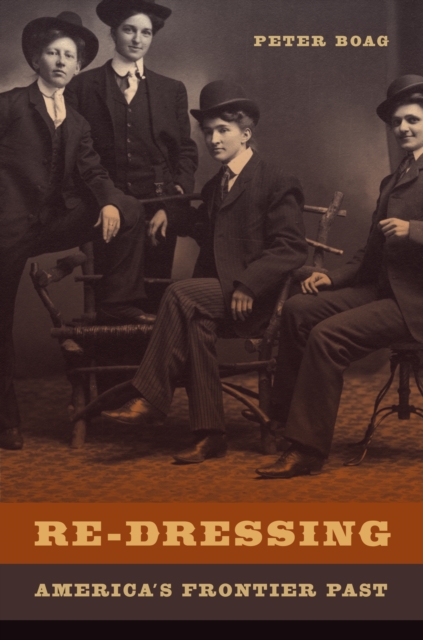
Re-dressing America's frontier past
Americans have long cherished romantic images of the frontier and its colorful cast of characters, where the cowboys are always rugged and the ladies always fragile. But in this book, Peter Boag opens an extraordinary window onto the real Old West. Delving into countless primary sources and surveying sexological and literary sources, Boag paints a vivid picture of a West where cross-dressing—for both men and women—was pervasive, and where easterners as well as Mexicans and even Indians could redefine their gender and sexual identities. Boag asks, why has this history been forgotten and erased? Citing a cultural moment at the turn of the twentieth century—when the frontier ended, the United States entered the modern era, and homosexuality was created as a category—Boag shows how the American people, and thus the American nation, were bequeathed an unambiguous heterosexual identity.
eBook

“O Piteous Spectacle! O Bloody Times!”: The Faithlessness of English Identity in I1/I, I2/I, and I3 Henry VI/I
Shakespeare’s Henry VI trilogy is jam-packed with spectacle: heads are severed and made to kiss, women dress as men and lead armies, ghosts predict the future, and a plethora of miracles take place all over the various locales we visit across fifteen acts. In fact, if “faith is… the evidence of things not seen,” as asserted by the author of Hebrews, then the Henry VI plays are entirely devoid of faith, by the merit of bringing miraculous events from the realm of faith into the realm of observational knowledge. Of note, then, is the fact that the trilogy depicts Henry as a weak king whose main virtue is his commitment to his faith. Compared to other kings in Shakespearean history plays, Henry is almost-constantly referencing the spiritual world, and the world he lives in is so full of miraculous happenings that miracles themselves run the risk of becoming banal. Perhaps surprisingly, given the trilogy’s thematic investment in miracles and spirituality, the English are defined in the plays as destroying or debunking miraculous spectacles. From Gloucester outsmarting Simpcox in his feigned healing to the putting-down of two witches (Joan in 1 Henry VI and Margery Jourdain in 2 Henry VI), it seems that, despite Henry’s incredible devotion, his courtiers raise skepticism to the level of modus operandi. In this essay, I hope to examine the way that the second Henriad depicts a version of England that places logic and skepticism in the seat of faith, while its ruler’s faith is often both uninterrogated and misplaced. Shakespeare stages a teleology of spectacle that highlights English faithlessness as a source of internecine struggle and insurrection, while also cautioning against naivete in the face of canny nemeses.
Journal Article

Trans-gendering the Irish Nation: Neil Jordan's Breakfast on Pluto
Occupying a relegated position as it does in Neil Jordan's filmography, it is my contention that Breakfast on Pluto is one of his most transgressive films. Not only does it cross the most evident boundaries of heteronormative gender roles by giving a transvestite the central position in the story, but also blends film genres as a way of vindicating hybridisation at all levels, challenging other modern categorisations as those informing Irish national identity. Thirteen years after The Crying Game (1992) was released, Irish filmmaker Neil Jordan returns to the intersectional issues of gender and national identity in his adaptation of Patrick McCabe's novel Breakfast on Pluto (1998). However, apart from the presence of a transvestite and the shadow of sectarian violence looming throughout the narrative, these films have little else in common: the dull, grey atmosphere of an obscure drama involving kidnap and murder by the IRA in The Crying Game contrasts sharply with the bright colours, ironic drive and parody in Breakfast on Pluto, a story about growing up in Ireland as an orphan transvestite who yearns for romantic true love. Moreover, while Jordan's first feature film was defined as a romantic drama with thriller hues, Breakfast moves between comedy and drama, the bildungsroman and the melodrama. This generic ambivalence goes hand in hand with Jordan's transgressing approach to the question of gender and national identity as a strategy to challenge fixed understandings of those labels as natural and given and, for that reason, the violence inflicted on the main character (and, by extension, on any Other body that does not fit those categories). Key Words. Film, genre, gender, nation, Ireland, identity. Resumen. A pesar de ser considerada una obra menor en la filmografía de Neil Jordan, Desayuno en Plutón es en mi opinión una de sus películas más transgresoras. No solo cruza todos los límites posibles en lo que a cuestiones de género heteronormativo se refiere al situar a un travestido en el centro de la historia, sino que también mezcla un buen número de géneros cinematográficos como una manera de reivindicar la hibridación a todos los niveles, desafiando, de paso, otras categorizaciones modernas como las que conforman la identidad nacional irlandesa. Trece años después del estreno de Juego de Lágrimas (1992) el cineasta irlandés retoma cuestiones interseccionales como son el género y la identidad nacional en su adaptación de la novela Desayuno en Plutón (1998) de Patrick McCabe. Sin embargo, aparte de la presencia de un travestí y la sombra de la violencia sectaria que se alarga por toda la narrativa, estas películas no tienen mucho más en común: la atmósfera gris y oscura de un drama turbio con el IRA por protagonista contrasta marcadamente con los colores chillones, el tono irónico y la parodia que permea Desayuno en Plutón, un bildungsroman sobre un travestido que crece huérfano en Irlanda y que lo único que anhela es el amor romántico verdadero. Mientras que Jordan definió su primer largometraje como un drama con pinceladas de suspense, Desayuno se mueve entre la comedia y el drama, el bildungsroman y el melodrama. Esta ambivalencia genérica sirve como marco formal para la mirada transgresora de Jordan en relación a la identidad nacional y de género, una estrategia que nos lleva a cuestionar esas etiquetas como naturales, dadas e inmutables y, de ahí la violencia que sufre el personaje principal (y, por extensión, cualquier Otro cuerpo que no se ajuste a esas cateogorías). Palabras Clave. Cine, género cinematográfico, género, nación, Irlanda, identidad.
Journal Article

Queen of the Capital
This is a film review of Queen of the Capital (2020) directed by Josh Davidsburg.
Journal Article