
Catalogue Search | MBRL


Are you sure you want to remove the book from the shelf?

{{itemTitle}}
12,985
result(s) for
"Treatises"
Sort by:

Two Treatises of Government and A Letter Concerning Toleration
Among the most influential writings in the history of Western political thought, John Locke'sTwo Treatises of GovernmentandA Letter Concerning Tolerationremain vital to political debates today, more than three centuries after they were written. The complete texts appear in this volume, accompanied by interpretive essays by three prominent Locke scholars.Ian Shapiro's introduction places Locke's political writings in historical and biographical context. John Dunn explores both the intellectual context in which Locke wrote theTwo Treatises of GovernmentandA Letter Concerning Tolerationand the major interpretive controversies surrounding their meaning. Ruth Grant offers a comprehensive discussion of Locke's views on women and the family, and Shapiro contributes an essay on the democratic elements of Locke's political theory. Taken together, the texts and essays in this volume offer invaluable insights into the history of ideas and the enduring influence of Locke's political thought.
eBook


Shakespeare and laughter
This book examines laughter in the Shakespearean theatre, in the context of a cultural history of early modern laughter, and looks at various strands of the early modern discourse on laughter, ranging from medical treatises and courtesy manuals to Puritan tracts and jestbook literature. It argues that few cultural phenomena have undergone as radical a change in meaning as laughter, a paradigm shift that can be traced back to the early modern period, which saw some remarkable changes in the culture of laughter. Hitherto, laughter had been mainly regarded as a social corrective that mocked those who transgressed societal norms. The evolving cult of courtly manners that spread throughout Renaissance Europe stigmatised derisive laughter as a sign of vulgarity. Laughter became bound up with questions of taste and class identity. At the same time, humanist thinkers revalorised the status of recreation and pleasure. These developments left their trace on the early modern theatre, where laughter was retailed as a commodity in an emerging entertainment industry. William Shakespeare's plays both reflect and shape these changes, particularly in his adaptation of the Erasmian wise fool as a stage figure and in the sceptical strain of thought that is encapsulated in the laughter evoked in the plays.
eBook

La ampelografía en español y en francés (1490-1807): difusión y traducción
El objeto de estudio de este artículo son los tratados de ampelografía en español y en francés entre 1490 y 1807, su difusión y su traducción, así como los nombres de las variedades de vid en ellos recogidos. Para la recopilación de los tratados hemos seguido el método de investigación documental con consultas in situ y telemáticas y para su estudio el cuantitativo y el cualitativo. Hemos recopilado 18 tratados, 11 en francés y 7 en español, más de la mitad de ellos publicados en el siglo xviii. Tan solo dos de ellos cuentan con traducciones. Hemos contabilizado 506 nombres distintos de variedades de vid, 283 en español y 223 en francés. Los veduños, linajes o suertes en español y los complants, espèces, sortes, variétés y cépages en francés comienzan a normalizar sus nombres a partir del siglo xviii. Constituyen una auténtica Torre de Babel por la gran variedad diatópica y diacrónica que conocen, así como por la abundancia de sinónimos.
Journal Article

The Geometrical Relationship Between Ancient Hindu Technical Treatises and the Planning and Organization of Angkor Wat
Angkor Wat is the supreme masterpiece of Khmer architecture, built by King Sūryavarman II during the 12th century A.D. Jane Przyluski hypothesized that Angkor Wat was the tomb of King Sūryavarman II. On the other hand, George Cœdès thought that Angkor Wat complex was habitation in the form of a celestial palace. According to Henri Parmentier, though the buildings and constructions in Angkor Wat temple complex are majestic, they are geometrically out of place. The temple complex is non-symmetrical, as the complex’s center is left-aligned. The above controversial opinions inspire a deep examination of the geometric system of the architectural and structural design of Angkor Wat. This research investigates the architectural planning and frame structures of Angkor Wat stone temple complex using a Hindu grid system. The study was based on field survey data of the temple complex and Hindu ancient texts, specifically the Vāstu Śāstra. PhotoModeler Pro5 and Polycam for iOS-4.0.5 were utilized to render three-dimensional (3D) images of the entire temple complex. The analysis finds the geometric code (suitable module) used in the planning of 2.75 m × 2.75 m in the metric system (1 Phyeam 1 Hat 1 Thnob in) the local Cambodian measuring system). The geometric code (2.75 m × 2.75 m) highlights the design diagram and construction of the temple complex. The research also unveiled the use of a center-shifting technique where the vertical axis running through the center is deliberately left-aligned, to avoid numerical fractions occurring in the grid modules. The technique gives rise to the asymmetry of the temple complex. The findings led to understanding the symbolic meaning of spatial organization of the layout and plan of Angkor Wat design, which was meant to be a suitable residence for the god on earth, the king, and his citizens. Moreover, it also means the final abode of King Sūryavarman II after his death, represented by the image of Lord Viṣṇu.
Journal Article

History of Science and Methodology: The Significance of Aristotle’s Treatises
The study is devoted to highlighting the legacy of Aristotle from the point of view of its modern interpretation. Also, this work has a didactic character, since the structure of the proposed educational material corresponds to the main milestones of the life and work of an outstanding thinker of antiquity. The article emphasises the importance of studying Aristotle’s biological knowledge in modern sciences, in particular in interdisciplinary studies, teaching methods, in the methodology of sciences, etc. The authors recommend scientists who work in the field of natural sciences, as well as teach these sciences to students in educational institutions, to take into account the principles of Aristotle’s scientific picture of the world, since Aristotle was the first in the history of science to present a scheme of scientific research methods and provide a complete classification of animals. He also proposed a hierarchy of levels of life, created a scheme of causality in biology, initiated the doctrine of distribution and the principle of analogy, laid the foundations of embryology, enriched the categorical apparatus of science (whole and its part, species and genus, functions, form and matter, movement, primary cause, entelechy, substance, soul, etc.), which are still used in various fields of scientific knowledge.
Journal Article

Foreigners are said to be wise and honest but they teach us false things
This article focuses on ‘On Military Tactics’ (‘O ratnom povedenii’), composed in winter 1700/1701 by Ivan Pososhkov and considered to be one of the first analytical military treatises written in the Russian language. Pososhkov heavily criticized foreign influences on native warfare, in particular, the Western infantry tactics and drill introduced by the tsar Peter the Great and his predecessors and reflected some controversial problems of contemporary military culture. Despite his declared hostility towards Western methods of warfare, Pososhkov acknowledged the utility of a ‘military science’ and read some foreign books on the subject.
Journal Article

Today's students engaging with Abbacus problems
In this paper, we describe an experiment in using history to work on problem-solving and the relationship between arithmetic and algebra. The students involved attended the first year of the Italian upper secondary school (grade 9). The original sources we used are problems from Italian treatises on arithmetic and algebra that appeared in the Middle Ages and the Renaissance. At the beginning, we present these treatises, which belong to a widespread mathematical tradition. We then describe the classroom experiment: we administered 14 problems from ancient treatises accompanied by the request to solve them and write impressions and comments. Data were collected through written protocols and interviews. The analysis of the results focused on the strategies implemented in solving the problems, with particular reference to the use of arithmetic and algebra, and on the perception of the cultural aspect introduced by these problems in the students’ approach to mathematics. The findings show the difficulties of some students on topics, such as fractions and direct proportionality, which should have been acquired in earlier school years. Combining the use of history with aspects of research in mathematics education allowed us to outline some teaching implications linked to the use of history.
Journal Article

Lives in Musicology: My Life in Arabic Music—Scholarship, Translation, Teaching, Performance
This overview of my five decades researching Arabic music, studying and translating treatises on Arabic music dating back to the ninth century CE, and teaching and performing this tradition is the latest installment of the \"Lives in Musicology\" series of Acta Musicologica. I cover my early training in Western music, seen at the time in my native country of Egypt as advanced compared to \"backward\" Arabic music, followed by my turn to a deep, lifelong involvement with the latter, which began with my reading of \"Kitāb al-Mūsīqī l-Kab¯r\" (Grand book of music) by al-Fārābī (d. 950), the beauty of whose scholarship and language stunned me. So instead of trying to bring Arabic music into the twentieth century, Arabic music brought me back to the medieval era! My overview of my many writings tries to offer a sense of the richness, humanity, and humor of the music to which I have devoted my career.
Journal Article
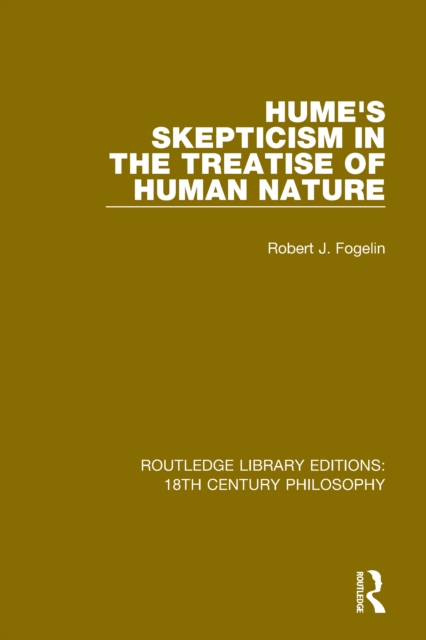
Hume’s Skepticism in the Treatise of Human Nature
This work, first published in 1985, offers a general interpretation of Hume's Treatise of Human Nature. Most Hume scholarship has either neglected or downplayed an important aspect of Hume's position - his scepticism. This book puts that right, examining in close detail the sceptical arguments in Hume's philosophy.
eBook