
Catalogue Search | MBRL


Are you sure you want to remove the book from the shelf?

{{itemTitle}}
63
result(s) for
"Triage - manpower"
Sort by:

Process evaluation for complex interventions in health services research: analysing context, text trajectories and disruptions
Background
Process evaluations assess the implementation and sustainability of complex healthcare interventions within clinical trials, with well-established theoretical models available for evaluating intervention delivery within specific contexts. However, there is a need to translate conceptualisations of context into analytical tools which enable the dynamic relationship between context and intervention implementation to be captured and understood.
Methods
In this paper I propose an alternative approach to the design, implementation and analysis of process evaluations for complex health interventions through a consideration of trial protocols as textual documents, distributed and enacted at multiple contextual levels. As an example, I conduct retrospective analysis of a sample of field notes and transcripts collected during the ESTEEM study - a cluster randomised controlled trial of primary care telephone triage. I draw on theoretical perspectives associated with Linguistic Ethnography to examine the delivery of ESTEEM through staff orientation to different texts. In doing so I consider what can be learned from examining the flow and enactment of protocols for notions of implementation and theoretical fidelity (i.e. intervention delivered as intended and whether congruent with the intervention theory).
Results
Implementation of the triage intervention required staff to integrate essential elements of the protocol within everyday practice, seen through the adoption and use of different texts that were distributed across staff and within specific events. Staff were observed deploying texts in diverse ways (e.g. reinterpreting scripts, deviating from standard operating procedures, difficulty completing decision support software), providing numerous instances of disruption to maintaining intervention fidelity. Such observations exposed tensions between different contextual features in which the trial was implemented, offering theoretical explanations for the main trial findings.
Conclusions
The value of following how trial protocols produce new texts is that we can observe the flow of ‘the intervention as intended’ across a series of events which are enacted to meet specific demands of intervention delivery. Such observations are not solely premised on identifying routines or practices of implementation, but where ‘protocols as intended’ breaks down. In doing so, I discuss whether it is here where we might expose the ‘active ingredients’ of interventions in action.
Journal Article

A technician-delivered ‘virtual clinic’ for triaging low-risk glaucoma referrals
Purpose
The purpose of this study is to describe the outcomes of a technician-delivered glaucoma referral triaging service with ‘virtual review’ of resultant data by a consultant ophthalmologist.
Patients and methods
The Glaucoma Screening Clinic reviewed new optometrist or GP-initiated glaucoma suspect referrals into a specialist ophthalmic hospital. Patients underwent testing by three ophthalmic technicians in a dedicated clinical facility. Data were reviewed at a different time and date by a consultant glaucoma ophthalmologist. Approximately 10% of discharged patients were reviewed in a face-to-face consultant-led clinic to examine the false-negative rate of the service.
Results
Between 1 March 2014 and 31 March 2016, 1380 patients were seen in the clinic. The number of patients discharged following consultant virtual review was 855 (62%). The positive predictive value of onward referrals was 84%. Three of the 82 patients brought back for face-to-face review were deemed to require treatment, equating to negative predictive value of 96%.
Conclusions
Our technician-delivered glaucoma referral triaging clinic incorporates consultant ‘virtual review’ to provide a service model that significantly reduces the number of onward referrals into the glaucoma outpatient department. This model may be an alternative to departments where there are difficulties in implementing optometrist-led community-based referral refinement schemes.
Journal Article

At the crossroads of violence and aggression in the emergency department: perspectives of Australian emergency nurses
Violence is widespread in Australian emergency departments (ED) and most prevalent at triage. The aim of the present study was to identify the causes and common acts of violence in the ED perceived by three distinct groups of nurses.
The Delphi technique is a method for consensus-building. In the present study a three-phase Delphi technique was used to identify and compare what nurse unit managers, triage and non-triage nurses believe is the prevalence and nature of violence and aggression in the ED.
Long waiting times, drugs and alcohol all contributed to ED violence. Triage nurses also indicated that ED staff, including security staff and the triage nurses themselves, can contribute to violence. Improved communication at triage and support from management to follow up episodes of violence were suggested as strategies to reduce violence in the ED CONCLUSION :There is no single solution for the management of ED violence. Needs and strategies vary because people in the waiting room have differing needs to those inside the ED. Participants agreed that the introduction and enforcement of a zero tolerance policy, including support from managers to follow up reports of violence, would reduce violence and improve safety for staff. Education of the public regarding ED processes, and the ED staff in relation to patient needs, may contribute to reducing ED violence. What is known about the topic? Violence is prevalent in Australian healthcare, and particularly in emergency departments (ED). Several organisations and government bodies have made recommendations aimed at reducing the prevalence of violence in healthcare but, to date, these have not been implemented consistently, and violence continues. What does this paper add? This study examined ED violence from the perspective of triage nurses, nurse unit managers and non-triage nurses, and revealed that violence is experienced differently by emergency nurses, depending on their area of work. Triage nurses have identified that they themselves contribute to violence in the ED by their style of communication. Nurse unit managers and non-triage nurses perceive that violence is the result of drugs and alcohol, as well as long waiting times. What are the implications for practitioners? Strategies to reduce violence must address the needs of patients and staff both within the ED and in the waiting room. Such strategies should be multifaceted and include education of ED consumers and staff, as well as support from management to respond to reports of violence.
Journal Article
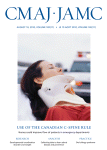
Multicentre prospective validation of use of the Canadian C-Spine Rule by triage nurses in the emergency department
The Canadian C-Spine Rule for imaging of the cervical spine was developed for use by physicians. We believe that nurses in the emergency department could use this rule to clinically clear the cervical spine. We prospect -ively evaluated the accuracy, reliability and acceptability of the Canadian C-Spine Rule when used by nurses.
We conducted this three-year prospective cohort study in six Canadian emergency departments. The study involved adult trauma patients who were alert and whose condition was stable. We provided two hours of training to 191 triage nurses. The nurses then assessed patients using the Canadian C-Spine Rule, including determination of neck tenderness and range of motion, reapplied immobilization and completed a data form.
Of the 3633 study patients, 42 (1.2%) had clinically important injuries of the cervical spine. The kappa value for interobserver assessments of 498 patients with the Canadian C-Spine Rule was 0.78. We calculated sensitivity of 100.0% (95% confidence interval [CI] 91.0%-100.0%) and specificity of 43.4% (95% CI 42.0%-15.0%) for the Canadian C-Spine Rule as interpreted by the investigators. The nurses classified patients with a sensitivity of 90.2% (95% CI 76.0%-95.0%) and a specificity of 43.9% (95% CI 42.0%-16.0%). Early in the study, nurses failed to identify four cases of injury, despite the presence of clear high-risk factors. None of these patients suffered sequelae, and after retraining there were no further missed cases. We estimated that for 40.7% of patients, the cervical spine could be cleared clinically by nurses. Nurses reported discomfort in applying the Canadian C-Spine Rule in only 4.8% of cases.
Use of the Canadian C-Spine Rule by nurses was accurate, reliable and clinically acceptable. Widespread implementation by nurses throughout Canada and elsewhere would diminish patient discomfort and improve patient flow in overcrowded emergency departments.
Journal Article

Prehospital diagnosis and triage of ST-elevation myocardial infarction by paramedics without advanced care training
Prehospital triage of ST-elevation myocardial infarction (STEMI) for primary percutaneous coronary intervention (PCI) reduces treatment times. Prehospital triage and transport of STEMI patients have traditionally been undertaken in emergency medical service systems with Advanced Care Paramedics (ACPs). However, ACPs are not available in many regions. A pilot study was conducted to determine the feasibility of prehospital STEMI triage in a region with only Primary Care Paramedics.
Hemodynamically stable patients with chest pain and suspected STEMI were brought directly to a catheterization laboratory for primary PCI. End points included accuracy of prehospital STEMI identification, complications during transfer, and treatment times.
One hundred thirty-four consecutive patients with suspected STEMI were triaged for primary PCI. Only 1 patient developed complications during transport (rapid atrial flutter) that required ACP skills. One hundred thirty-three patients underwent urgent angiography, and 105 patients underwent PCI. Based on physician interpretation of the prehospital electrocardiogram, there was agreement with triage decision for 121 (90%) of the 134 cases. The final diagnosis based on the angiogram and cardiac markers was true STEMI for 106 patients and false positive for 28 patients. The median first medical contact to balloon time was 91 (81-115) minutes.
Hemodynamically stable patients with suspected STEMI can be safely and effectively transported directly for primary PCI by paramedics without advanced care training. Prehospital STEMI triage for primary PCI can be extended to regions that have few or no paramedics with advanced care training.
Journal Article

Effectiveness of Resident Physicians as Triage Liaison Providers in an Academic Emergency Department
Emergency department (ED) crowding is associated with detrimental effects on ED quality of care. Triage liaison providers (TLP) have been used to mitigate the effects of crowding. Prior studies have evaluated attending physicians and advanced practice providers as TLPs, with limited data evaluating resident physicians as TLPs. This study compares operational performance outcomes between resident and attending physicians as TLPs.
This retrospective cohort study compared aggregate operational performance at an urban, academic ED during pre- and post-TLP periods. The primary outcome was defined as cost-effectiveness based upon return on investment (ROI). Secondary outcomes were defined as differences in median ED length of stay (LOS), median door-to-provider (DTP) time, proportion of left without being seen (LWBS), and proportion of \"very good\" overall patient satisfaction scores.
Annual profit generated for physician-based collections through LWBS capture (after deducting respective salary costs) equated to a gain (ROI: 54%) for resident TLPs and a loss (ROI: -31%) for attending TLPs. Accounting for hospital-based collections made both profitable, with gains for resident TLPs (ROI: 317%) and for attending TLPs (ROI: 86%). Median DTP time for resident TLPs was significantly lower (p<0.0001) than attending or historical control. Proportion of \"very good\" patient satisfaction scores and LWBS was improved for both resident and attending TLPs over historical control. Overall median LOS was not significantly different.
Resident and attending TLPs improved DTP time, patient satisfaction, and LWBS rates. Both resident and attending TLPs are cost effective, with residents having a more favorable financial profile.
Journal Article

A Daytime Fast Track Improves Throughput in a Single Physician Coverage Emergency Department
Fast tracks are one approach to reduce emergency department (ED) crowding. No studies have assessed the use of fast tracks in smaller hospitals with single physician coverage. Our study objective was to determine if implementation of an ED fast track in a single physician coverage setting would improve wait times for low-acuity patients without negatively impacting those of higher acuity.
A daytime fast track opened in 2010 at Strathroy Middlesex General Hospital, a southwestern Ontario community hospital. Before and after intervention groups comprised of ED visits in 2009 and 2011 were compared. Pooled comparison of all Canadian Triage and Acuity Scale (CTAS) patients in each period, and between subgroups CTAS 2-5 comparisons were performed for: wait time (WT), length of stay (LOS), WTs that met national CTAS time guidelines (MNCTG), and proportion of patients that left without being seen (LWBS).
WT and LOS were six minutes (88 min to 82 min, p=0.002) and 15 minutes (158 min to 143 min, p<0.001) lower, respectively, in the post-intervention period. Subgroup analysis showed CTAS 4 had the most pre- to post-intervention decrease in WT, of 13 minutes (98 min to 85 min, p<0.001). There was statistical improvement in MNCTG in the post-intervention period. No differences were found in outcome measures for higher-acuity patients or LWBS rates.
Implementation of a fast track in a medium-volume community hospital with single physician coverage can improve patient throughput by decreasing WT and LOS without negatively impacting high-acuity patients. This may be clinically relevant, particularly for hospital administrators, given the improvement in meeting national WT standards we found post-intervention.
Journal Article

Workforce planning for urgent care services
Due to major changes in how emergency care is delivered across different communities, one emergency department is no longer like another. Some have separate minor injury provision, some are general departments that cater for all types of patient, while others are designated major trauma centres. These differences in patient profile affect the required numbers and skill mix of nursing establishments so that the nursing workforce in each cannot be predicated on patient numbers alone. This article describes the development by the RCN Emergency Care Association of an evidence-based staffing tool and how it can be used in practice.
Journal Article
Physician workload and the Canadian Emergency Department Triage and Acuity Scale: the Predictors of Workload in the Emergency Room (POWER) Study
The Canadian Emergency Department Triage and Acuity Scale (CTAS) is a 5-level triage tool used to determine the priority by which patients should be treated in Canadian emergency departments (EDs). To determine emergency physician (EP) workload and staffing needs, many hospitals in Ontario use a case-mix formula based solely on patient volume at each triage level. The purpose of our study was to describe the distribution of EP time by activity during a shift in order to estimate the amount of time required by an EP to assess and treat patients in each triage category and to determine the variability in the distribution of CTAS scoring between hospital sites.
Research assistants directly observed EPs for 592 shifts and electronically recorded their activities on a moment-by-moment basis. The duration of all activities associated with a given patient were summed to derive a directly observed estimate of the amount of EP time required to treat the patient.
We observed treatment times for 11 716 patients in 11 hospital-based EDs. The mean time for physicians to treat patients was 73.6 minutes (95% confidence interval [CI] 63.6-83.7) for CTAS level 1, 38.9 minutes (95% CI 36.0-41.8) for CTAS-2, 26.3 minutes (95% CI 25.4-27.2) for CTAS-3, 15.0 minutes (95% CI 14.6-15.4) for CTAS-4 and 10.9 minutes (95% CI 10.1-11.6) for CTAS-5. Physician time related to patient care activities accounted for 84.2% of physicians' ED shifts.
In our study, EPs had very limited downtime. There was significant variability in the distribution of CTAS scores between sites and also marked variation in EP time related to each triage category. This brings into question the appropriateness of using CTAS alone to determine physician staffing levels in EDs.
Journal Article
How rapid assessment at triage can improve care outcomes
As the number of patients who present at emergency departments (EDs) increases (Australian College for Emergency Medicine 2005), ED staff are coming under greater pressure to assess, treat and discharge patients within time limits. This article describes the introduction of a rapid assessment team in an ED in Adelaide, Australia, which assesses patients at triage and treats them until space is available in the main department, thereby improving access and patient flow.
Journal Article