
Catalogue Search | MBRL


Are you sure you want to remove the book from the shelf?

{{itemTitle}}
47
result(s) for
"Trials (Political crimes and offenses) -- United States"
Sort by:


Terrorism on trial : political violence and abolitionist futures
A landmark sociological examination of terrorism prosecution in United States courts Rather than functioning as a final arbiter of justice, U.S. domestic courts are increasingly seen as counterterrorism tools that can incapacitate terrorists, maintain national security operations domestically, and produce certain narratives of conflict. Terrorism on Trial examines the contemporary role that these courts play in the global war on terror and their use as a weapon of war: hunting, criminalizing, and punishing entire communities in the name of national security. Nicole Nguyen advocates for a rethinking of popular understandings of political violence and its root causes, encouraging readers to consider anti-imperial abolitionist alternatives to the criminalization, prosecution, and incarceration of individuals marked as real or perceived terrorists. She exposes how dominant academic discourses, geographical imaginations, and social processes have shaped terrorism prosecutions, as well as how our fundamental misunderstanding of terrorism has led to punitive responses that do little to address the true sources of violence, such as military interventions, colonial occupations, and tyrannical regimes. Nguyen also explores how these criminal proceedings bear on the lives of defendants and families, seeking to understand how legal processes unevenly criminalize and disempower communities of color. A retheorization of terrorism as political violence, Terrorism on Trial invites readers to carefully consider the role of power and politics in the making of armed resistance, addressing the root causes of political violence, with a goal of building toward a less violent and more liberatory world.
eBook


Trotskyists on Trial
Passed in June 1940, the Smith Act was a peacetime anti-sedition law that marked a dramatic shift in the legal definition of free speech protection in America by criminalizing the advocacy of disloyalty to the government by force. It also criminalized the acts of printing, publishing, or distributing anything advocating such sedition and made it illegal to organize or belong to any association that did the same. It was first brought to trial in July 1941, when a federal grand jury in Minneapolis indicted twenty-nine Socialist Workers Party members, fifteen of whom also belonged to the militant Teamsters Local 544. Eighteen of the defendants were convicted of conspiring to overthrow the government. Examining the social, political, and legal history of the first Smith Act case, this book focuses on the tension between the nation's cherished principle of free political expression and the demands of national security on the eve of America's entry into World War II.
Based on newly declassified government documents and recently opened archival sources,Trotskyists on Trialexplores the implications of the case for organized labor and civil liberties in wartime and postwar America. The central issue of how Americans have tolerated or suppressed dissent during moments of national crisis is not only important to our understanding of the past, but also remains a pressing concern in the post-9/11 world. This volume traces some of the implications of the compromise between rights and security that was made in the mid-twentieth century, offering historical context for some of the consequences of similar bargains struck today.
eBook


The Fear Within
Sixty years ago political divisions in the United States ran even deeper than today's name-calling showdowns between the left and right. Back then, to call someone a communist was to threaten that person's career, family, freedom, and, sometimes, life itself. Hysteria about the \"red menace\" mushroomed as the Soviet Union tightened its grip on Eastern Europe, Mao Zedong rose to power in China, and the atomic arms race accelerated. Spy scandals fanned the flames, and headlines warned of sleeper cells in the nation's midst--just as it does today with the \"War on Terror.\"
In his new book,The Fear Within, Scott Martelle takes dramatic aim at one pivotal moment of that era. On the afternoon of July 20, 1948, FBI agents began rounding up twelve men in New York City, Chicago, and Detroit whom the U.S. government believed posed a grave threat to the nation--the leadership of the Communist Party-USA. After a series of delays, eleven of the twelve \"top Reds\" went on trial in Manhattan's Foley Square in January 1949.
The proceedings captivated the nation, but the trial quickly dissolved into farce. The eleven defendants were charged under the 1940 Smith Act with conspiring to teach the necessity of overthrowing the U.S. government based on their roles as party leaders and their distribution of books and pamphlets. In essence, they were on trial for their libraries and political beliefs, not for overt acts threatening national security. Despite the clear conflict with the First Amendment, the men were convicted and their appeals denied by the U.S. Supreme Court in a decision that gave the green light to federal persecution of Communist Party leaders--a decision the court effectively reversed six years later. But by then, the damage was done. So rancorous was the trial the presiding judge sentenced the defense attorneys to prison terms, too, chilling future defendants' access to qualified counsel.
Martelle's story is a compelling look at how American society, both general and political, reacts to stress and, incongruously, clamps down in times of crisis on the very beliefs it holds dear: the freedoms of speech and political belief. At different points in our history, the executive branch, Congress, and the courts have subtly or more drastically eroded a pillar of American society for the politics of the moment. It is not surprising, then, thatThe Fear Withintakes on added resonance in today's environment of suspicion and the decline of civil rights under the U.S. Patriot Act.
eBook

Perjury
When the Hiss-Chambers case first burst on the scene in 1948, its main characters and events seemed more appropriate to spy fiction than to American reality. The major historical authority on the case, Perjury was first published in 1978. Now, in its latest edition, Perjury links together the old and new evidence, much of it previously undiscovered or unavailable, bringing the Hiss-Chambers's amazing story up to the present.
eBook

Fugitive justice : runaways, rescuers, and slavery on trial
During the tumultuous decade before the Civil War, no issue was more divisive than the pursuit and return of fugitive slaves—a practice enforced under the Fugitive Slave Act of 1850. When free Blacks and their abolitionist allies intervened, prosecutions and trials inevitably followed. These cases involved high legal, political, and—most of all—human drama, with runaways desperate for freedom, their defenders seeking recourse to a \"higher law\" and normally fair-minded judges (even some opposed to slavery) considering the disposition of human beings as property.
Fugitive Justice tells the stories of three of the most dramatic fugitive slave trials of the 1850s, bringing to vivid life the determination of the fugitives, the radical tactics of their rescuers, the brutal doggedness of the slavehunters, and the tortuous response of the federal courts. These cases underscore the crucial role that runaway slaves played in building the tensions that led to the Civil War, and they show us how \"civil disobedience\" developed as a legal defense. As they unfold we can also see how such trials—whether of rescuers or of the slaves themselves—helped build the northern anti-slavery movement, even as they pushed southern firebrands closer to secession.
How could something so evil be treated so routinely by just men? The answer says much about how deeply the institution of slavery had penetrated American life even in free states. Fugitive Justice powerfully illuminates this painful episode in American history, and its role in the nation's inexorable march to war.
eBook
Economist video. What does this guilty verdict mean for Trump?
Donald Trump is a convicted felon. Historic, yes. Game-changer? Don't bank on it.
Streaming Video
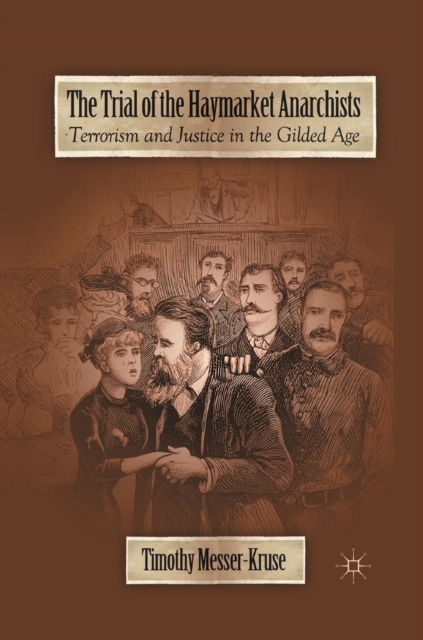
The trial of the Haymarket Anarchists : terrorism and justice in the Gilded Age
The Trial of the Haymarket Anarchists is the culmination of seven years of research into the 1886 Haymarket bombing and subsequent trial. It not only overturns the prevailing consensus on this event, it documents in detail how the basic facts, as far as they can be determined, have been distorted, obscured, or suppressed for seventy years.
eBook