
Catalogue Search | MBRL


Are you sure you want to remove the book from the shelf?

{{itemTitle}}
852
result(s) for
"Trials (Witchcraft)"
Sort by:


Witchcraft and Inquisition in Early Modern Venice
In early modern Europe, ideas about nature, God, demons and occult forces were inextricably connected and much ink and blood was spilled in arguments over the characteristics and boundaries of nature and the supernatural. Seitz uses records of Inquisition witchcraft trials in Venice to uncover how individuals across society, from servants to aristocrats, understood these two fundamental categories. Others have examined this issue from the points of view of religious history, the history of science and medicine, or the history of witchcraft alone, but this work brings these sub-fields together to illuminate comprehensively the complex forces shaping early modern beliefs.
eBook

The crucible : a play in four acts
As a wave of anti-communist investigations swept across American society during the 1950s, Miller exposed the horror of such witch-hunts by retelling the story of the infamous Salem witch trials in Massachusetts in 1692.
Book

Magic, Body and the Self in Eighteenth-Century Sweden
Providing a unique insight into early modern notions of body and self, this book offers a comprehensive interpretation of Swedish witchcraft in the eighteenth century and its endurance as every day social practice in the age of Enlightenment.
eBook

The heretic's daughter : a novel
Martha Carrier was one of the first women to be accused, tried, and hanged as a witch in Salem, Massachusetts. This is the haunting story of Carrier's courageous defiance and ultimate death, as told by her daughter, Sarah.
Book

Desperate Magic
In the courtrooms of seventeenth-century Russia, the great majority of those accused of witchcraft were male, in sharp contrast to the profile of accused witches across Catholic and Protestant Europe in the same period. While European courts targeted and executed overwhelmingly female suspects, often on charges of compacting with the devil, the tsars' courts vigorously pursued men and some women accused of practicing more down-to-earth magic, using poetic spells and home-grown potions. Instead of Satanism or heresy, the primary concern in witchcraft testimony in Russia involved efforts to use magic to subvert, mitigate, or avenge the harsh conditions of patriarchy, serfdom, and social hierarchy.
Broadly comparative and richly illustrated with color plates,Desperate Magicplaces the trials of witches in the context of early modern Russian law, religion, and society. Piecing together evidence from trial records to illuminate some of the central puzzles of Muscovite history, Kivelson explores the interplay among the testimony of accusers, the leading questions of the interrogators, and the confessions of the accused. Assembled, they create a picture of a shared moral vision of the world that crossed social divides. Because of the routine use of torture in extracting and shaping confessions, Kivelson addresses methodological and ideological questions about the Muscovite courts' equation of pain and truth, questions with continuing resonance in the world today. Within a moral economy that paired unquestioned hierarchical inequities with expectations of reciprocity, magic and suspicions of magic emerged where those expectations were most egregiously violated.
Witchcraft in Russia surfaces as one of the ways that oppression was contested by ordinary people scrambling to survive in a fiercely inequitable world. Masters and slaves, husbands and wives, and officers and soldiers alike believed there should be limits to exploitation and saw magic deployed at the junctures where hierarchical order veered into violent excess.
eBook

City of Crows
\"Set in seventeenth-century France--a country in the thrall of dark magic, its social fabric weakened by years of plague--Chris Womersley's City of Crows ... tells the story of Charlotte Picot, a young woman from the country forced to venture to the fearsome city of Paris in search of her only-remaining son, Nicolas. Fate (or coincidence) places the quick-witted charlatan Adam Lesage in her path\"--Publisher marketing.
Book

The Templars, the Witch, and the Wild Irish
Early medieval Ireland is remembered as the \"Land of Saints and Scholars,\" due to the distinctive devotion to Christian faith and learning that permeated its culture. As early as the seventh century, however, questions were raised about Irish orthodoxy, primarily concerning Easter observances. Yet heresy trials did not occur in Ireland until significantly later, long after allegations of Irish apostasy from Christianity had sanctioned the English invasion of Ireland. InThe Templars, the Witch, and the Wild Irish, Maeve Brigid Callan analyzes Ireland's medieval heresy trials, which all occurred in the volatile fourteenth century. These include the celebrated case of Alice Kyteler and her associates, prosecuted by Richard de Ledrede, bishop of Ossory, in 1324. This trial marks the dawn of the \"devil-worshipping witch\" in European prosecutions, with Ireland an unexpected birthplace.
Callan divides Ireland's heresy trials into three categories. In the first stand those of the Templars and Philip de Braybrook, whose trial derived from the Templars', brought by their inquisitor against an old rival. Ledrede's prosecutions, against Kyteler and other prominent Anglo-Irish colonists, constitute the second category. The trials of native Irishmen who fell victim to the sort of propaganda that justified the twelfth-century invasion and subsequent colonization of Ireland make up the third. Callan contends that Ireland's trials resulted more from feuds than doctrinal deviance and reveal the range of relations between the English, the Irish, and the Anglo-Irish, and the church's role in these relations; tensions within ecclesiastical hierarchy and between secular and spiritual authority; Ireland's position within its broader European context; and political, cultural, ethnic, and gender concerns in the colony.
Early medieval Ireland is remembered as the \"Land of Saints and Scholars,\" due to the distinctive devotion to Christian faith and learning that permeated its culture. As early as the seventh century, however, questions were raised about Irish orthodoxy, primarily concerning Easter observances. Yet heresy trials did not occur in Ireland until significantly later, long after allegations of Irish apostasy from Christianity had sanctioned the English invasion of Ireland. InThe Templars, the Witch, and the Wild Irish, Maeve Brigid Callan analyzes Ireland's medieval heresy trials, which all occurred in the volatile fourteenth century. These include the celebrated case of Alice Kyteler and her associates, prosecuted by Richard de Ledrede, bishop of Ossory, in 1324. This trial marks the dawn of the \"devil-worshipping witch\" in European prosecutions, with Ireland an unexpected birthplace.Callan divides Ireland's heresy trials into three categories. In the first stand those of the Templars and Philip de Braybrook, whose trial derived from the Templars', brought by their inquisitor against an old rival. Ledrede's prosecutions, against Kyteler and other prominent Anglo-Irish colonists, constitute the second category. The trials of native Irishmen who fell victim to the sort of propaganda that justified the twelfth-century invasion and subsequent colonization of Ireland make up the third. Callan contends that Ireland's trials resulted more from feuds than doctrinal deviance and reveal the range of relations between the English, the Irish, and the Anglo-Irish, and the church's role in these relations; tensions within ecclesiastical hierarchy and between secular and spiritual authority; Ireland's position within its broader European context; and political, cultural, ethnic, and gender concerns in the colony.
eBook

The witches : Salem, 1692
The Pulitzer Prize-winning author of Cleopatra analyzes the Salem Witch Trials to offer key insights into the role of women in its events while explaining how its tragedies became possible.
Book
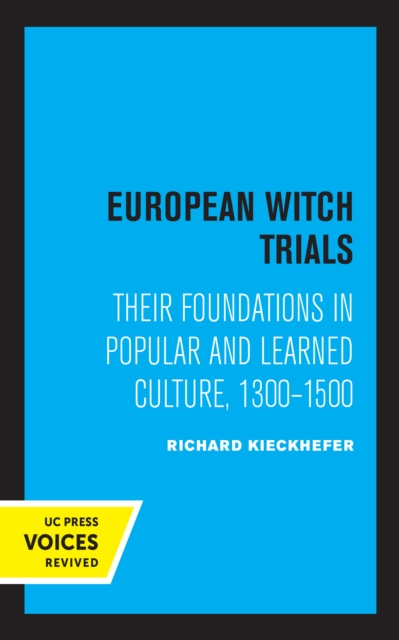
European Witch Trials
This title is part of UC Press's Voices Revived program, which commemorates University of California Press's mission to seek out and cultivate the brightest minds and give them voice, reach, and impact. Drawing on a backlist dating to 1893, Voices Revived makes high-quality, peer-reviewed scholarship accessible once again using print-on-demand technology. This title was originally published in 1976.
eBook