
Catalogue Search | MBRL


Are you sure you want to remove the book from the shelf?

{{itemTitle}}
32
result(s) for
"Trump, Donald, 1946- Impeachment."
Sort by:


The Comparative Constitutional Law of Presidential Impeachment
With the charging and acquittal of President Donald Trump, impeachment once again assumed a central role in U.S. constitutional law and politics. Yet because so few impeachments, presidential or otherwise, have occurred in U.S history, we have little understanding of how removing presidents in the middle of a term alters the direction or quality of a constitutional democracy. This Article illuminates the appropriate scope and channels of impeachment by providing a comprehensive description of the law and practice of presidential removal in the global frame. We first catalog possible modalities of impeachment through case studies from South Korea, Paraguay, Brazil, and South Africa. We then deploy large-N empirical analysis of constitutional texts, linked to data about democratic quality in the wake of successful and unsuccessful removal efforts, in order to understand the impact of impeachment on democracy. Contrary to claims tendered in the U.S. context, we show that impeachment is not well conceived as solely and exclusively a tool for removing criminals or similar \"bad actors\" from the presidency. Instead, it is commonly and effectively used as a tool to resolve a particular kind of political crisis in which the incumbent has lost most popular support. Moreover, despite much recent concern about the traumatic and destabilizing effects of an impeachment, we do not find that either successful or unsuccessful removals have a negative impact on the quality of democracy as such. Our comparative analysis has normative implications for the design and practice of impeachment, especially in the United States—although those implications must be carefully drawn given the limits of feasible causal inference. The analysis provides consequentialist grounds for embracing a broader, more political gloss on the famously cryptic phrase \"high Crimes and Misdemeanors,\" in contrast to the narrow, criminal standard that President Trump, in line with other presidents, promoted. A criminal offense standard, however, might be appropriate for judges and other officers subject to impeachment. We suggest a multitiered impeachment standard is sensible. Also against settled U.S. understandings, the analysis shows how other institutions, such as courts, can and do play a valuable role in increasing the credibility of factual and legal determinations made during impeachment. Finally, it suggests that impeachment works best where, in contrast to U.S. design, a successful removal triggers rapid new elections that can serve as a \"hard reboot\" for a crisis-ridden political system.
Journal Article
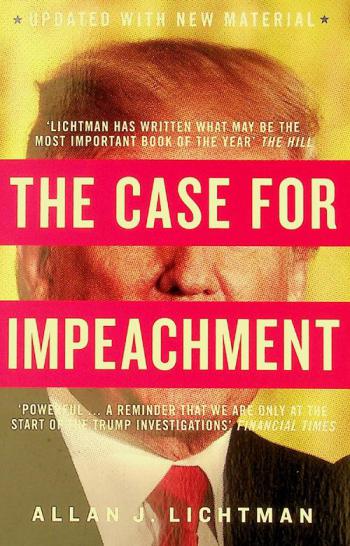
The case for impeachment
Professor Allan J. Lichtman, who has correctly forecasted thirty years of presidential elections, makes the case for impeaching the 45th president of the United States, Donald J. Trump. In the fall of 2016, Distinguished Professor of History at American University Allan Lichtman made headlines when he predicted that Donald J. Trump would defeat Democrat, Hillary Clinton, to win the presidential election. Now, in clear, nonpartisan terms, Lichtman lays out the reasons Congress could remove Trump from the Oval Office: his ties to Russia before and after the election, the complicated financial conflicts of interest at home and abroad, and his abuse of executive authority. The Case for Impeachment also offers a fascinating look at presidential impeachments throughout American history, including the often-overlooked story of Andrew Johnson's impeachment, details about Richard Nixon's resignation, and Bill Clinton's hearings. Lichtman shows how Trump exhibits many of the flaws (and more) that have doomed past presidents. Historians, legal scholars, and politicians alike agree: we are in politically uncharted waters. The durability of institutions is being undermined and the public's confidence in them is eroding, threatening American democracy itself. The world wants to know where the United States is headed. Lichtman argues, with clarity and power, that for Donald Trump's presidency, smoke has become fire.

President Trump Impeached and Acquitted of Charges Relating to His Conduct of Foreign Affairs
On December 18, 2019, by a majority vote, the House of Representatives impeached President Trump for abusing power by soliciting Ukrainian interference in the 2020 presidential election and then obstructing the House's impeachment investigation. The allegations against Trump rested substantially on a phone conversation between Trump and Ukrainian president Volodymyr Zelensky on July 25, 2019. During this conversation, Trump asked Zelensky to investigate the prior conduct of Joe Biden—Trump's likely political opponent for the 2020 presidential election. While the House was conducting its impeachment investigation, the White House directed executive branch officials not to testify or to turn over documents. Less than two months after the impeachment, on February 5, 2020, the Senate voted to acquit Trump of the charges, with a majority of Senators voting in favor of acquittal.
Journal Article


The case for impeachment
\"In the fall of 2016, Allan J. Lichtman ... made headlines when he predicted that Donald J. Trump would defeat Hillary Clinton to win the presidency. In this timely, considered volume written in clear, nonpartisan terms, Lichtman lays out the reasons Congress could remove Trump from the Oval Office: his ties to Russia before and after the election and his possible obstruction of the investigation--including his firing FBI Director James Comey--the complicated financial conflicts of interest at home and abroad, and his abuse of executive authority. [This book] also offers a fascinating look at presidential impeachment proceedings throughout American history, including those involving Andrew Johnson, Richard Nixon, and Bill Clinton. Lichtman shows how Trump exhibits many of the flaws (and more) that have doomed past presidents and argues, with clarity and power, that for Donald Trump's presidency, smoke has become fire.\"--Page [4] of cover.
BOOK