
Catalogue Search | MBRL


Are you sure you want to remove the book from the shelf?

{{itemTitle}}
2,057
result(s) for
"Tschechien"
Sort by:

Flashbacks of the bad old days?
Numerous countries are reportedly witnessing the bureaucratization of universities, manifesting inter alia in a gradual increase in the administrative burden that overshadows the core missions of universities. Regrettably, there is a notable gap in research specifically focused on bureaucratization of higher education institutions in post-communist countries, where state bureaucratic control over economies, societies, and academic institutions prevailed before 1990. This article seeks to address this gap by examining the perception of the administrative burden among a representative sample of 1117 Czech academic workers, utilizing a diverse range of methods, including an experimental component. The majority of academics are experiencing an escalation in administrative demands that curtails the time and effort they can allocate to research and teaching. While they do see potential in digitalization and modern technology, they view the existing university bureaucracy as inefficient, ever-increasing, and excessively regulated, particularly in relation to grants and subsidy programs. Notably, for many seasoned academics who have lived through communism, modern university bureaucracy is a reminder of the \"bad old days.\" (HRK / Abstract übernommen).
Journal Article

The Relationship Between the Inhabitants of the City Divided by the Border with Polish and Czech Cultural Institutions in the Context of Cultural Education
Purpose: The aim of the article is to define the factors that affect the relationship between the inhabitants of the city divided by the border with Polish and Czech cultural institutions, in terms of cultural education. Design/Methodology/Approach: The survey was conducted using the CATI (Computer-Assisted Telephone Interview) technique in October and November 2019 on a randomly selected sample--1035 inhabitants of Cieszyn (555 respondents from Poland) and Czech Cieszyn (480 people from the Czech side). The acquired data was subjected to factor analysis and SEM (Structural Equation Modelling) analysis. Findings: The results of the SEM analysis confirmed that the instruments identified by the authors had a positive (stimulating) effect on the tendency of the inhabitants of the city divided by the border to establish relations with Polish and Czech cultural institutions. The article proves that the activities of cultural institutions located both on the Polish and Czech sides of the city of Cieszyn--Czech Cieszyn, divided by the border, have a positive impact on establishing relationships between cultural entities and the inhabitants of the city divided by the border. Practical Implications: The analysed instruments can be used in the process of shaping long-term relationships with recipients of the cultural offer on both sides of the border. Originality/value: The article shows that the marketing instruments identified by the authors can also be used in the broadly understood process of cultural education. Keywords: Cultural education, cultural institutions, city borders, marketing, relations. JEL classification: M31, L31. Paper Type: Research study. Acknowledgement: The paper is funded under the program of the Minister of Science and Higher Education titled \"Regional Initiative of Excellence\" in 2019-2022, project number 018/RID/2018/19, the amount of funding PLN 10788423,16.
Journal Article

Europe under multi-year droughts: how severe was the 2014–2018 drought period?
The recent dry and warm years in Europe are often assessed as extreme in terms of socio-economic and environmental losses. However, the impact of a drought is a function of its duration. This fact needs to be considered in the evaluation of a drought. In this study, we use a hydrological model to analyze the 2018 European drought, an event that significantly affected vegetation. We show that the severity of the soil moisture drought is high in Central Europe and Mediterranean, but it does not reach the levels observed in the first half of the 20th century. Nevertheless, we demonstrate that when the multi-year 2014–2018 period is considered, its soil moisture drought severity is exceptional in a 253 year period, especially for Central Europe. While single-year droughts can be sustained by ecosystems like forests, the repeated stress exposure of such multi-year droughts may have significant impacts on their functioning. This is already evident in some regions of Central Europe, e.g. in the Czech Republic, Germany, and Poland.
Journal Article

Influence of precipitation and temperature on maize production in the Czech Republic from 2002 to 2019
Maize is one of the important food crops in the Czech Republic, its growth and productivity are influenced by climate change. This study investigated the influence of precipitation under recent climate change on maize yield both for grain and silage in the whole Czech Republic during 2002–2019. Total maize yield and yield rate increased in the Czech Republic from 1961 to 2010, but they became to decrease after 2010. This is in line with the tendency of decreased precipitation and an increase in temperature after 2010, and changes are especially significant during the maize growing period, which indicates the importance of temperature and precipitation. In detail, there is a low to moderate negative correlation (−0.39 to −0.51) between grain maize yield and the average temperature in August for almost all the regions. While there is a low negative correlation between silage maize yield with the average temperature in July and August from some regions. The precipitation in July exhibited moderate to high positive correlation (0.54–0.79) to grain maize yield rate for almost all the regions, and it had low to moderate positive correlation (0.35–0.70) to silage maize yield rate for all the regions. Water deficit exhibited a negative correlation with both maize yield rate and its influence mainly in July for silage but both in July and August for grain. Farmer’s profit from grain maize is influence by yield rate, temperature, precipitation, and water deficit. A positive correlation was found between profit and grain yield rate and precipitation from July and August, while a negative correlation was detected between profit and water deficit and the average temperature in July and August. In conclusion, our results pointed out the factors influencing maize yield rate under changing climate conditions in the Czech Republic, and it warrants further studies on how to maintain maize production in a changing climate.
Journal Article

EnviBIM: Environmental data module for BIM library of construction elements
BIM has become widely used and preferred in building design. The benefits of this model can also be used to calculate the environmental impact of buildings. This paper presents the acquisition and implementation of environmental data to the existing and growing BIM library of building materials. The library contains specific (non-generic) elements, and its content is focused on conventional solutions used in Czech Republic. Environmental impacts associated with the production of building materials and elements (cradle-gate) were added to the BIM library and were expressed by 14 indicators. Generic environmental data were used. Linking them with specifics products demand high expertise and a lot of time. By designing methodology and specific guidelines, this process is speeded up, simplified, and future update and extend of resulting tool is enabled. Resulting tool (EnviBIM) will provide quantification of embodied environmental impacts of each single building part directly in the BIM model.
Journal Article
The burden of kidney cancer and its attributable risk factors in 195 countries and territories, 1990–2017
Kidney cancer globally accounts for more than 131,000 deaths each year and has been found to place a large economic burden on society. However, there are no recent articles on the burden of kidney cancer across the world. The aim of this study was to present a status report on the incidence, mortality and disability-adjusted life years (DALYs) associated with kidney cancer in 195 countries, from 1990 to 2017. Vital registration and cancer registry data (total of 23,660 site-years) were used to generate the estimates. Mortality was estimated first and the incidence and DALYs were calculated based on the estimated mortality values. All estimates were presented as counts and age-standardised rates per 100,000 population. The estimated rates were calculated by age, sex and according to the Socio-Demographic Index (SDI). In 2017, kidney cancer accounted for 393.0 thousand (95% UI: 371.0–404.6) incident cases, 138.5 thousand (95% UI: 128.7–142.5) deaths and 3.3 million (95% UI: 3.1–3.4) DALYs globally. The global age-standardised rates for the incidence, deaths and DALY were 4.9 (95% UI: 4.7–5.1), 1.7 (95% UI: 1.6–1.8) and 41.1 (95% UI: 38.7–42.5), respectively. Uruguay [15.8 (95% UI: 13.6–19.0)] and Bangladesh [1.5 (95% UI: 1.0–1.8)] had highest and lowest age-standardised incidence rates, respectively. The age-standardised death rates varied substantially from 0.47 (95% UI: 0.34–0.58) in Bangladesh to 5.6 (95% UI: 4.6–6.1) in the Czech Republic. Incidence and mortality rates were higher among males, than females, across all age groups, with the highest rates for both sexes being observed in the 95+ age group. Generally, positive associations were found between each country’s age-standardised DALY rate and their corresponding SDI. The considerable burden of kidney cancer was attributable to high body mass index (18.5%) and smoking (16.6%) in both sexes. There are large inter-country differences in the burden of kidney cancer and it is generally higher in countries with a high SDI. The findings from this study provide much needed information for those in each country that are making health-related decisions about priority areas, resource allocation, and the effectiveness of prevention programmes. The results of our study also highlight the need for renewed efforts to reduce exposure to the kidney cancer risk factors and to improve the prevention and the early detection of this disease.
Journal Article
Analysis of the Differences in Using Online Marketing Tools for Measuring its Effectiveness in the Segment of Small and Medium-Sized Companies in the Czech Republic
Originality/Value: The need to monitor the use of online marketing communication tools, measure their effectiveness and determine the real usefulness of their use in the segment of small and medium-sized businesses will be a current topic for the research team soon at the end of the year 2022, and it will be useful to ask respondents recurring questions and create time series from the answers found. It is advisable to look for answers to the perception of the usefulness of using online marketing in business by the business entities themselves and to expand the research with new current topics. A new perspective can bring about the inclusion of another criterion for the breakdown of respondents, namely their age
Journal Article
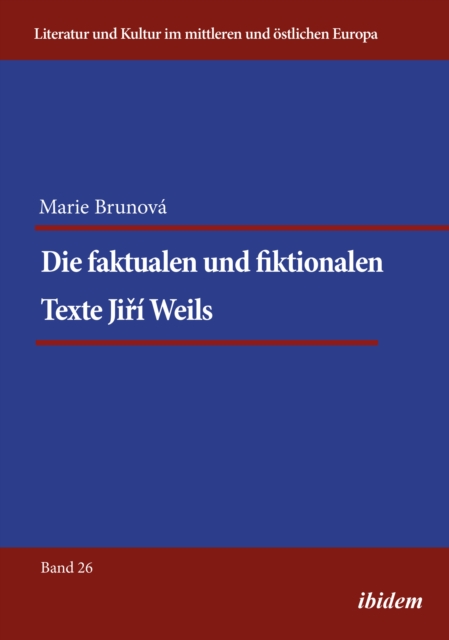
Die Faktualen und Fiktionalen Texte Jiri Weils
Mit dem vorliegenden Band legt Marie Brunová die Ergebnisse langjähriger Recherche und Forschung zu Leben und Werk von Jiří Weil (1900–1959) vor. Der kommunistisch orientierte Schriftsteller jüdischer Herkunft verfasste Reportagen, Erzählungen und Romane; er wurde sowohl von den Nationalsozialisten als auch vom kommunistischen Regime schikaniert und unterdrückt.
Auf der Basis der Fiktionalitätstheorie unternimmt Brunová eine Klassifikation und textkritische Beschreibung der Prosatexte Weils, die auf viele Sachverhalte in der Werkgenese und auch Biographie Weils ein neues Licht wirft und überraschende Perspektiven aufzeigt.
Das Buch stellt die bislang detaillierteste und ausführlichste Würdigung von und Auseinandersetzung mit Weils Schaffen dar.
eBook


Investigating the impact of person-organization fit on employee well-being in uncertain conditions: a study in three central European countries
PurposeThe objective of this research is to explore the relationship between person-organization fit and employee well-being in the context of uncertainty across three Central European countries: Lithuania, Slovakia and Hungary.Design/methodology/approachThis study employed a survey-based approach to gather primary data from Lithuania, Slovakia and Hungary, resulting in a total of 1,140 respondents. The survey utilized a structured questionnaire designed with a five-point Likert scale. The questionnaire consisted of three main sections: person-organization fit, employee well-being and demographic information. Person-organization fit was assessed through a 3-item scale, while employee well-being was evaluated using an 18-item scale that included 3 dimensions: life well-being, workplace well-being and psychological well-being. Partial least squares structural equation modeling (PLS-SEM) was employed to analyze the survey data.FindingsThe findings of the study reveal significant positive relationships between person-organization fit and three dimensions of employee well-being – life well-being, workplace well-being and psychological well-being – in three Central European countries: Lithuania, Slovakia and Hungary. Notably, there were discernible differences between Hungary and Lithuania, as well as between Slovakia and Lithuania. Conversely, no significant distinctions were observed between Hungary and Slovakia in relation to these variables.Originality/valueThis research has the potential to shed light on how the alignment between individual values and organizational values impacts employee well-being, particularly within the context of volatile periods such as the COVID-19 pandemic. This understanding can guide organizations in fostering a work environment that supports employees. Furthermore, the results of this study create the prospect of providing actionable guidance to organizations aiming to strengthen their approaches for enhancing employee well-being across dimensions such as life well-being, workplace well-being and psychological well-being.
Journal Article