
Catalogue Search | MBRL


Are you sure you want to remove the book from the shelf?

{{itemTitle}}
322
result(s) for
"Turkey -- History -- 19th century"
Sort by:


Opposition and Legitimacy in the Ottoman Empire
This book looks at opposition to the Ottoman government in the second half of the nineteenth century, examining a number of key political conspiracies and how these relate to an existing political culture. In his detailed analysis of these conspiracies, the author offers a new perspective on an important and well researched period of Ottoman history.
A close reading of police records on five conspiracies offers the opportunity to analyse this opposition in great detail, giving special attention to the different groups of political actors in these conspiracies that often did not come from the established political elites. Florian Riedler investigates how their background of class and education, but also their individual life experiences influenced their aims and strategies, their political styles as well as their ways of thinking on political legitimacy. In contrast, the reaction of the authorities to these conspiracies reveals the official understanding of Ottoman legitimacy.
The picture that emerges of the political culture of opposition during the second half of the nineteenth century offers a unique contribution to our understanding of the great changes in the political system of the Ottoman Empire at the time. As such, it will be of great interest to scholars of Middle Eastern history, political history, and the Ottoman Empire.
Florian Riedler is a historian specialising in Ottoman history of the nineteenth century. His current research interests are social and urban history of the Eastern Mediterranean, particularly Istanbul, as well as the history of migration in the Ottoman Empire.
1. Introduction: Political Culture of Conspiracy 2. A Sheikh and an Officer: The Society of Martyrs and the Kuleli Incident 3. New and Old Forms of Opposition: The Young Ottomans and the Vocation Group 4. How To Exchange Sultans: The Successful Coup Against Abdülaziz 5. War and Refugees: Ali Suavi and the Çırağan Incident 6. Bourgeois Conspirators: The Skalieri-Aziz Committee 7. Conclusion: The Tanzimat and Beyond
eBook

Conversion and apostasy in the late Ottoman Empire
\"In the nineteenth-century Ottoman Empire traditional religious structures crumbled as the empire itself began to fall apart. The state's answer to schism was regulation and control, administered in the form of a number of edicts in the early part of the century. It is against this background that different religious communities and individuals negotiated survival by converting to Islam when their political interests or their lives were at stake. As the century progressed, however, conversion was no longer sufficient to guarantee citizenship and property rights as the state became increasingly paranoid about its apostates and what it perceived as their 'denationalization'. The book tells the story of the struggle between the Ottoman State, the Great Powers and a multitude of evangelical organizations, shedding light on current flash-points in the Arab world and the Balkans, offering alternative perspectives on national and religious identity and the interconnection between the two\"-- Provided by publisher.
Book

Turkey, Islam, nationalism, and modernity : a history, 1789-2007
This title reveals the historical dynamics propelling two centuries of Ottoman and Turkish history. Findley's reassessment of political, economic and cultural history highlights the dialectical interaction between radical and conservative currents of change.
eBook


Biography of an empire
This vividly detailed revisionist history opens a new vista on the great Ottoman Empire in the early nineteenth century, a key period often seen as the eve of Tanzimat westernizing reforms and the beginning of three distinct histories—ethnic nationalism in the Balkans, imperial modernization from Istanbul, and European colonialism in the Middle East. Christine Philliou brilliantly shines a new light on imperial crisis and change in the 1820s and 1830s by unearthing the life of one man. Stephanos Vogorides (1780–1859) was part of a network of Christian elites known phanariots, institutionally excluded from power yet intimately bound up with Ottoman governance. By tracing the contours of the wide-ranging networks—crossing ethnic, religious, and institutional boundaries—in which the phanariots moved, Philliou provides a unique view of Ottoman power and, ultimately, of the Ottoman legacies in the Middle East and Balkans today. What emerges is a wide-angled analysis of governance as a lived experience at a moment in which there was no clear blueprint for power.
eBook


Orphans and Destitute Children in the Late Ottoman Empire
History books often weave tales of rising and falling empires, royal dynasties, and wars among powerful nations. Here, Maksudyan succeeds in making those who are farthest removed from power the lead actors in this history. Focusing on orphans and destitute youth of the late Ottoman Empire, the author gives voice to those children who have long been neglected. Their experiences and perspectives shed new light on many significant developments of the late Ottoman period, providing an alternative narrative that recognizes children as historical agents.Maksudyan takes the reader from the intimate world of infant foundlings to the larger international context of missionary orphanages, all while focusing on Ottoman modernization, urbanization, citizenship, and the maintenance of order and security. Drawing upon archival records, she explores the ways in which the treatment of orphans intersected with welfare, labor, and state building in the Empire. Throughout the book, Maksudyan does not lose sight of her lead actors, and the influence of the children is always present if we simply listen and notice carefully as Maksudyan so convincingly argues.
eBook

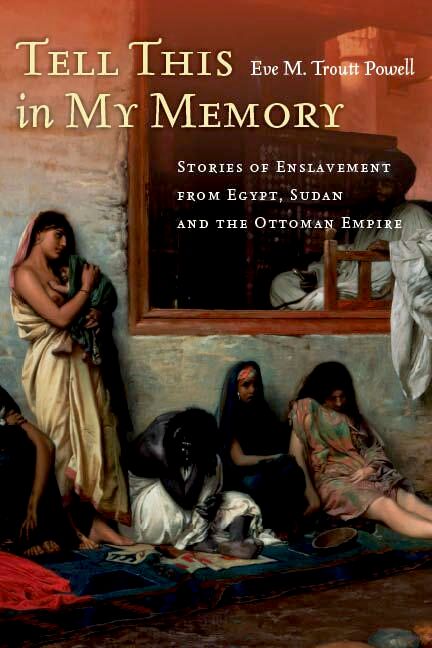
Tell this in my memory : stories of enslavement from Egypt, Sudan, and the Ottoman Empire
In the late nineteenth century, an active slave trade sustained social and economic networks across the Ottoman Empire and throughout Egypt, Sudan, the Caucasus, and Western Europe. Unlike the Atlantic trade, slavery in this region crossed and mixed racial and ethnic lines. Fair-skinned Circassian men and women were as vulnerable to enslavement in the Nile Valley as were teenagers from Sudan or Ethiopia.
Tell This in My Memory opens up a new window in the study of slavery in the modern Middle East, taking up personal narratives of slaves and slave owners to shed light on the anxieties and intimacies of personal experience. The framework of racial identity constructed through these stories proves instrumental in explaining how countries later confronted—or not—the legacy of the slave trade. Today, these vocabularies of slavery live on for contemporary refugees whose forced migrations often replicate the journeys and stigmas faced by slaves in the nineteenth century.
eBook