
Catalogue Search | MBRL


Are you sure you want to remove the book from the shelf?

{{itemTitle}}
27
result(s) for
"Turkey -- Politics and government -- 1909"
Sort by:


Return to Point Zero
How did the Turkish-Kurdish Conflict arise? Why have Turks and
Kurds failed for so long to solve it? How can they solve it today?
How can social scientists better analyze this and other protracted
conflicts and propose better prescriptions for sustainable peace?
Return to Point Zero develops a novel framework for
analyzing the historical-structural and contemporary causes of
ethnic-national conflicts, highlighting an understudied dimension:
politics. Murat Somer argues that intramajority group politics
rather than majority-minority differences better explains
ethnic-national conflicts. Hence, the political-ideological
divisions among Turks are the key to understanding the
Turkish-Kurdish Conflict; though it was nationalism that produced
the Kurdish Question during late-Ottoman imperial
modernization, political elite decisions by the Turks created the
Kurdish Conflict during the postimperial nation-state
building. Today, ideational rigidities reinforce the conflict.
Analyzing this conflict from \"premodern\" times to today, Somer
emphasizes two distinct periods: the formative era of 1918-1926 and
the post-2011 reformative period. Somer argues that during the
formative era, political elites inadequately addressed three
fundamental dilemmas of security, identity, and cooperation and
includes a discussion of how the legacy of those political elite
decisions impacted and framed peace attempts that have failed in
the 1990s and 2010s. Return to Point Zero develops new
concepts to analyze conflicts and concrete conflict-resolution
proposals.
eBook

The making of modern Turkey : nation and state in Eastern Anatolia, 1913-1950
This novel perspective on the establishment of the Turkish nation state highlights how the Young Turk regime, from 1913 to 1950, subjected Eastern Turkey to various forms of nationalist population policies aimed at ethnically homogenizing the region and including it in the Turkish nation state.
Book

Genocide in the Ottoman Empire
The final years of the Ottoman Empire were catastrophic ones for its non-Turkish, non-Muslim minorities. From 1913 to 1923, its rulers deported, killed, or otherwise persecuted staggering numbers of citizens in an attempt to preserve \"Turkey for the Turks,\" setting a modern precedent for how a regime can commit genocide in pursuit of political ends while largely escaping accountability. While this brutal history is most widely known in the case of the Armenian genocide, few appreciate the extent to which the Empire's Assyrian and Greek subjects suffered and died under similar policies. This comprehensive volume is the first to broadly examine the genocides of the Armenians, Assyrians, and Greeks in comparative fashion, analyzing the similarities and differences among them and giving crucial context to present-day calls for recognition.
eBook

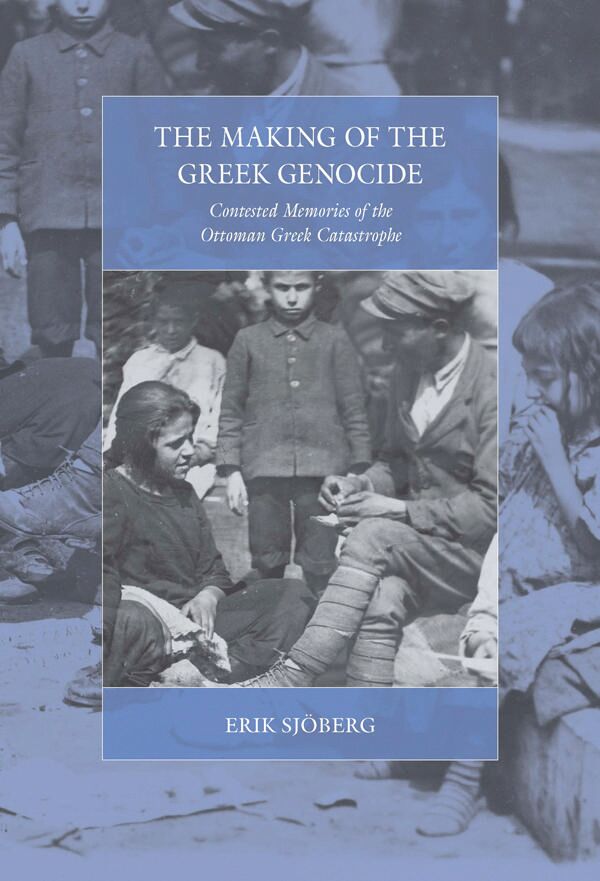
The Making of the Greek Genocide
During and after World War I, over one million Ottoman Greeks were expelled from Turkey, a watershed moment in Greek history that resulted in hundreds of thousands of deaths. And while few dispute the expulsion's tragic scope, it remains the subject of fierce controversy, as activists have fought for international recognition of an atrocity they consider comparable to the Armenian genocide. This book provides a much-needed analysis of the Greek genocide as cultural trauma. Neither taking the genocide narrative for granted nor dismissing it outright, Erik Sjöberg instead recounts how it emerged as a meaningful but contested collective memory with both nationalist and cosmopolitan dimensions.
eBook


The Making of the Greek Genocide
During and after World War I, over one million Ottoman Greeks
were expelled from Turkey, a watershed moment in Greek history that
resulted in hundreds of thousands of deaths. And while few dispute
the expulsion's tragic scope, it remains the subject of fierce
controversy, as activists have fought for international recognition
of an atrocity they consider comparable to the Armenian genocide.
This book provides a much-needed analysis of the Greek genocide as
cultural trauma. Neither taking the genocide narrative for granted
nor dismissing it outright, Erik Sjöberg instead recounts how it
emerged as a meaningful but contested collective memory with both
nationalist and cosmopolitan dimensions.
eBook

The making of the Greek genocide: Contested memories of the Ottoman Greek catastrophe
During and after World War I, over one million Ottoman Greeks were expelled from Turkey, a watershed moment in Greek history that resulted in hundreds of thousands of deaths. And while few dispute the expulsion’s tragic scope, it remains the subject of fierce controversy, as activists have fought for international recognition of an atrocity they consider comparable to the Armenian genocide. This book provides a much-needed analysis of the Greek genocide as cultural trauma. Neither taking the genocide narrative for granted nor dismissing it outright, Erik Sjöberg instead recounts how it emerged as a meaningful but contested collective memory with both nationalist and cosmopolitan dimensions.
Book