
Catalogue Search | MBRL


Are you sure you want to remove the book from the shelf?

{{itemTitle}}
48,735
result(s) for
"U.S. Education"
Sort by:


How Schools Meet Students' Needs
Meeting students' basic needs - including ensuring they have access to nutritious meals and a sense of belonging and connection to school - can positively influence students' academic performance. Recognizing this connection, schools provide resources in the form of school meals programs, school nurses, and school guidance counselors. However, these resources are not always available to students and are not always prioritized in school reform policies, which tend to focus more narrowly on academic learning. This book is about the balancing act that schools and their teachers undertake to respond to the social, emotional, and material needs of their students in the context of standardized testing and accountability policies. Drawing on conversations with teachers and classroom observations in two elementary schools, How Schools Meet Students' Needs explores the factors that both enable and constrain teachers in their efforts to meet students' needs and the consequences of how schools organize this work on teachers' labor and students' learning.
eBook


Bright epoch
With the passage of the Morrill Act in 1862, many states in the Midwest and the West chartered land-grant colleges following the Civil War. Because of both progressive ideologies and economic necessity, these institutions admitted women from their inception and were among the first public institutions to practice coeducation. Although female students did not feel completely accepted by their male peers and professors in the land-grant environment, many of them nonetheless successfully negotiated greater gender inclusion for themselves and their peers.
InBright Epoch, Andrea G. Radke-Moss tells the story of female students' early mixed-gender encounters at four institutions: Iowa Agricultural College, the University of Nebraska, Oregon Agricultural College, and Utah State Agricultural College. Although land-grant institutions have been most commonly associated with domestic science courses for women,Bright Epochilluminates the diversity of other courses of study available to female students, including the sciences, literature, journalism, business commerce, and law. In a culture where the forces of gender separation constantly battled gender inclusion, women found new opportunities for success and achievement through activities such as literary societies, athletics, military regiments, and women's rights and suffrage activism. Through these venues, women students challenged nineteenth-century gender limitations and created broader definitions of female inclusion and participation in the land-grant environment and in the larger American society.
eBook


The Education Myth
The Education Myth questions the idea that education represents the best, if not the only, way for Americans to access economic opportunity. As Jon Shelton shows, linking education to economic well-being was not politically inevitable. In the eighteenth and nineteenth centuries, for instance, public education was championed as a way to help citizens learn how to participate in a democracy. By the 1930s, public education, along with union rights and social security, formed an important component of a broad-based fight for social democracy. Shelton demonstrates that beginning in the 1960s, the political power of the education myth choked off powerful social democratic alternatives like A. Philip Randolph and Bayard Rustin's Freedom Budget. The nation's political center was bereft of any realistic ideas to guarantee economic security and social dignity for the majority of Americans, particularly those without college degrees. Embraced first by Democrats like Lyndon Johnson, Jimmy Carter, and Bill Clinton, Republicans like George W. Bush also pushed the education myth. The result, over the past four decades, has been the emergence of a deeply inequitable economy and a drastically divided political system.
eBook

John Lewis : a life
Born into poverty in rural Alabama, Lewis would become second only to Martin Luther King, Jr. in his contributions to the Civil Rights Movement. He was a Freedom Rider who helped to integrate bus stations in the South, a leader of the Nashville sit-in movement, the youngest speaker at the 1963 March on Washington, and the chairman of the Student Nonviolent Coordinating Committee (SNCC), which he made into one of the major civil rights organizations. He may be best remembered as the victim of a vicious beating by Alabama state troopers at the foot of the Edmund Pettus Bridge in Selma, Alabama, where he nearly died. Greenberg's biography traces Lewis's life through the post-Civil Rights years, when he headed the Voter Education Project, which enrolled millions of African American voters across the South. The book reveals the little-known story of his political ascent first locally in Atlanta, and then as a member of Congress. Tapped to be a part of the Democratic leadership in Congress, he earned respect on both sides of the aisle for the sacrifices he had made on behalf of nonviolent integration in the South and came to be known as the \"conscience of the Congress.\" Thoroughly researched and dramatically told, Greenberg's biography captures John Lewis's influential career through documents from dozens of archives, interviews with hundreds of people who knew Lewis, and long-lost footage of Lewis himself speaking to reporters from his hospital bed following his severe beating on \"Bloody Sunday\" in Selma. With new details about his personal and professional relationships, John Lewis: A Life is the definitive biography of a man whose heroism during the Civil Rights movement helped to bring America a new birth of freedom. -- Provided by publisher.
BOOK

The attainment agenda : state policy leadership in higher education
How state leadership determines effective higher education attainment. Although the federal government invests substantial resources into student financial aid, states have the primary responsibility for policies that raise overall higher educational attainment and improve equity across groups. The importance of understanding how states may accomplish these goals has never been greater, as educational attainment is increasingly required for economic and social well-being of individuals and society. Drawing on data collected from case studies of the relationship between public policy and higher education performance in five states—Georgia, Illinois, Maryland, Texas, and Washington—The Attainment Agenda offers a framework for understanding how state public policy can effectively promote educational attainment. Laura W. Perna and Joni E. Finney argue that there is no silver bullet to improve higher education attainment. Instead, achieving the required levels of attainment demands a comprehensive approach. State leaders must consider how performance in one area (such as degree completion) is connected to performance in other areas (such as preparation or affordability), how particular policies interact to produce expected and unexpected outcomes, and how policy approaches must be adapted to reflect their particular context. The authors call for greater attention to the state role in providing policy leadership to advance a cohesive public agenda for higher education and adopting public policies that not only increase the demand for and supply of higher education but also level the playing field for higher educational opportunity. The insights offered in The Attainment Agenda have important implications for public policymakers, college and university leaders, and educational researchers interested in ensuring sustained higher education attainment.
eBook
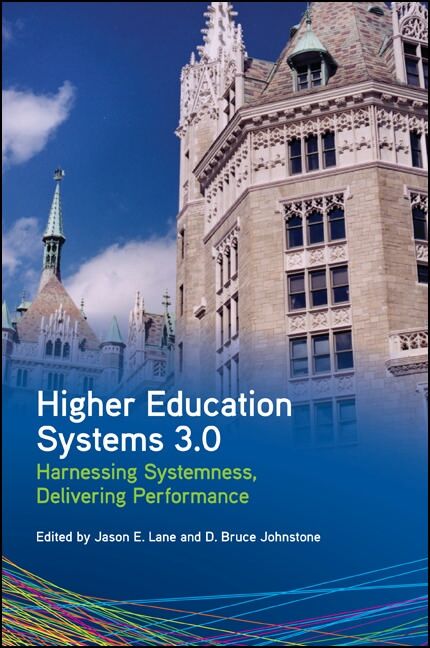
Higher Education Systems 3.0
This thought-provoking volume brings together scholars and system
leaders to analyze some of the most pressing and complex issues now
facing higher education systems and society. Higher Education
Systems 3.0 focuses on the remaking of higher education
coordination in an era of increased accountability, greater calls
for productivity, and intensifying fiscal austerity. System heads
have been identifying ways to harness the collective contributions
of their various institutions to benefit the students, communities,
and other stakeholders that they serve. The contributors explore
the recent dynamics of higher education systems, focusing
particularly on how systems are now working to improve their
effectiveness in educating students and improving our communities,
while also identifying new means for operating more efficiently.
This enhanced collaboration, or systemness , is the key
aspect of version 3.0.
eBook
