
Catalogue Search | MBRL


Are you sure you want to remove the book from the shelf?

{{itemTitle}}
15,349
result(s) for
"UNITED STATES - HISTORICAL "
Sort by:


Museums, Monuments, and National Parks
The rapid expansion of the field of public history since the 1970s has led many to believe that it is a relatively new profession. In this book, Denise D. Meringolo shows that the roots of public history actually reach back to the nineteenth century, when the federal government entered into the work of collecting and preserving the nation’s natural and cultural resources. Scientists conducting research and gathering specimens became key figures in a broader effort to protect and interpret the nation’s landscape. Their collaboration with entrepreneurs, academics, curators, and bureaucrats alike helped pave the way for other governmental initiatives, from the Smithsonian Institution to the parks and monuments today managed by the National Park Service. All of these developments included interpretive activities that shaped public understanding of the past. Yet it was not until the emergence of the educationoriented National Park Service history program in the 1920s and 1930s that public history found an institutional home that grounded professional practice simultaneously in the values of the emerging discipline and in government service. Even thereafter, tensions between administrators in Washington and practitioners on the ground at National Parks, monuments, and museums continued to define and redefine the scope and substance of the field. The process of definition persists to this day, according to Meringolo, as public historians establish a growing presence in major universities throughout the United States and abroad.
eBook

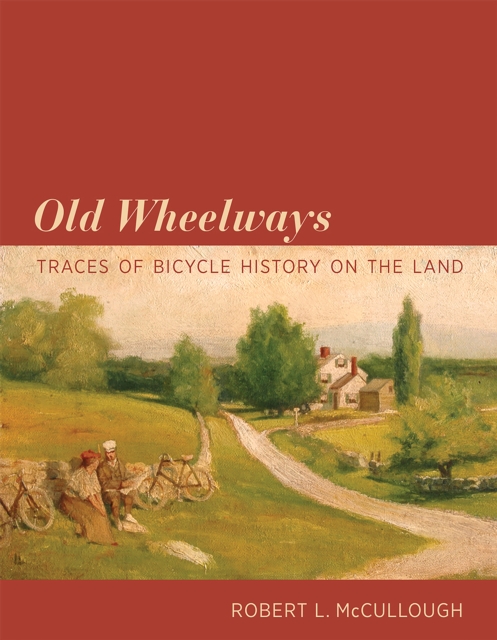
Old Wheelways
How American bicyclists shaped the landscape and left traces of their journeys for us in writing, illustrations, and photographs. In the later part of the nineteenth century, American bicyclists were explorers, cycling through both charted and uncharted territory. These wheelmen and wheelwomen became keen observers of suburban and rural landscapes, and left copious records of their journeys-in travel narratives, journalism, maps, photographs, illustrations. They were also instrumental in the construction of roads and paths (\"wheelways\")-building them, funding them, and lobbying legislators for them. Their explorations shaped the landscape and the way we look at it, yet with few exceptions their writings have been largely overlooked by landscape scholars, and many of the paths cyclists cleared have disappeared. In Old Wheelways, Robert McCullough restores the pioneering cyclists of the nineteenth century to the history of American landscapes.McCullough recounts marathon cycling trips around the Northeast undertaken by hardy cyclists, who then describe their journeys in such magazines as The Wheelman Illustrated and Bicycling World; the work of illustrators (including Childe Hassam, before his fame as a painter); efforts by cyclists to build better rural roads and bicycle paths; and conflicts with park planners, including the famous Olmsted Firm, who often opposed separate paths for bicycles.Today's ubiquitous bicycle lanes owe their origins to nineteenth century versions, including New York City's \"asphalt ribbons.\" Long before there were \"rails to trails,\" there was a movement to adapt existing passageways-including aqueduct corridors, trolley rights-of-way, and canal towpaths-for bicycling. The campaigns for wheelways, McCullough points out, offer a prologue to nearly every obstacle faced by those advocating bicycle paths and lanes today. McCullough's text is enriched by more than one hundred historic images of cyclists (often attired in skirts and bonnets, suits and ties), country lanes, and city streets.
eBook

The making of America's culture regions
\"Richard L. Nostrand's regional geography framework emphasizes the three themes that are central to cultural geography to explain the formation and change of culture regions in the United States\"-- Provided by publisher.
Book

The Leading Man
American presidents and Hollywood have interacted since the 1920s. This relationship has made our entertainment more political and our political leadership more aligned with the world of movies and movie stars.
InThe Leading Man, Burton W. Peretti explores the development of the cinematic presidential image. He sets the scene in chapter 1 to show us how the chief executive, beginning with George Washington, was positioned to assume the mantle of cultural leading man. As an early star figure in the young republic, the president served as a symbol of national survival and wish fulfillment. The president, as head of government and head of state, had the potential to portray a powerful and charismatic role.
At the center of the story are the fourteen presidents of the cinematic era, from Herbert Hoover to Barack Obama. Since the 1920s, the president, like the lead actor in a movie, has been given the central place on the political stage under the intense glare of the spotlight. Like other American men, future presidents were taught by lead movie actors how to look and behave, what to say, and how to say it. Some, like John F. Kennedy and Richard M. Nixon, took particular care to learn from the grooming, gestures, movements, and vocal inflections of film actors and applied these lessons to their political careers. Ronald Reaganwasa professional actor. Bill Clinton, a child of the post-World War II Baby Boom, may have been the biggest movie fan of all presidents. Others, including Lyndon Johnson, showed little interest in movies and their lessons for politicians.
Presidents and other politicians have been criticized for cheapening their offices by hiring image and advertising consultants and staging their public events. Peretti analyzes the evolution and the significance of this interaction to trace the convoluted history of the presidential cinematic image. He demonstrates how movies have been the main force in promoting appearance and drama over the substance of governing, and how Americans' lives today may be dominated by entertainment at the expense of their engagement as citizens.
eBook


Reconstructing American Historical Cinema
In Reconstructing American Historical Cinema: From Cimarron to Citizen Kane, J. E. Smyth dramatically departs from the traditional understanding of the relationship between film and history. By looking at production records, scripts, and contemporary reviews, Smyth argues that certain classical Hollywood filmmakers were actively engaged in a self-conscious and often critical filmic writing of national history. Her volume is a major reassessment of American historiography and cinematic historians from the advent of sound to the beginning of wartime film production in 1942. Focusing on key films such as Cimarron (1931), The Public Enemy (1931), Scarface (1932), Ramona (1936), A Star Is Born (1937), Jezebel (1938), Young Mr. Lincoln (1939), Gone with the Wind (1939), Stagecoach (1939), and Citizen Kane (1941), Smyth explores historical cinema's connections to popular and academic historigraphy, historical fiction, and journalism, providing a rich context for the industry's commitment to American history. Rather than emphasizing the divide between American historical cinema and historical writing, Smyth explores the continuities between Hollywood films and history written during the first four decades of the twentieth century, from Carl Becker's famous \"Everyman His Own Historian\" to Howard Hughes's Scarface to Margaret Mitchell and David O. Selznick's Gone with the Wind. Hollywood's popular and often controversial cycle of historical films from 1931 to 1942 confronted issues as diverse as frontier racism and women's experiences in the nineteenth-century South, the decline of American society following the First World War, the rise of Al Capone, and the tragic history of Hollywood's silent era. Looking at rarely discussed archival material, Smyth focuses on classical Hollywood filmmakers' adaptation and scripting of traditional historical discourse and their critical revision of nineteenth- and twentieth-century American history. Reconstructing American Historical Cinema uncovers Hollywood's diverse and conflicted attitudes toward American history. This text is a fundamental challenge the prevailing scholarship in film, history, and cultural studies.
eBook


Embodying American Slavery in Contemporary Culture
This study explores contemporary novels, films, performances, and reenactments that depict American slavery and its traumatic effects by invoking a time-travel paradigm to produce a representational strategy of \"bodily epistemology.\" Disrupting the prevailing view of traumatic knowledge that claims that traumatic events are irretrievable and accessible only through oblique reference, these novels and films circumvent the notion of indirect reference by depicting a replaying of the past, forcing present-day protagonists to witness and participate in traumatic histories that for them are neither dead nor past. Further, live performances and reenactments of slavery also rely on the time-travel motif (and the requisite suspension of disbelief) as a strategy to confront contemporary audiences with such spectacles as slave ship captivity, slave auctions, or a slave's decision to escape to freedom._x000B__x000B_As Lisa Woolfork cogently reveals, these cultural expressions indicate a concern that the traumatic meanings and consequences of American slavery have been lost to those living in the twentieth and twenty-first centuries. Woolfork analyzes how these works deploy a representational strategy that challenges the divide between past and present, imparting to their re-creations of American slavery a physical and emotional energy to counter America's apathetic or amnesiac attitude about the trauma of the slave past.
eBook