
Catalogue Search | MBRL


Are you sure you want to remove the book from the shelf?

{{itemTitle}}
4,223
result(s) for
"US Cultural History"
Sort by:

Immigrants in the far West : historical identities and experiences
This book is a collection of essays showcasing cutting-edge research and innovative approaches that a new generation of scholars is bringing to the study of immigration in the American West. Often overlooked in general studies of immigration, the western United States has been and is an important destination for immigrants. The unique combination of ethnicities and races in the West, combined with political and economic peculiarities, has given the region an immigration narrative that departs significantly from that of the East and Midwest. This volume explores facets of this narrative with case studies that reveal how immigration in the American West has influenced the region’s development culturally, economically, socially, and politically. Contributors offer historical narrative and theory to illuminate factors that have galvanized immigration and the ways that agency, cultural resources, institutions, and societal attitudes have shaped immigrant experiences. With chapters written by scholars from multiple fields, the book’s interdisciplinary framework will make it of interest to readers from a variety of backgrounds.
eBook

Hillbilly : a cultural history of an American icon
In this pioneering work of cultural history, historian Anthony Harkins argues that the hillbilly-in his various guises of \"briar hopper,\" \"brush ape,\" \"ridge runner,\" and \"white trash\"-has been viewed by mainstream Americans simultaneously as a violent degenerate who threatens the modern order and as a keeper of traditional values of family, home, and physical production, and thus symbolic of a nostalgic past free of the problems of contemporary life. \"Hillbilly\" signifies both rugged individualism and stubborn backwardness, strong family and kin networks but also inbreeding and bloody feuds. Spanning film, literature, and the entire expanse of American popular culture, from D. W. Griffith to hillbilly music to the Internet, Harkins illustrates how the image of the hillbilly has consistently served as both a marker of social derision and regional pride. He traces the corresponding changes in representations of the hillbilly from late-nineteenth century America, through the great Depression, the mass migrations of Southern Appalachians in the 1940s and 1950s, the War on Poverty in the mid 1960s, and to the present day. and to the present day. Harkins also argues that images of hillbillies have played a critical role in the construction of whiteness and modernity in twentieth century America. Richly illustrated with dozens of photographs, drawings, and film and television stills, this unique book stands as a testament to the enduring place of the hillbilly in the American imagination.
eBook

The Eastern Archaic, historicized
The Eastern Archaic, Historicized offers an alternative perspective on the genesis and transformation of cultural diversity over eight millennia of hunter-gatherer dwelling in eastern North America. For many decades, archaeological understanding of Archaic diversity has been dominated by perspectives that emphasize localized relationships between humans and environment. The evidence, shows, however that Archaic people routinely associated with other groups throughout eastern North America and expressed themselves materially in ways that reveal historical links to other places and times. Starting with the colonization of eastern North America by two distinct ancestral lines, the Eastern Archaic was an era of migrations, ethnogenesis, and coalescence—an 8,200-year era of making histories through interactions and expressing them culturally in ritual and performance.
eBook
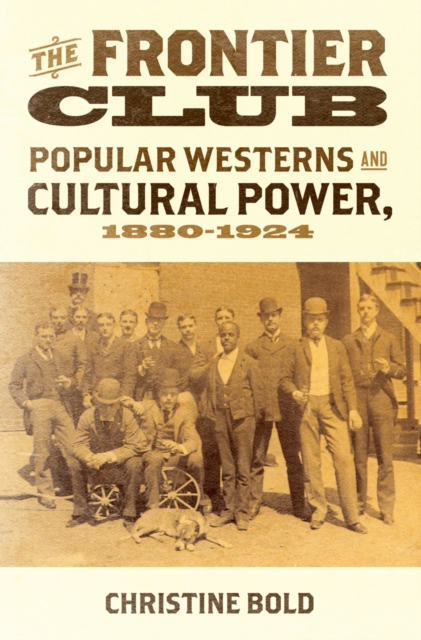
The frontier club : popular westerns and cultural power, 1880-1924
“The Frontier Club” is Christine Bold’s name for the network of eastern aristocrats who created the western as we now most commonly know it. At the turn of the twentieth century, they yoked this most popular formula to their own elite causes—from big-game hunting to conservation, immigration restriction to Jim Crow segregation—and aligned themselves with cattle kings and “quality” publishers. This book tells the story of that cultural sleight-of-hand. It delves into institutional archives and personal papers to excavate the hidden social, political, and financial interests in the making of the modern western. It re-reads frontier club fiction in relation to the federal policies and cultural spaces (from exclusive gentlemen’s clubs to national parks to zoos) with which it was intimately connected; the centerpiece is Owen Wister’s bestselling novel The Virginian. It casts new light on nine key clubmen, both the famous and the forgotten—in addition to Wister, the network included Theodore Roosevelt, George Bird Grinnell, Silas Weir Mitchell, Henry Cabot Lodge, Madison Grant, Caspar Whitney, Winthrop Chanler, and Frederic Remington—while recovering the women on whom these men depended and without whom this version of the popular West would not exist. Bold also considers some of the costs of the frontier club formula, in terms of its impact on Indigenous peoples and its marginalization of other popular voices, including western writings by African Americans, white women, and non-elite white men. The book ends by briefly charting the frontier club’s enduring impression on western movies.
eBook

No requiem for the space age : the Apollo moon landings and American culture
Why did support for the American space program decrease so sharply by the early 1970s, even as its Apollo missions continued visiting the moon? Rooted in profound scientific and technological leaps, rational technocratic management, and an ambitious view of the universe as a realm susceptible to human mastery, the Apollo moon landings were the grandest manifestation of postwar American progress and optimism. To the great dismay of its many proponents, however, NASA found the ground shifting beneath its feet as a fierce wave of antirationalism arose throughout American society, fostering a cultural environment in which growing numbers of Americans began to contest rather than embrace the rationalist values and vision of progress that Apollo embodied. Moving the conversation of Apollo from its Cold War origins to its place in American culture and society, and probing an eclectic mix of contemporary voices, including intellectuals, religious leaders, rock musicians, politicians, and a variety of everyday Americans, this book paints a portrait of a nation in the midst of questioning the very values that had guided it through the postwar years as it began to develop new conceptions of progress that had little to do with blasting ever more men to the moon. Here is a narrative of the 1960s and 1970s unlike any told before, with the story of Apollo as the story of America itself in a time of dramatic cultural change.
eBook

Freedom's orator
Here is the first biography of Mario Savio, the brilliant leader of Berkeley's Free Speech Movement, the largest and most disruptive student rebellion in American history. Savio risked his life to register black voters in Mississippi in the Freedom Summer of 1964 and did more than anyone to bring daring forms of non-violent protest from the civil rights movement to the struggle for free speech and academic freedom on American campuses. Drawing upon previously unavailable Savio papers, as well as oral histories from friends and fellow movement leaders, Freedom's Orator illuminates Mario's egalitarian leadership style, his remarkable eloquence, and the many ways he embodied the youthful idealism of the 1960s. The book also narrates, for the first time, his second phase of activism against \"Reaganite Imperialism\" in Central America and the corporatization of higher education. Including a generous selection of Savio's speeches, Freedom's Orator speaks with special relevance to a new generation of activists and to all who cherish the '60s and democratic ideals for which Savio fought so selflessly.
eBook

The ends of life : roads to fulfilment in early modern England
How should we live? That question was no less urgent for English men and women who lived between the early sixteenth and late eighteenth centuries than for this book's readers. Keith Thomas's masterly exploration of the ways in which people sought to lead fulfilling lives in those centuries between the beginning of the Reformation and the heyday of the Enlightenment illuminates the central values of the period, while casting incidental light on some of the perennial problems of human existence. Consideration of the origins of the modern ideal of human fulfilment and of obstacles to its realization in the early modern period frames an investigation that ranges from work, wealth, and possessions to the pleasures of friendship, family, and sociability. The cult of military prowess, the pursuit of honour and reputation, the nature of religious belief and scepticism, and the desire to be posthumously remembered are all drawn into the discussion, and the views and practices of ordinary people are measured against the opinions of the leading philosophers and theologians of the time. The Ends of Life offers a fresh approach to the history of early modern England, by one of the foremost historians of our time. It also provides modern readers with much food for thought on the problem of how we should live and what goals in life we should pursue.
eBook

History of Universities
Volume XXII/1 of History of Universities contains the customary mix of learned articles, book reviews, conference reports, and bibliographical information, which makes this publication such an indispensable tool for the historian of higher education. Its contributions range widely geographically, chronologically, and in subject-matter. The volume is, as always, a lively combination of original research and invaluable reference material.
eBook

History of Universities
Volume XXI/1 of History of Universities contains the customary mix of learned articles, book reviews, conference reports, and bibliographical information, which makes this publication such an indispensable tool for the historian of higher education. Its contributions range widely geographically, chronologically, and in subject-matter. The volume is, as always, a lively combination of original research and invaluable reference material.
eBook

History of Universities
Volume XX/2 of History of Universities contains the customary mix of learned articles, book reviews, conference reports, and bibliographical information, which makes this publication such an indispensable tool for the historian of higher education. Its contributions range widely geographically, chronologically, and in subject-matter. The volume is, as always, a lively combination of original research and invaluable reference material.
eBook