
Catalogue Search | MBRL


Are you sure you want to remove the book from the shelf?

{{itemTitle}}
19
result(s) for
"Ukraine -- Politics and government -- 19th century"
Sort by:


Children of Rus
InChildren of Rus', Faith Hillis recovers an all but forgotten chapter in the history of the tsarist empire and its southwestern borderlands. The right bank, or west side, of the Dnieper River-which today is located at the heart of the independent state of Ukraine-was one of the Russian empire's last territorial acquisitions, annexed only in the late eighteenth century. Yet over the course of the long nineteenth century, this newly acquired region nearly a thousand miles from Moscow and St. Petersburg generated a powerful Russian nationalist movement. Claiming to restore the ancient customs of the East Slavs, the southwest's Russian nationalists sought to empower the ordinary Orthodox residents of the borderlands and to diminish the influence of their non-Orthodox minorities.
Right-bank Ukraine would seem unlikely terrain to nourish a Russian nationalist imagination. It was among the empire's most diverse corners, with few of its residents speaking Russian as their native language or identifying with the culture of the Great Russian interior. Nevertheless, as Hillis shows, by the late nineteenth century, Russian nationalists had established a strong foothold in the southwest's culture and educated society; in the first decade of the twentieth, they secured a leading role in local mass politics. By 1910, with help from sympathetic officials in St. Petersburg, right-bank activists expanded their sights beyond the borderlands, hoping to spread their nationalizing agenda across the empire.
Exploring why and how the empire's southwestern borderlands produced its most organized and politically successful Russian nationalist movement, Hillis puts forth a bold new interpretation of state-society relations under tsarism as she reconstructs the role that a peripheral region played in attempting to define the essential characteristics of the Russian people and their state.
eBook

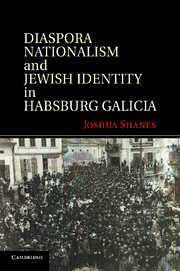
Diaspora Nationalism and Jewish Identity in Habsburg Galicia
The triumph of Zionism has clouded recollection of competing forms of Jewish nationalism vying for power a century ago. This study explores alternative ways to construct the modern Jewish nation. Jewish nationalism emerges from this book as a Diaspora phenomenon much broader than the Zionist movement. Like its non-Jewish counterparts, Jewish nationalism was first and foremost a movement to nationalize Jews, to construct a modern Jewish nation while simultaneously masking its very modernity. Diaspora Nationalism and Jewish Identity in Habsburg Galicia traces this process in what was the second largest Jewish community in Europe, Galicia. The history of this vital but very much understudied community of Jews fills a critical lacuna in existing scholarship while revisiting the broader question of how Jewish nationalism - or indeed any modern nationalism - was born. Based on a wide variety of sources, many newly uncovered, this study challenges the still-dominant Zionist narrative by demonstrating that Jewish nationalism was a part of the rising nationalist movements in Europe.
eBook

Brothers or enemies : the Ukrainian national movement and Russia, from the 1840s to the 1870s
\"Contrary to the prevailing opinion, the idea of Ukrainian independence did not emerge at the end of the nineteenth-century. In Brothers and Enemies, Johannes Remy reveals that the roots of Ukrainian independence were planted fifty years earlier. Remy contextualizes the Ukrainian national movement against the backdrop of the Russian Empire and its policy of oppression in the mid-nineteenth-century. Remy utilizes a wide range of unpublished archival sources to shed light on topics that are absent from current discourse including: Ilarion Vasilchikov's alliance with Ukrainian activists in 1861, the forged revolutionary proclamation used to deport Pavlo Chubynsky (who is known today as the author of the Ukrainian national anthem), and the 1864 negotiations between Kyiv activists and the Polish National Government. Brothers and Enemies is the first systematic study of imperial censorship policies during the period and will be of interest to those who seek a better understanding of the current Ukrainian-Russian conflict.\"--Jacket flap.
Book

Brothers or Enemies
In Brothers and Enemies, Johannes Remy reveals that the roots of Ukrainian independence were planted fifty years earlier. Remy contextualizes the Ukrainian national movement against the backdrop of the Russian Empire and its policy of oppression in the mid-nineteenth-century.
eBook

The Roots of Ukrainian Nationalism
To the surprise of many, the Soviet Union ceased to exist in 1991, and out of its ruins arose an independent Ukraine. This was a remarkable achievement, and one that owed much to activities in Galicia, as Paul Robert Magocsi reveals here.
Magocsi begins with a brief historical survey of Galicia, where Ukrainian national and cultural interests have long flourished. His subsequent essays focus on the role played by Galicia during the nineteenth century, when Ukrainians were struggling for recognition as a distinct nationality. He places Galicia in the larger context of Ukrainian and eastern European politics, then follows with studies of the nuts and bolts of nation building – language, culture, ideology and so on. He also explores the influence of the Habsburg Empire in creating unique conditions for Ukraine's national and social revival, and considers the impact of both Habsburg and Soviet rule on the Ukrainian national psyche.
This study provides a solid background for understanding nineteenth-century Galicia as the historic Piedmont of the Ukrainian national revival. It is essential reading for historians, public-policy makers, and all those interested in regional differentiation within Europe's second largest country – Ukraine.
eBook


From Citizens to Subjects
From Citizens to Subjectschallenges the common assertion in historiography that Enlightenment-era centralization and rationalization brought progress and prosperity to all European states, arguing instead that centralization failed to improve the socioeconomic position of urban residents in the former Polish-Lithuanian Commonwealth over a hundred-year period.Murphy examines the government of the Polish-Lithuanian Commonwealth and the several imperial administrations that replaced it after the Partitions, comparing and contrasting their relationships with local citizenry, minority communities, and nobles who enjoyed considerable autonomy in their management of the cities of present-day Poland, Ukraine, and Belarus. He shows how the failure of Enlightenment-era reform was a direct result of the inherent defects in the reformers' visions, rather than from sabotage by shortsighted local residents. Reform in Poland-Lithuania effectively destroyed the existing system of complexities and imprecisions that had allowed certain towns to flourish, while also fostering a culture of self-government and civic republicanism among city citizens of all ranks and religions. By the mid-nineteenth century, the increasingly immobile post-Enlightenment state had transformed activist citizens into largely powerless subjects without conferring the promised material and economic benefits of centralization.
eBook
