
Catalogue Search | MBRL


Are you sure you want to remove the book from the shelf?

{{itemTitle}}
199
result(s) for
"Ukraine Biography"
Sort by:

City of Rogues and Schnorrers
Old Odessa, on the Black Sea, gained notoriety as a legendary city of Jewish gangsters and swindlers, a frontier boomtown mythologized for the adventurers, criminals, and merrymakers who flocked there to seek easy wealth and lead lives of debauchery and excess. Odessa is also famed for the brand of Jewish humor brought there in the 19th century from the shtetls of Eastern Europe and that flourished throughout Soviet times. From a broad historical perspective, Jarrod Tanny examines the hybrid Judeo-Russian culture that emerged in Odessa in the 19th century and persisted through the Soviet era and beyond. The book shows how the art of eminent Soviet-era figures such as Isaac Babel, Il'ia Ilf, Evgenii Petrov, and Leonid Utesov grew out of the Odessa Russian-Jewish culture into which they were born and which shaped their lives.
eBook

Founder of Hasidism
The Ba'al Shem Tov is an elusive subject for historians because documentary evidence about his life is scanty and equivocal. Until now, much of what was known about him was based on stories compiled more than a generation after his death, many of which serve more to mythologize him than to describe him. The portrait Moshe Rosman provides is drawn from life instead of from myth. Based on innovative critical analysis of familiar and previously unexplored archival sources, and concentrating on accounts that can be attributed to the Besht or to contemporary eyewitnesses, this book goes further than any previous work in uncovering the historical Ba'al Shem Tov. Additionally, documents in Polish and Hebrew discovered by Professor Rosman during his research for the book enable him to give the first detailed description of the cultural, social, economic, and political context of the Besht's life. Founder of Hasidism supplies the history behind the legend. It presents the best, most convincing description that can be drawn from the existing documentary evidence, changing our understanding of the Besht and with it the master-narrative of hasidism. A substantial new introduction considers what has changed in the study of Hasidism since the influential first edition was published, these changes being in part due to the effect of the book. New approaches, new sources, and new interpretations have been introduced, and these are reviewed and critically assessed. Criticisms of the original edition are answered and key issues reconsidered, including the authenticity of the various versions of the Holy Epistle; the ways in which Jacob Joseph of Polonne's books can be utilized as historical sources; and the relationship to history of the stories about the Ba'al Shem Tov in the hagiographical collection Shivhei Ha-Besht.
eBook

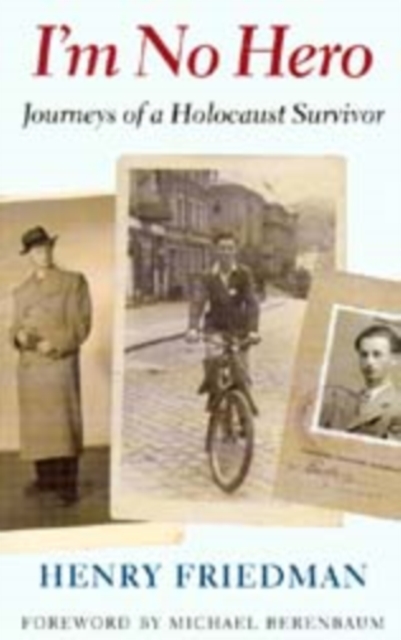
I'm No Hero
Henry Friedman was robbed of his adolescence by the monstrous evil that annihilated millions of European Jews and changed forever the lives of those who survived. When the Nazis overran their home town near the Polish-Ukrainian border, the Friedman family was saved by Ukrainian Christians who had worked at their farm. Henry, his mother, his younger brother, and a young schoolteacher who had been hired by his father when Jews were forbidden to attend school were hidden in a loft over the animal stalls at a neighbor s farm; his father hid in another hayloft half a mile away.
When the family was liberated by the Russians after eighteen months in hiding, Henry, at age fifteen, was emaciated and too weak to walk. The Friedmans eventually made their way to a displaced persons camp in Austria where Henry learned quickly to wheel and deal, seducing women of various ages and nationalities and mastering the intricacies of dealing in the black market. In I m No Hero, he confronts with unblinking honesty the pain, the shame, and the bizarre comedy of his passage to adulthood.
The family came to Seattle in 1949, where Henry Friedman has made his home ever since. In 1988 he returned with his wife to Brody and Suchowola, where he succeeded in finding Julia Symchuk, who, as a young girl, had warned his father that the Gestapo was looking for him, and whose family had hidden the Friedmans in their loft. The following year he was able to bring Julia to Seattle for a triumphal visit, where she was honored in many ways, although, as Friedman writes, in her own country she had never been honored with anything except hard work.
Like many other survivors, Henry Friedman has found it difficult to confront his past. Like others, too, he has felt the obligation to bear witness. Now retired, he devotes much of his time to telling his story, which he believes is a message of hope, to thousands of schoolchildren throughout the Pacific Northwest. He has received national recognition for his role in establishing the United States Holocaust Museum in Washington, DC, and as a founder of the Washington State Holocaust Education Resource Center.
eBook

VZ : Volodymyr Zelenskyy and the making of a nation
\"How does a comedian become the face of a nation's fight for survival? In VZ, celebrated Russian author Dmitry Bykov unpacks the extraordinary rise of Vladimir Zelenskyi--from a TV star to a wartime leader defying a global superpower. With wit and razor-sharp insight, Bykov dives into the moments that shaped Zelenskyi's improbable journey, revealing the man behind the headlines. This is not just a story of one leader but of a nation on the edge, and the power of resilience in the face of overwhelming odds. Bykov offers a fresh, compelling take on Zelenskyi's leadership, Ukraine's struggle for sovereignty, and what it truly means to fight for democracy in the modern world. For anyone eager to understand the making of a modern hero and the fierce will of a nation under siege, VZ is essential reading\"-- Provided by publisher.
BOOK

Ukrainian Minstrels
The blind mendicant in Ukrainian folk tradition is a little-known social order, but an important one. The singers of Ukrainian epics, these minstrels were organized into professional guilds that set standards for training and performance. Repressed during the Stalin era, this is their story.
eBook