
Catalogue Search | MBRL


Are you sure you want to remove the book from the shelf?

{{itemTitle}}
2,623
result(s) for
"Ukraine History."
Sort by:

Ukraine
Readers will travel to this amazing country and learn all about Ukraine's land, history, cities, food, holidays, and sports.
Book

Blood of Others
Blood of Others offers a cultural history of Crimea and
the Black Sea region, one of Europe's most volatile flashpoints, by
chronicling the aftermath of Stalin's 1944 deportation of the
Crimean Tatars in four different literary traditions.
eBook


Forging Rights in a New Democracy
The last two decades have been marked by momentous changes in forms of governance throughout the post-Soviet region. Ukraine's political system, like those of other formerly socialist states of Eastern Europe, has often been characterized as being \"in transition,\" moving from a Soviet system to one more closely aligned with Western models. Anna Fournier challenges this view, investigating what is increasingly recognized as a critical aspect of contemporary global rights discourse: the active involvement of young people living in societies undergoing radical change. Fournier delineates a generation simultaneously embracing various ideological stances in an attempt to make sense of social conditions marked by the disjuncture between democratic ideals and the everyday realities of growing economic inequality. Based on extensive fieldwork in public and private schools in the Ukrainian capital city of Kyiv,Forging Rights in a New Democracyexplores high-school-aged students' understanding of rights and justice, and the ways they interpret and appropriate discourses of citizenship and civic values in the educational setting and beyond. Fournier's rich ethnographic account assesses the impact on the making of citizens of both formal and informal pedagogical practices, in schools and on the streets. Chronicling her subjects' encounters with state representatives and \"violent entrepreneurs\" as well as their involvement in peaceful protests alongside political activists, Fournier demonstrates the extent to which young people both reproduce and challenge the liberal discourse of rights in ways that illuminate the everyday paradoxes of market democracy. By tracking students' active participation in larger contests about the nature of liberty and entitlement in the context of redefined rights, her book provides insight into emergent configurations of citizenship in the New Europe.
eBook


Everyday War
Everyday War provides an accessible lens through which to understand what noncombatant civilians go through in a country at war. What goes through the mind of a mother who must send her child to school across a minefield or the men who belong to groups of volunteer body collectors? In Ukraine, such questions have been part of the daily calculus of life. Greta Uehling engages with the lives of ordinary people living in and around the armed conflict over Donbas that began in 2014 and shows how conventional understandings of war are incomplete. In Ukraine, landscapes filled with death and destruction prompted attentiveness to human vulnerabilities and the cultivation of everyday, interpersonal peace. Uehling explores a constellation of social practices where ethics of care were in operation. People were also drawn into the conflict in an everyday form of war that included provisioning fighters with military equipment they purchased themselves, smuggling insulin, and cutting ties to former friends. Each chapter considers a different site where care can produce interpersonal peace or its antipode, everyday war. Bridging the fields of political geography, international relations, peace and conflict studies, and anthropology, Everyday War considers where peace can be cultivated at an everyday level.
eBook

Odessa : genius and death in a city of dreams
Describes the vibrant Black Sea port city of Odessa and the thriving Jewish population that included Alexander Pushkin, Isaac Babel, and Zionist activist Vladimir Jabotinsky, and examines the mass murders of the Romanian occupation during World War II.
Book

The Cossack Myth
In the years following the Napoleonic Wars, a mysterious manuscript began to circulate among the dissatisfied noble elite of the Russian Empire. Entitled The History of the Rus', it became one of the most influential historical texts of the modern era. Attributed to an eighteenth-century Orthodox archbishop, it described the heroic struggles of the Ukrainian Cossacks. Alexander Pushkin read the book as a manifestation of Russian national spirit, but Taras Shevchenko interpreted it as a quest for Ukrainian national liberation, and it would inspire thousands of Ukrainians to fight for the freedom of their homeland. Serhii Plokhy tells the fascinating story of the text's discovery and dissemination, unravelling the mystery of its authorship and tracing its subsequent impact on Russian and Ukrainian historical and literary imagination. In so doing he brilliantly illuminates the relationship between history, myth, empire and nationhood from Napoleonic times to the fall of the Soviet Union.
eBook

The Cossack myth : history and nationhood in the age of empires
\"In the years following the Napoleonic Wars, a mysterious manuscript began to circulate among the dissatisfied noble elite of the Russian Empire. Entitled 'The History of the Rus,' it became one of the most influential historical texts of the modern era. Attributed to an eighteenth-century Orthodox archbishop, it described the heroic struggles of the Ukrainian Cossacks. Alexander Pushkin read the book as a manifestation of Russian national spirit, but Taras Shevchenko interpreted it as a quest for Ukrainian national liberation and it would inspire thousands of Ukrainians to fight for the freedom of their homeland. Serhii Plokhy tells the fascinating story of the text's discovery and dissemination unravelling the mystery of its authorship and tracing its subsequent impact on Russian and Ukrainian historical and literary imagination. In so doing he brilliantly illuminates the relationship between history, myth, empire and nationhood from Napoleonic times to the fall of the Soviet Union\"-- Provided by publisher.
Book
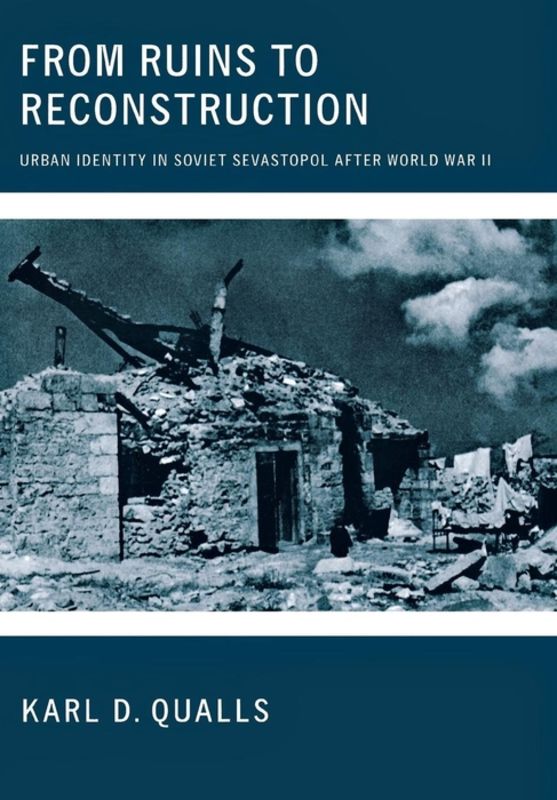
From Ruins to Reconstruction
Sevastopol, located in present-day Ukraine but still home to the Russian Black Sea Fleet and revered by Russians for its role in the Crimean War, was utterly destroyed by German forces during World War II. In From Ruins to Reconstruction, Karl D. Qualls tells the complex story of the city's rebuilding. Based on extensive research in archives in both Moscow and Sevastopol, architectural plans and drawings, interviews, and his own extensive experience in Sevastopol, Qualls tells a unique story in which the periphery \"bests\" the Stalinist center: the city's experience shows that local officials had considerable room to maneuver even during the peak years of Stalinist control.Qualls first paints a vivid portrait of the ruined city and the sufferings of its surviving inhabitants. He then turns to Moscow's plans to remake the ancient city on the heroic socialist model prized by Stalin and visited upon most other postwar Soviet cities and towns. In Sevastopol, however, the architects and city planners sent out from the center \"went native,\" deviating from Moscow's blueprints to collaborate with local officials and residents, who seized control of the planning process and rebuilt the city in a manner that celebrated its distinctive historical identity. When completed, postwar Sevastopol resembled a nineteenth-century Russian city, with tree-lined boulevards; wide walkways; and buildings, street names, and memorials to its heroism in wars both long past and recent. Though visually Russian (and still containing a majority Russian-speaking population), Sevastopol was in 1954 joined to Ukraine, which in 1991 became an independent state. In his concluding chapter, Qualls explores how the \"Russianness\" of the city and the presence of the Russian fleet affect relations between Ukraine, Russia, and the West.
eBook