
Catalogue Search | MBRL


Are you sure you want to remove the book from the shelf?

{{itemTitle}}
51
result(s) for
"Ukrainiens."
Sort by:

Ukraine: remember also me : testimonies from the war
\"Over the course of a year after the Russian invasion, award-winning artist George Butler drew portraits of Ukrainians as he interviewed them about the extraordinary turmoil the war had caused in their lives. From civilians in occupied cities to soldiers on the front line, this is a unique collection that vividly captures personal testimonies of community, tragedy, and perseverance. This is an illuminating and powerful testament to the resilience and pride of the people of Ukraine, and a timely reminder of the universal need for peace\" -- Dust jacket.
BOOK

Jewish Odesa
Jewish Odesa: Negotiating Identities and Traditions in
Contemporary Ukraine explores the rich Jewish history in
Ukraine's port city of Odesa. Long considered both a uniquely
cosmopolitan and Jewish place, Odesa's Jewish character has shifted
since the Soviet Union collapsed and Ukraine gained its
independence.
Drawing on extensive field research, Marina Sapritsky-Nahum,
examines how the role of Russian language and culture, memories of
the Soviet political project, and Odesan's place in a Ukrainian
national project have all been questioned in recent years.
Jewish Odesa reveals how a city once famous for its
progressive Jewish traditions has become dominated by Orthodox
Judaism and framed by the agendas of international Jewish
organizations embedded in a religiosity that is foreign to the
city. Russia's war in Ukraine has forced Jewish identities with
ties to Odesa to change still further.
eBook

The Zelensky effect
\"With Russian shells raining on Kyiv and tanks closing in, American forces prepared to evacuate Ukraine's leader. Just three years earlier, his apparent main qualification had been playing a president on TV. But Volodymyr Zelensky reportedly retorted, 'I need ammunition, not a ride.' Ukrainian forces won the battle for Kyiv, ensuring their country's independence even as a longer war began for the southeast. You cannot understand the historic events of 2022 without understanding Zelensky. But the Zelensky effect is less about the man himself than about the civic nation he embodies: what makes Zelensky most extraordinary in war is his very ordinariness as a Ukrainian. The Zelensky Effect explains this paradox, exploring Ukraine's national history to show how its now-iconic president reflects the hopes and frustrations of the country's first 'independence generation'. Interweaving social and political background with compelling episodes from Zelensky's life and career, this is the story of Ukraine told through the journey of one man who has come to symbolize his country.\" -- Publisher's description.
Book

Haunted Empire
Haunted Empire shows that Gothic elements in Russian
literature frequently expressed deep-set anxieties about the
Russian imperial and national identity.
Valeria Sobol argues that the persistent presence of Gothic
tropes in the literature of the Russian Empire is a key literary
form that enacts deep historical and cultural tensions arising from
Russia's idiosyncratic imperial experience. Her book brings
together theories of empire and colonialism with close readings of
canonical and less-studied literary texts as she explores how
Gothic horror arises from the threatening ambiguity of Russia's own
past and present, producing the effect Sobol terms \"the imperial
uncanny.\" Focusing on two spaces of the imperial uncanny-the Baltic
north/Finland and the Ukrainian south- Haunted Empire
reconstructs a powerful discursive tradition that reveals the
mechanisms of the Russian imperial imagination that are still at
work today.
eBook

Haunted Empire
Haunted Empire shows that Gothic elements in Russian literature frequently expressed deep-set anxieties about the Russian imperial and national identity. Valeria Sobol argues that the persistent presence of Gothic tropes in the literature of the Russian Empire is a key literary form that enacts deep historical and cultural tensions arising from Russia's idiosyncratic imperial experience. Her book brings together theories of empire and colonialism with close readings of canonical and less-studied literary texts as she explores how Gothic horror arises from the threatening ambiguity of Russia's own past and present, producing the effect Sobol terms \"the imperial uncanny.\" Focusing on two spaces of the imperial uncanny—the Baltic north/Finland and the Ukrainian south—Haunted Empire reconstructs a powerful discursive tradition that reveals the mechanisms of the Russian imperial imagination that are still at work today.
eBook

Between national socialism and Soviet communism
In May of 1945, there were more than eight million \"displaced persons\" (or DPs) in Germany-recently liberated foreign workers, concentration camp prisoners, and prisoners of war from all of Nazi-occupied Europe, as well as eastern Europeans who had fled west before the advancing Red Army. Although most of them quickly returned home, it soon became clear that large numbers of eastern European DPs could or would not do so. Focusing on Bavaria, in the heart of the American occupation zone,Between National Socialism and Soviet Communismexamines the cultural and political worlds that four groups of displaced persons-Polish, Ukrainian, Russian, and Jewish-created in Germany during the late 1940s and early 1950s. The volume investigates the development of refugee communities and how divergent interpretations of National Socialism and Soviet Communism defined these displaced groups.
Combining German and eastern European history, Anna Holian draws on a rich array of sources in cultural and political history and engages the broader literature on displacement in the fields of anthropology, sociology, political theory, and cultural studies. Her book will interest students and scholars of German, eastern European, and Jewish history; migration and refugees; and human rights.
eBook

Building Fortress Europe
What happens when a region accustomed to violent shifts in borders is subjected to a new, peaceful partitioning? Has the European Union spent the last decade creating a new Iron Curtain at its fringes?Building Fortress Europe: The Polish-Ukrainian Frontierexamines these questions from the perspective of the EU's new eastern external boundary. Since the Schengen Agreement in 1985, European states have worked together to create a territory free of internal borders and with heavily policed external boundaries. In 2004 those boundaries shifted east as the EU expanded to include eight postsocialist countries-including Poland but excluding neighboring Ukraine. Through an analysis of their shared frontier,Building Fortress Europeprovides an ethnographic examination of the human, social, and political consequences of developing a specialized, targeted, and legally advanced border regime in the enlarged EU. Based on fieldwork conducted with border guards, officials, and migrants shuttling between Poland and Ukraine as well as extensive archival research,Building Fortress Europeshows how people in the two countries are adjusting to living on opposite sides of a new divide. Anthropologist Karolina S. Follis argues that the policing of economic migrants and asylum seekers is caught between the contradictory imperatives of the European Union's border security, economic needs of member states, and their declared commitment to human rights. The ethnography explores the lives of migrants, and their patterns of mobility, as framed by these contradictions. It suggests that only a political effort to address these tensions will lead to the creation of fairer and more humane border policies.
eBook

Enemy Archives
Soviet counterinsurgency officers assembled a comprehensive archive documenting the ideological worldview, operational structures, and activities of the Ukrainian nationalist movement. Viatrovych and Luciuk have curated a selection of these documents that challenges prejudices about who these Ukrainian nationalists were, whom they fought, and why.
eBook

The Conflict in Ukraine
Ukraine has long been a country rent by linguistic differences, ethnic strife and divided political loyalties. This book provides the crucial historical background for understanding the conflict in Ukraine. It also looks beyond the appearance of ethnic strife to the conflict's deeper causes, the clash of different political models and concepts of citizenship.
eBook
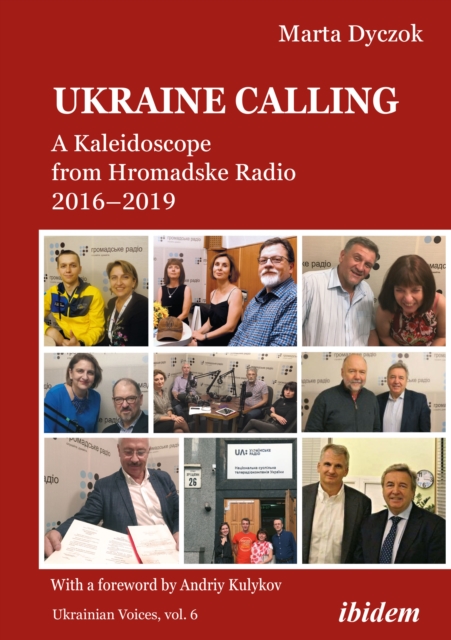
Ukraine Calling
This book is like a time capsule containing a selection of interviews that aired on Hromadske Radios Ukraine Calling show.They capture what people were thinking during a critical time in the countrys history, from the July 2016 NATO Summit through to Volodymyr Zelenskyys 2019 landslide election victories.
eBook