
Catalogue Search | MBRL


Are you sure you want to remove the book from the shelf?

{{itemTitle}}
12,345
result(s) for
"Underwater exploration"
Sort by:

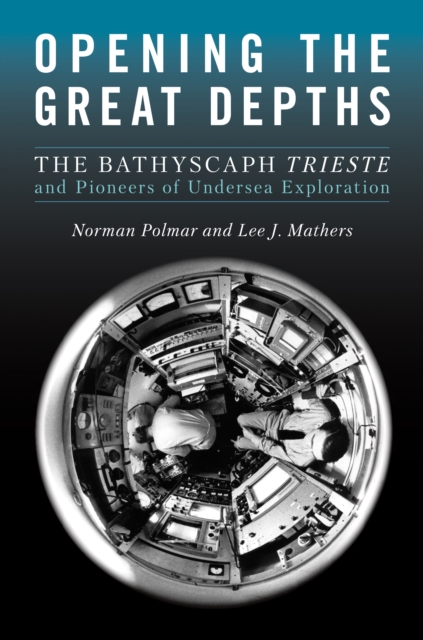
Opening the Great Depths: The Bathyscaph Trieste and Pioneers of Undersea Exploration
We were certainly pioneers as the Trieste was one of only two such vehicles in the world--the French Navy's bathyscaphe FNRS-3 was the other. It meant that we had to 'write the book' about deep submergence operations in terms of technique and technologies. We learned by doing and by failures, although very few of the latter were serious. For example, if we needed a piece of equipment we would have to design it and make it. There were no commercial vendors who catered to deep submergence technology requirements. The market was far too small. - From the foreword by Capt. Don Walsh, USN (Ret.), PhD, U.S. Navy Submersible Pilot No. 1 Developed by French physicist Auguste Piccard and his son Jacques, the bathyscaph Trieste was a scientific marvel that allowed unprecedented scientific, technical, and military feats in the ocean depths. France and the United States both acquired and subsequently developed variants of the original bathyscaph. While both France and the United States employed the bathyscaph as a tool for scientific investigation of the deepest ocean depths, the U.S. Navy developed and employed the Trieste for military missions as well. From its earliest years, participants in the Trieste program realized that they were making history, blazing a trail into previously unexplored and unexploited depths, developing new capabilities and opening a new frontier. Comparisons with developments in space and the space-race between the United States and the Soviet Union often were made concerning the Trieste program and contemporary developments in undersea technologies and capabilities. The Trieste opened the entire oceans to exploration, exploitation, and operations. The bathyscaph was a first-generation system, a \"\"Model-T\"\" that spawned an entirely new industry and encouraged new concepts for deep-ocean naval operations. Advances in deep-sea technologies lacked the \"\"gee-whiz\"\" factor of the concurrent space race, but were highly significant in the development of new technology, new knowledge, and new military capabilities. Opening the Great Depths is the story of the three Trieste deep-ocean vehicles, their officers and enlisted men, and the civilians, often told in their own words, documenting for the first time the earliest years of humanity's probing into Earth's final frontier.
eBook


Review of Underwater Sensing Technologies and Applications
As the ocean development process speeds up, the technical means of ocean exploration are being upgraded. Due to the characteristics of seawater and the complex underwater environment, conventional measurement and sensing methods used for land are difficult to apply in the underwater environment directly. Especially for the seabed topography, it is impossible to carry out long-distance and accurate detection via electromagnetic waves. Therefore, various types of acoustic and even optical sensing devices for underwater applications have come into use. Equipped by submersibles, those underwater sensors can sense underwater wide-range and accurately. Moreover, the development of sensor technology will be modified and optimized according to the needs of ocean exploitation. This paper has made a summary of the ocean sensing technologies applied in some critical underwater scenarios, including geological surveys, navigation and communication, marine environmental parameters, and underwater inspections. In order to contain as many submersible-based sensors as possible, we have to make a trade-off on breadth and depth. In the end, the authors predict the development trend of underwater sensor technology based on the future ocean exploration requirements.
Journal Article


Underwater vision enhancement technologies: a comprehensive review, challenges, and recent trends
Cameras are integrated with various underwater vision systems for underwater object detection and marine biological monitoring. However, underwater images captured by cameras rarely achieve the desired visual quality, which may affect their further applications. Various underwater vision enhancement technologies have been proposed to improve the visual quality of underwater images in the past few decades, which is the focus of this paper. Specifically, we review the theory of underwater image degradations and the underwater image formation models. Meanwhile, this review summarizes various underwater vision enhancement technologies and reports the existing underwater image datasets. Further, we conduct extensive and systematic experiments to explore the limitations and superiority of various underwater vision enhancement methods. Finally, the recent trends and challenges of underwater vision enhancement are discussed. We wish this paper could serve as a reference source for future study and promote the development of this research field.
Journal Article


Bioinspired soft robots for deep-sea exploration
The deep ocean, Earth’s untouched expanse, presents immense challenges for exploration due to its extreme pressure, temperature, and darkness. Unlike traditional marine robots that require specialized metallic vessels for protection, deep-sea species thrive without such cumbersome pressure-resistant designs. Their pressure-adaptive forms, unique propulsion methods, and advanced senses have inspired innovation in designing lightweight, compact soft machines. This perspective addresses challenges, recent strides, and design strategies for bioinspired deep-sea soft robots. Drawing from abyssal life, it explores the actuation, sensing, power, and pressure resilience of multifunctional deep-sea soft robots, offering game-changing solutions for profound exploration and operation in harsh conditions.
High pressure and low temperature are the greatest challenges faced by scientists to explore deep oceans, which remain largely unknow to us today. Li et al. review these challenges and give insight into designing soft robots, inspired by deep-sea creatures, that enable resilient operations in harsh conditions.
Journal Article