
Catalogue Search | MBRL


Are you sure you want to remove the book from the shelf?

{{itemTitle}}
25,880
result(s) for
"Unemployment in the United States"
Sort by:

Monopsony in Motion
What happens if an employer cuts wages by one cent? Much of labor economics is built on the assumption that all the workers will quit immediately. Here, Alan Manning mounts a systematic challenge to the standard model of perfect competition.Monopsony in Motionstands apart by analyzing labor markets from the real-world perspective that employers have significant market (or monopsony) power over their workers. Arguing that this power derives from frictions in the labor market that make it time-consuming and costly for workers to change jobs, Manning re-examines much of labor economics based on this alternative and equally plausible assumption.
The book addresses the theoretical implications of monopsony and presents a wealth of empirical evidence. Our understanding of the distribution of wages, unemployment, and human capital can all be improved by recognizing that employers have some monopsony power over their workers. Also considered are policy issues including the minimum wage, equal pay legislation, and caps on working hours. In a monopsonistic labor market, concludes Manning, the \"free\" market can no longer be sustained as an ideal and labor economists need to be more open-minded in their evaluation of labor market policies.Monopsony in Motionwill represent for some a new fundamental text in the advanced study of labor economics, and for others, an invaluable alternative perspective that henceforth must be taken into account in any serious consideration of the subject.
eBook

The Chicken Trail
InThe Chicken Trail, Kathleen C. Schwartzman examines the impact of globalization-and of NAFTA in particular-on the North American poultry industry, focusing on the displacement of African American workers in the southeast United States and workers in Mexico. Schwartzman documents how the transformation of U.S. poultry production in the 1980s increased its export capacity and changed the nature and consequences of labor conflict. She documents how globalization-and NAFTA in particular-forced Mexico to open its commodity and capital markets, and eliminate state support of corporations and rural smallholders. As a consequence, many Mexicans were forced to abandon their no longer sustainable small farms, with some seeking work in industrialized poultry factories north of the border.
By following this chicken trail, Schwartzman breaks through the deadlocked immigration debate, highlighting the broader economic and political contexts of immigration flows. The narrative that undocumented worker take jobs that Americans don't want to do is too simplistic. Schwartzman argues instead that illegal immigration is better understood as a labor story in which the hiring of undocumented workers is part of a management response to the crises of profit making and labor-management conflict. By placing the poultry industry at the center of a constellation of competing individual, corporate, and national interests and such factors as national debt, free trade, economic development, industrial restructuring, and African American unemployment,The Chicken Trailmakes a significant contribution to our understanding of the implications of globalization for labor and how the externalities of free trade and neoliberalism become the social problems of nations and the tragedies of individuals.
eBook

Job Loss, Identity, and Mental Health
Our jobs are often a big part of our identities, and when we are fired, we can feel confused, hurt, and powerless-at sea in terms of who we are. Drawing on extensive, real-life interviews,Job Loss, Identity, and Mental Healthshines a light on the experiences of unemployed, middle-class professional men and women, showing how job loss can affect both identity and mental health.
Sociologist Dawn R. Norris uses in-depth interviews to offer insight into the experience of losing a job-what it means for daily life, how the unemployed feel about it, and the process they go through as they try to deal with job loss and their new identities as unemployed people. Norris highlights several specific challenges to identity that can occur. For instance, the way other people interact with the unemployed either helps them feel sure about who they are, or leads them to question their identities. Another identity threat happens when the unemployed no longer feel they are the same person they used to be. Norris also examines the importance of the subjective meaning people give to statuses, along with the strong influence of society's expectations. For example, men in Norris's study often used the stereotype of the \"male breadwinner\" to define who they were.Job Loss, Identity, and Mental Healthdescribes various strategies to cope with identity loss, including \"shifting\" away from a work-related identity and instead emphasizing a nonwork identity (such as \"a parent\"), or conversely \"sustaining\" a work-related identity even though he or she is actually unemployed. Finally, Norris explores the social factors-often out of the control of unemployed people-that make these strategies possible or impossible.
A compelling portrait of a little-studied aspect of the Great Recession,Job Loss, Identity, and Mental Healthis filled with insight into the identity crises that unemployment can trigger, as well as strategies to help the unemployed maintain their mental strength.
eBook

Demanding Work
\"Since the early 1980s, a vast number of jobs have been created in the affluent economies of the industrialized world. Many workers are doing more skilled and fulfilling jobs, and getting paid more for their trouble. Yet it is often alleged that the quality of work life has deteriorated, with a substantial and rising proportion of jobs providing low wages and little security, or requiring unusually hard and stressful effort. In this unique and authoritative formal account of changing job quality, economist Francis Green highlights contrasting trends, using quantitative indicators drawn from public opinion surveys and administrative data. In most affluent countries average pay levels have risen along with economic growth, a major exception being the United States. Skill requirements have increased, potentially meaning a more fulfilling time at work. Set against these beneficial trends, however, are increases in inequality, a strong intensification of work effort, diminished job satisfaction, and less employee influence over daily work tasks. Using an interdisciplinary approach, Demanding Work shows how aspects of job quality are related, and how changes in the quality of work life stem from technological change and transformations in the politico-economic environment. The book concludes by discussing what individuals, firms, unions, and governments can do to counter declining job quality.\" Forschungsmethode: deskriptive Studie; empirisch-quantitativ; empirisch. (author's abstract, IAB-Doku).
eBook

Job Loss, Identity, and Mental Health
Sociologist Dawn R. Norris uses in-depth interviews to offer insight into the experience of losing a job-what it means for daily life, how the unemployed feel about it, and the process they go through as they try to deal with job loss and their new identities as unemployed people. Job Loss, Identity, and Mental Health is filled with insight into the identity crises that unemployment can trigger, as well as strategies to help the unemployed maintain their mental strength
Book

American Unemployment
The history of unemployment and many concepts surrounding it remain a mystery to many Americans. Frank Stricker believes we need to understand this essential thread in our shared past. American Unemployment is an introduction for everyone that takes aim at misinformation, willful deceptions, and popular myths to set the record straight: Workers do not normally choose to be unemployed. In our current system, persistent unemployment is not an aberration. It is much more common than full employment, and the outcome of elite policy choices. Labor surpluses propped up by flawed unemployment numbers have helped to keep real wages stagnant for more than forty years. Prior to the New Deal and the era of big government, laissez-faire policies repeatedly led to depressions with heavy, even catastrophic, job losses. Undercounting the unemployed sabotages the creation of government job programs that can lead to more high-paying jobs and full employment. Written for non-economists, American Unemployment is a history and primer on vital economic topics that also provides a roadmap to better jobs and economic security.
eBook
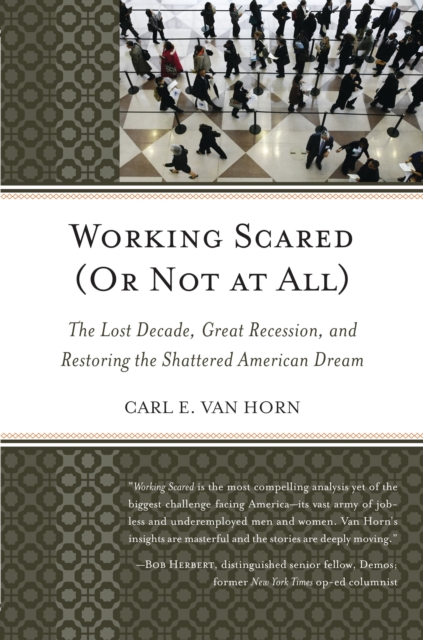
Working Scared (or Not at All)
At the end of the 20th century, with the economy booming and unemployment at historic lows, the American economy was a job-producing marvel.The first decade of the 21st century was entirely different as the worst economy in 70 years, the Great Recession, crushed the lives of tens of millions of workers and their families, forestalled careers.
eBook


International Trade with Equilibrium Unemployment
While most standard economic models of international trade assume full employment, Carl Davidson and Steven Matusz have argued over the past two decades that this reliance on full-employment modeling is misleading and ill-equipped to tackle many important trade-related questions. This book brings together the authors' pioneering work in creating models that more accurately reflect the real-world connections between international trade and labor markets.
The material collected here presents the theoretical and empirical foundations of equilibrium unemployment modeling, which the authors and their collaborators developed to give researchers and policymakers a more realistic picture of how international trade affects labor markets, and of how transnational differences in labor markets affect international trade. They address the shortcomings of standard models, describe the empirics that underlie equilibrium unemployment models, and illustrate how these new models can yield vital insights into the relationship between international trade and employment. This volume also includes an indispensable general introduction as well as concise section introductions that put the authors' work in context and reveal the thinking behind their ideas.
Economists are only now realizing just how important these ideas are, making this book essential reading for researchers and students.
eBook
The American Dole: Unemployment Relief and the Welfare State in the Great Depression
As Jeff Singleton shows, the rapid expansion of unemployment relief in the early 1930s generated pressures which led to the first federal welfare programs. However the process has received relatively little attention from historians, and unemployment relief does not play a major role in discussions of the current state of welfare. Singleton seeks not only to fill this gap, but to challenge popular interpretations of relief policy in the early 1930s. He shows that relief was expanding prior to the depression and that the modern aspects of social policy implemented in the 1920s profoundly influenced the response of the welfare system to the early stages of the economic crisis. Relief under President Herbert Hoover was neither primarily voluntarist nor traditional. The first full-fledged federal welfare program was implemented under the Hoover administration by the Reconstruction Finance Corporation. The initial goals of the New Deal's Federal Emergency Relief Administration were to reduce the national relief caseload and the federal welfare role, while improving standards for those on the dole. The institutionalization of state-level welfare was a consequence of the failure of the 1935 reform program (the WPA and the Social Security Act) to eliminate the dole, not a product of conscious liberal policy. Singleton concludes by evaluating the 1996 Personal Responsibility Act in the context of these conclusions. If the dole was not a product of liberal reform, but, instead, arose to fill a policy vacuum, then it will be difficult to eliminate by legislative fiat unless states and the federal government are willing to finance relatively costly alternatives. A provocative analysis of interest to historians and social scientists concerned with American social and labor policy.
eBook