
Catalogue Search | MBRL


Are you sure you want to remove the book from the shelf?

{{itemTitle}}
3,078
result(s) for
"Unesco"
Sort by:


UNESCO and the Fate of the Literary
A case study of one of the most important global institutions of cultural policy formation, UNESCO and the Fate of the Literary demonstrates the relationship between such policymaking and transformations in the economy. Focusing on UNESCO's use of books, Sarah Brouillette identifies three phases in the agency's history and explores the literary and cultural programming of each. In the immediate postwar period, healthy economies made possible the funding of an infrastructure in support of a liberal cosmopolitanism and the spread of capitalist democracy. In the decolonizing 1960s and '70s, illiteracy and lack of access to literature were lamented as a \"book hunger\" in the developing world, and reading was touted as a universal humanizing value to argue for a more balanced communications industry and copyright regime. Most recently, literature has become instrumental in city and nation branding that drive tourism and the heritage industry. Today, the agency largely treats high literature as a commercially self-sustaining product for wealthy aging publics, and fundamental policy reform to address the uneven relations that characterize global intellectual property creation is off the table. UNESCO's literary programming is in this way highly suggestive. A trajectory that might appear to be one of triumphant success—literary tourism and festival programming can be quite lucrative for some people—is also, under a different light, a story of decline.
eBook


Individual Tree Crown Segmentation and Classification of 13 Tree Species Using Airborne Hyperspectral Data
Knowledge of the distribution of tree species within a forest is key for multiple economic and ecological applications. This information is traditionally acquired through time-consuming and thereby expensive field work. Our study evaluates the suitability of a visible to near-infrared (VNIR) hyperspectral dataset with a spatial resolution of 0.4 m for the classification of 13 tree species (8 broadleaf, 5 coniferous) on an individual tree crown level in the UNESCO Biosphere Reserve ‘Wienerwald’, a temperate Austrian forest. The study also assesses the automation potential for the delineation of tree crowns using a mean shift segmentation algorithm in order to permit model application over large areas. Object-based Random Forest classification was carried out on variables that were derived from 699 manually delineated as well as automatically segmented reference trees. The models were trained separately for two strata: small and/or conifer stands and high broadleaf forests. The two strata were delineated beforehand using CHM-based tree height and NDVI. The predictor variables encompassed spectral reflectance, vegetation indices, textural metrics and principal components. After feature selection, the overall classification accuracy (OA) of the classification based on manual delineations of the 13 tree species was 91.7% (Cohen’s kappa (κ) = 0.909). The highest user’s and producer’s accuracies were most frequently obtained for Weymouth pine and Scots Pine, while European ash was most often associated with the lowest accuracies. The classification that was based on mean shift segmentation yielded similarly good results (OA = 89.4% κ = 0.883). Based on the automatically segmented trees, the Random Forest models were also applied to the whole study site (1050 ha). The resulting tree map of the study area confirmed a high abundance of European beech (58%) with smaller amounts of oak (6%) and Scots pine (5%). We conclude that highly accurate tree species classifications can be obtained from hyperspectral data covering the visible and near-infrared parts of the electromagnetic spectrum. Our results also indicate a high automation potential of the method, as the results from the automatically segmented tree crowns were similar to those that were obtained for the manually delineated tree crowns.
Journal Article

Global Climate Change and UNESCO World Heritage
This article considers the fiftieth anniversary of the 1972 United Nations Educational, Scientific and Cultural Organization’s (UNESCO) World Heritage Convention in light of climate change, offering a state of the field review of climate responses for World Heritage sites (WHS). Opening with a brief review of UNESCO World Heritage activities around climate change, we then detail the primary impacts and risks that climate change pose for WHS and the reporting and monitoring systems in place to document and track these impacts. Looking forward, we examine the most promising pathways for World Heritage to advance in the domains of climate mitigation, adaptation, climate communication, and climate action.
Journal Article

A Review of Malay Assimilations in Penang
Purpose: The objective of research study was to review the chronology of Malay assimilations based on early scholars of Kajai (1935), Nagaraj (1974) and Hirschman (1987).
Theoretical framework: Recent literature has reported that since 1786, Francis Light was glorified as the founder of Penang (Mohamed, et al. 2006). Light was not the founder of Penang. He was a developer of Penang, at best (FMT, 2021). Hence, it is vital to understand who the Malays are, based on early scholars of Kajai (1935), Nagaraj (1974) and Hirschman (1987).
Design/methodology/approach: I reviewed the chronology of Malay assimilations based on early scholars of Kajai (1935), Nagaraj (1974) and Hirschman (1987). The review explores how multi-ethnic Muslim groups have evolved and been classified as Malays.
Findings: The findings showed that there are four typologies of takrif Melayu (definition of Malay) according to Kajai (1935), Nagata (1974), Hirschman (1987) and the Federal Constitution of Malaysia (1963).
Research, Practical & Social implications: I suggest future research to particularly focus on the contributions of each multi-ethnic Muslim community in Penang.
Originality/value: The findings showed that very a few articles about the definition of multi-ethnic Muslim community were published, and this is where the research comes in – to fill up the gap.
Journal Article
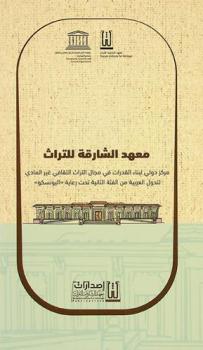
معهد الشارقة للتراث : مركز دولي لبناء القدرات في مجال التراث الثقافي غير المادي للدول العربية من الفئة الثانية تحت رعاية اليونسكو
معهد الشارقة للتراث، يختص في بناء القدرات للمحافظة على التراث الثقافي غير المادي وذلك بهدف تعزيز اتفاقية عام 2003 لحماية التراث الثقافي غير المادي والمساهمة في تنفيذها بالدول العربية وتعزيز القدرات المؤسسية لحماية التراث الثقافي غير المادي في الدول العربية مع تعزيز مقاصد وأهداف اتفاقية عام 2003 في المنطقة ورفع مستوى مشاركة المجتمعات والمجموعات والأفراد في حماية التراث الثقافي غير المادي إضافة إلى رفع مستوى الوعي بالتراث الثقافي غير المادي وضمان احترامه في الدول العربية وتعزيز التعاون الإقليمي والدولي لحماية التراث الثقافي غير المادي.
BOOK

United Nations Educational, Scientific, and Cultural Organization (UNESCO)
This book traces the history of UNESCO from its foundational idealism to its current stature as the preeminent international organization for science, education, and culture, building a well rounded understanding of this important organization.
The book:
provides an overview of the organization and its institutional architecture in the context of its humanistic idealism
details the subsequent challenges UNESCO faced through cold war and power politics, global dependence and interdependence, and the rise of identity and culture in global politics
analyses the functioning of UNESCO administration, finance, and its various constituencies including the secretariat, member-states, and civil society
explores the major controversies and issues underlying the initiatives in education, sciences, culture and communication
examines the current agenda and future challenges through three major issues in UNESCO: Education or All, digital divide issues, and norms on cultural diversity
assesses the role of UNESCO in making norms in complex world of multiple actors and intersecting issue-areas.
Reflecting on UNESCO’s vision, its everyday practices, and future challenges; this work is an essential resource for students and scholars of international relations and international organizations.
J. P. Singh is Associate Professor at the graduate program in Communication, Culture and Technology at Georgetown University. He is the author of Globalized Arts: The Entertainment Economy and Cultural Identity (New York: Columbia University Press, 2010); International Cultural Policies and Power (Basingstoke, UK: Palgrave Macmillan, 2010); Negotiation and the Global Information Economy (Cambridge: Cambridge University Press, 2008); with James N. Rosenau, Information Technologies and Global Politics (Albany, NY: State University of New York Press, 2002); and Leapfrogging Development? The Political Economy of Telecommunications Restructuring (Albany, NY: State University of New York Press, 1999).
1. UNESCO's Organizational History and Structure 2. Prioritizing Education 3. Making Science 4. The Prominence of Culture 5. Debating Global Communication Orders 6. Reflections and Possibilities
eBook