
Catalogue Search | MBRL


Are you sure you want to remove the book from the shelf?

{{itemTitle}}
78
result(s) for
"United Arab Emirates History 20th century"
Sort by:

Honour Is in Contentment
Based on interviews and field research, the authors explore the sets of ideas Arab tribespeople from Ras Al-Khaimah had about tribe and community; social and economic networks, and jural contracts for livelihoods and profits; their uses of their environments; the moral relations of credit, debt and labour; ruling; economic and political transformations; and ideas of regional history where conflicts were regarded as disputes over sets of ideas, and informal accounts of tribal and local histories.
Their lively descriptions and explanations of life before oil portrayed tribal societies whose relationships were moral rather than political and were between jurally equal persons. All lived from their own resources; 'wealth' was material self-sufficiency; 'riches' the richness of social relationships. Political arenas were decentralised and underpinned by common cultural and moral values.
Published sources give a wider context to these ideas and events which show the great complexity and differing perspectives of 'life before oil' in the Gulf.
eBook

Political Transformation of Gulf Tribal States
The reform movements and attempts to establish parliamentary institutions in the Persian Gulf states of Kuwait, Bahrain and Dubai between the First World War and the independent era of the 1970s were not inspired by western example or by any tradition of civil representation. The move to a parliamentary system not only represented a milestone in the history of the region, creating a legacy for future generations, but was a unique transition in the Arab world. The transformation of these states from loose chiefdoms of minimal coherence and centralization, into centralizing and institutionalized monarchies, involved the setting up of primary institutions of government, the demarcation of borders, and establishment of a monarchical order. As this new political and social order evolved, ideas of national struggle and national rights penetrated Gulf societies. Gulf citizens who had spent time in Arab states, mostly in Egypt and Iraq, took part in the genesis of a public Arab-Gulf national discourse, enabling the Gulf population to become acquainted with national struggles for independence. As a result merchants of notable families, newly educated elements, and even workers, began to oppose the dominance of the rulers. Both the rulers and the commercial elites (including members of the ruling families) tried to formulate a new and different social contract with the rulers seeking to entrench their political power by using new administrative means and financial power. Opposition against this current crystallized in 1938 among the ranks of the commercial oligarchy as well as within the ruling families. In spite of its failure to create its own political institutions, the oligarchy remained the foremost social and economic class. But the ruling families could no longer treat national oil revenues as their private income, and they began to channel part of these funds to public needs. The most important consequence of the '1938' movement was the formation of a new social contract between the two traditional power centers: the governing structures were fitted into the political and economic reality brought about by the oil wealth, but remained essentially tribal and committed to the power division between the major Gulf families.
eBook

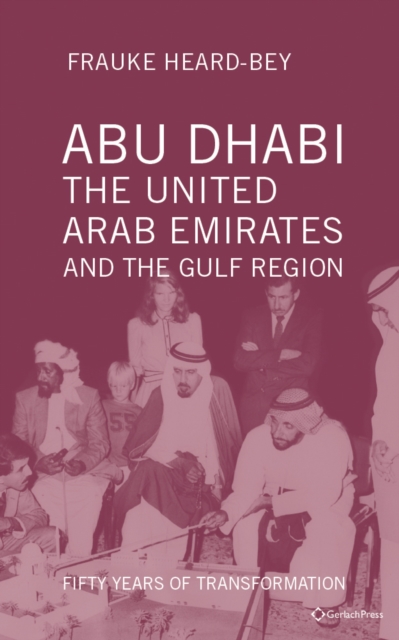
Abu Dhabi, the United Arab Emirates, and the Gulf Region
The unexpected decision of the British Government in January 1968 to withdraw its military and diplomatic protection from the Gulf catapulted the region into the limelight. For the following five decades the historian Dr. Frauke Heard-Bey was best placed to observe subsequent developments in the Gulf, having joined her husband David, a petroleum engineer, in Abu Dhabi in 1967. Through her role over decades in the Centre for Documentation and Research (now the UAE’s National Archive), Frauke Heard-Bey made use its archives about the Gulf, while taking every opportunity to travel in the area and immerse herself in the local environment. The work covers a broad spectrum, including the formation of the UAE in 1971, the subsequent development of this federation, the first oil crisis and geopolitical repercussions, urbanisation, labour migration, electoral systems, trade, the changing way of life and its implications for traditional loyalties in the Gulf states and Oman. The results of much of this work (which rely little on secondary sources) are collected in this volume, parts of which have been printed in hard-to access journals, while others are published here for the first time.
eBook

The establishment of the United Arab Emirates 1950-85
The United Arab Emirates were established in response to the British decision to withdraw from the Gulf by 1971. This decision, announced in 1968, had left the rulers of the emirates perplexed and alarmed. After decades of mutual suspicion and rivalry, fostered by British imperial dominance, the emirates were now obliged to seek security in federal union. This book, first published in 1987, chronicles this process which led to the establishment of the UAE and explains the circumstances which brought it about.
Book

Tribal modern
In the 1970s, one of the most torrid and forbidding regions in the world burst on to the international stage. The discovery and subsequent exploitation of oil allowed tribal rulers of the U.A.E, Qatar, Bahrain, and Kuwait to dream big. How could fishermen, pearl divers and pastoral nomads catch up with the rest of the modernized world? Even today, society is skeptical about the clash between the modern and the archaic in the Gulf. But could tribal and modern be intertwined rather than mutually exclusive? Exploring everything from fantasy architecture to neo-tribal sports and from Emirati dress codes to neo-Bedouin poetry contests, Tribal Modern explodes the idea that the tribal is primitive and argues instead that it is an elite, exclusive, racist, and modern instrument for branding new nations and shaping Gulf citizenship and identity—an image used for projecting prestige at home and power abroad.
eBook

Archives, Museums and Collecting Practices in the Modern Arab World
Collecting has a long tradition in the Middle East but the museum as a public institution is relatively new. Today there are national museums for antiquities in most Arab countries. While in some cases the political and social climate has hindered the foundation of museums, with existing collections even destroyed at times, the recent museum boom in the Gulf States is again changing the outlook. This unique book is the first to explore collecting practices in archives and museums in the modern Arab world, featuring case studies of collecting practices in countries ranging from Egypt and Lebanon to Palestine, Jordan, Iraq and the Gulf, and providing a theoretical and methodological basis for future research. The authors are also concerned with investigating the relationship between past and present, since collecting practices tell us a great deal not only about the past but also about the ways we approach the past and present conceptions of our identities. Collections can be textual as well, as in the stories, memories or events selected, recalled, and retold in the pages of a text. As interest in memory studies as well as popular and visual culture grows in the Arab World, so collecting practices are at the heart of any critical approach to the past and the present in that region. The book will be of great interest not only to scholars and students of the modern Arab world but also to professionals in museums and collections in the region, as well as around the world.
eBook