Catalogue Search | MBRL


Are you sure you want to remove the book from the shelf?

{{itemTitle}}
20
result(s) for
"United Arab Emirates Politics and government 1971-"
Sort by:
Abu Dhabi, the United Arab Emirates, and the Gulf Region
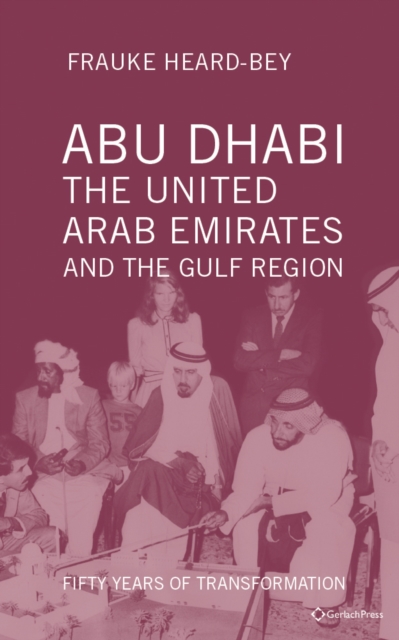
The unexpected decision of the British Government in January 1968 to withdraw its military and diplomatic protection from the Gulf catapulted the region into the limelight. For the following five decades the historian Dr. Frauke Heard-Bey was best placed to observe subsequent developments in the Gulf, having joined her husband David, a petroleum engineer, in Abu Dhabi in 1967. Through her role over decades in the Centre for Documentation and Research (now the UAE’s National Archive), Frauke Heard-Bey made use its archives about the Gulf, while taking every opportunity to travel in the area and immerse herself in the local environment. The work covers a broad spectrum, including the formation of the UAE in 1971, the subsequent development of this federation, the first oil crisis and geopolitical repercussions, urbanisation, labour migration, electoral systems, trade, the changing way of life and its implications for traditional loyalties in the Gulf states and Oman. The results of much of this work (which rely little on secondary sources) are collected in this volume, parts of which have been printed in hard-to access journals, while others are published here for the first time.
eBook
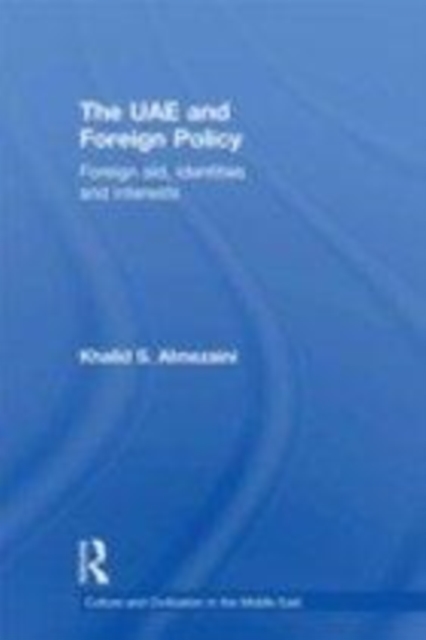
The UAE and Foreign Policy
This book offers a concise and detailed analysis of the United Arab Emirates (UAE) foreign aid as a main instrument in its foreign policy. Exploring the cultural factors that have impacted on the foreign policy behaviour of the UAE and its foreign aid, the author argues that Arabism and Islamic traditions have shaped the country's foreign policy in general and foreign aid in particular.
Examining in depth the motives and purposes of this large aid program through the lens of International Relations theories (mainly Constructivism and Rationalism), the book details the UAE's foreign policy and aid program since its inception. Drawing on a comprehensive analysis of two major recipients of aid from the UAE - Palestine and Pakistan - the focus moves beyond the UAE to show how cultural factors have impacted on the behaviour of the authorities across the wider Arab Middle East.
This critical assessment and analysis of the UAE's foreign policy will be of particular interest to students, researchers and academics interested in Middle East studies, the Gulf States, Middle East politics, and foreign aid and foreign policy.
eBook

The Wages of Oil
The contrast between Kuwait and the UAE today illustrates the vastly different possible futures facing the smaller states of the Gulf. Dubai's rulers dream of creating a truly global business center, a megalopolis of many millions attracting immigrants in great waves from near and far. Kuwait, meanwhile, has the most spirited and influential parliament in any of the oil-rich Gulf monarchies.
InThe Wages of Oil, Michael Herb provides a robust framework for thinking about the future of the Gulf monarchies. The Gulf has seen enormous changes in recent years, and more are to come. Herb explains the nature of the changes we are likely to see in the future. He starts by asking why Kuwait is far ahead of all other Gulf monarchies in terms of political liberalization, but behind all of them in its efforts to diversify its economy away from oil. He compares Kuwait with the United Arab Emirates, which lacks Kuwait's parliament but has moved ambitiously to diversify.
This data-rich book reflects the importance of both politics and economic development issues for decision-makers in the Gulf. Herb develops a political economy of the Gulf that ties together a variety of issues usually treated separately: Kuwait's National Assembly, Dubai's real estate boom, the paucity of citizen labor in the private sector, class divisions among citizens, the caste divide between citizens and noncitizens, and the politics of land.
eBook
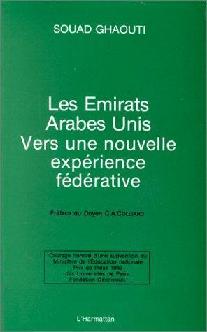

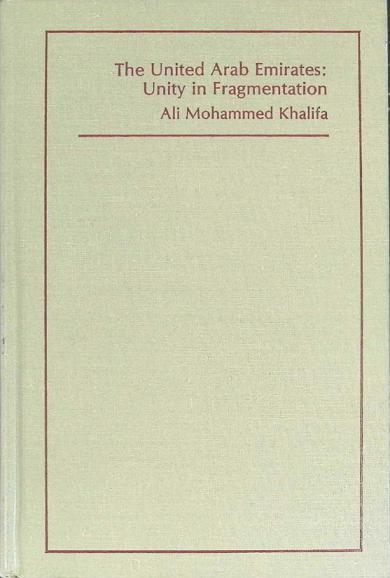
The United Arab Emirates : unity in fragmentation
\"The United Arab Emirates: Unity in Fragmentation\" is a seminal scholarly analysis of the political evolution and federal integration of the UAE. Authored by Ali Mohammed Khalifa, the work investigates the complex transition of the Trucial States from a collection of fragmented, autonomous sheikhdoms under British protection into a cohesive, modern sovereign federation. The book is particularly noted for its focus on the \"trial of unity\"—the delicate negotiation between the individual sovereignty of the seven emirates and the necessity of a centralized federal authority to ensure national security and economic prosperity.
BOOK